

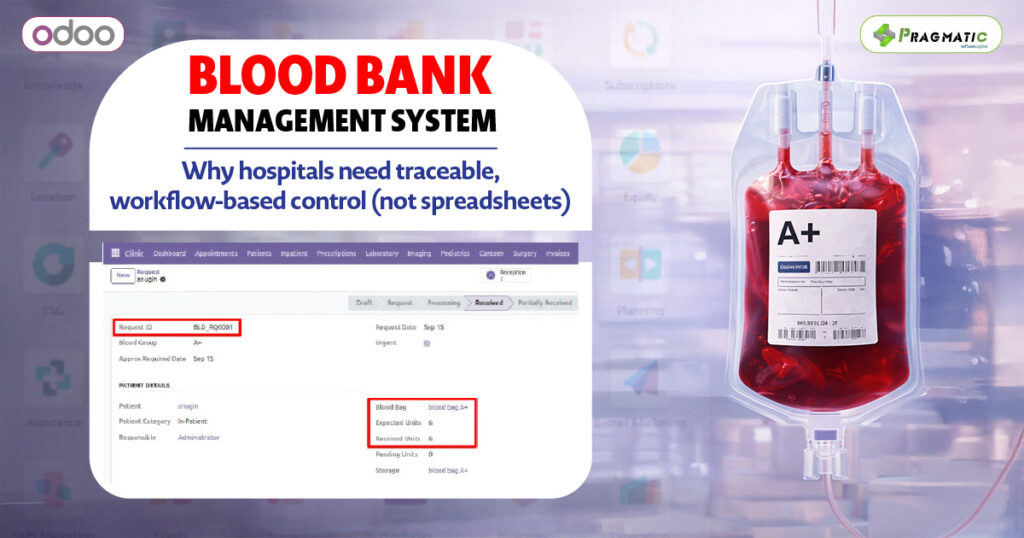
Why blood bank operations can’t rely on memory or spreadsheets
A blood bank isn’t “just another store room.”
It is a life-critical department managing a perishable inventory where the cost of errors can be severe. Even global health guidance describes the blood cold chain as a complete system from donor collection to transfusion.
As WHO puts it : “The blood cold chain is a system for storing and transporting blood and blood products… from the point of collection… to the point of transfusion.”
That single sentence captures the reality : blood bank work is a chain and chains break at weak links.
If your donor records, donation validation and request processing are tracked in different places (or tracked inconsistently), teams lose time, visibility and confidence.
The result is usually a mix of :
- Avoidable wastage
- Emergency scrambling
- Audit stress
- Slower response when every minute matters
That’s why hospitals increasingly look for a blood bank management system (or hospital blood bank software) that enforces workflow and traceability, instead of leaving critical steps to chance.
The real risks when blood bank processes aren’t tracked
Risk 1 : Wastage rises quietly
Blood components expire. When stock levels, rotation, and issuance are not managed tightly, wastage creeps up.
Australia’s National Blood Authority is blunt about the balancing act: “The key to good inventory management is balancing sufficient inventory to meet clinical need while keeping wastage rates at a minimum.”
If stock sits without clear visibility, expiry becomes “normal,” and cost control becomes reactive.
Risk 2 : Stockouts can affect clinical care
Shortages aren’t hypothetical. They happen, and when they do, it affects care pathways.
NHSBT’s best practice guidance highlights the seriousness of stockouts, noting the need to balance wastage against potentially severe outcomes.
And professional bodies in the UK have discussed blood shortages and the need for maintained supply levels to avoid impact on clinical care.
Risk 3 : Traceability gaps create safety + compliance exposure
Traceability is a foundational expectation in transfusion systems. AABB’s standards include requirements around “Traceability of blood, blood components and critical materials.”
When blood bank tracking depends on manual logs and informal handoffs, traceability can break in small ways :
- Unclear chain-of-custody details
- Incomplete documentation
- Harder incident investigation
- Slower recall or corrective actions
Risk 4 : Cold-chain control becomes difficult to prove
Cold chain isn’t only about owning the right equipment. It’s about consistent process and documentation across storage and transfer.
WHO provides dedicated guidance around the blood cold chain because maintaining the right conditions is essential for blood quality and safety.
Cold chain + traceability : The two pillars of safe blood handling
Think of a blood bank’s operational credibility as two pillars :
Pillar A : Cold chain discipline
You need validated storage and transport conditions, with documentation to back it up. WHO’s cold-chain guidance exists because temperature control is a safety requirement, not a preference.
Pillar B : Traceability by design
Traceability can’t be an afterthought. AABB standards explicitly call it out, and modern labeling/data standards like ISBT 128 exist to improve product identification and information transfer across facilities.
A good blood bank management system supports both pillars by making tracking part of the workflow, not an optional step.
What “good blood inventory management” looks like in practice
Real blood inventory management is a trade-off between two risks –
- Too much stock = more expiry and discard
- Too little stock = shortages and delayed fulfillment
That trade-off is a recurring theme in published inventory best practices and guidelines.
In practical terms, strong blood inventory management usually includes :
- Clear stock policies and reorder logic
- Monitoring of wastage and expiry trends (and fixing root causes)
- Controlled issuance and request processing
- Reliable reporting so improvements aren’t guesswork
The point is not “more admin.” It’s fewer surprises.
What a blood bank management system should handle end-to-end
When a hospital searches for a hospital blood bank software, they’re typically trying to cover three day-to-day realities:
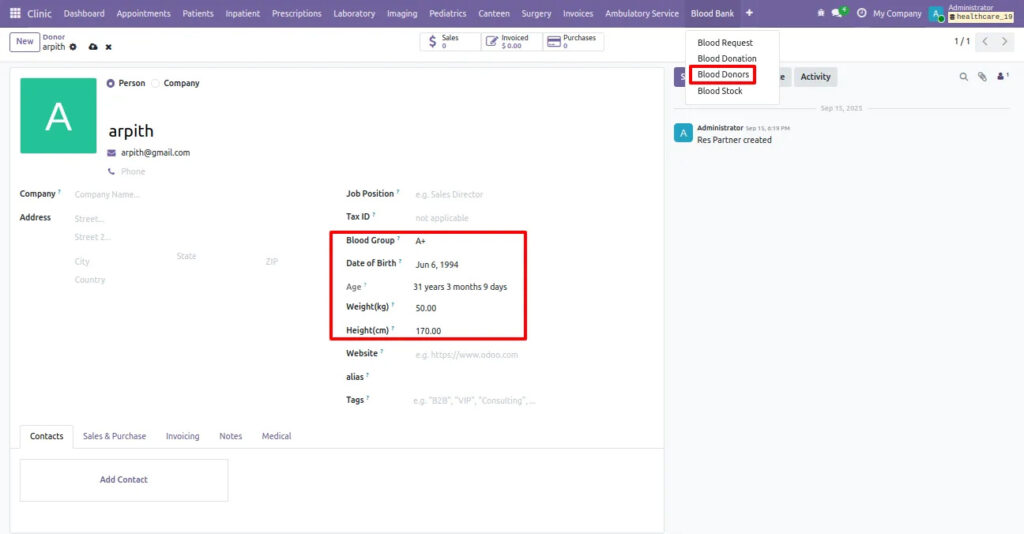
1) Donor records management (accurate donor profiles)
A proper system should standardize donor information like –
- Blood group
- DOB and eligibility indicators
- Essential physical/medical attributes (as your workflow requires)
This matters as it reduces errors, avoids duplicate records and improves speed when staff need to act.
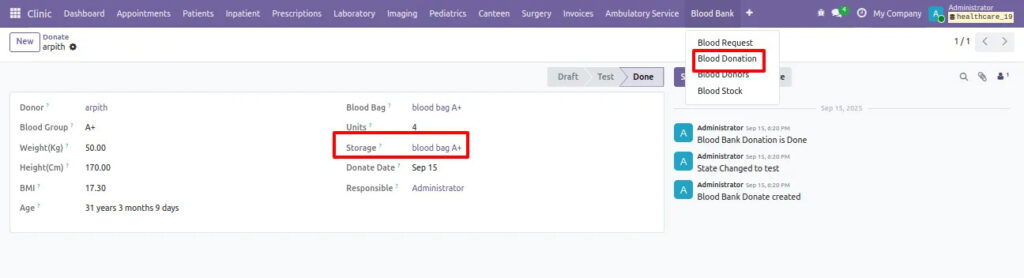
2) Blood donation tracking with controlled workflow
Your workflow logic (Draft → Test → Done, with rejection when required) is exactly the kind of structured process hospitals want.
This ensures test results and validation steps are captured consistently and it prevents “skipped steps” under pressure.
3) Blood request management (status clarity + partial fulfillment)
Hospitals need request flow visibility : what’s requested, what’s being processed, what’s received and what’s partially fulfilled.
Request status clarity improves response time and helps staff coordinate with clinical teams quickly.
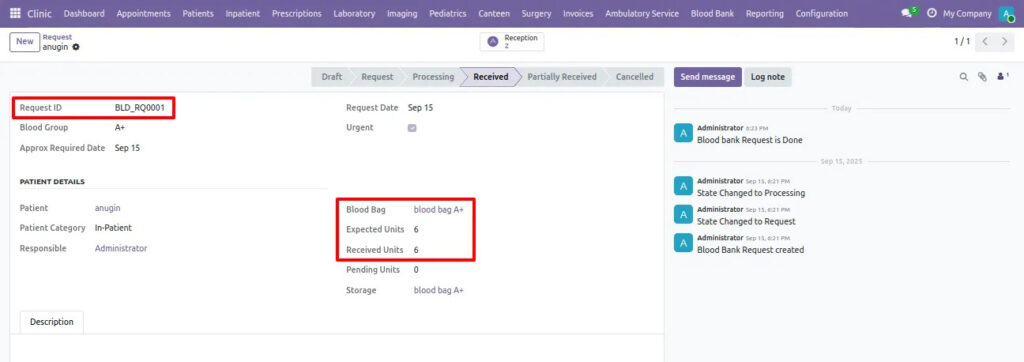
This is where many “manual” systems break down : the request exists, but its status is not visible to everyone who needs it.
How Pragmatic Techsoft’s Blood Bank functionality fits into hospital workflows
Our Healthcare & Hospital Management solution includes a dedicated Blood Bank area that supports the daily operational needs of blood bank departments :
- Blood Donors : Structured donor records (blood group, DOB, age, weight, height, etc.)
- Blood Donation : State-driven workflow (Draft → Test → Done, with rejection when abnormal)
- Blood Request : Request lifecycle tracking (Draft, Requested, Processing, Received, Partially Received, Cancelled)
This matters because it’s not just “data entry.” It’s workflow clarity.
And because it sits inside a broader hospital system, teams can avoid the typical problem of running blood bank processes in isolation from the rest of the hospital’s operational flow.
If you’re evaluating blood bank software, the smartest next step is simple :
- Map your current process to a workflow (who does what, and what status changes mean)
- See how a system enforces those steps consistently
- Check how reporting and tracking support audits and continuous improvement
Practical next steps
Blood bank teams carry one of the highest-responsibility functions in a hospital: protecting patient outcomes through safe, fast, traceable blood availability.
A blood bank management system helps hospitals reduce avoidable wastage, improve traceability and run donation/request workflows with confidence, especially during peak pressure situations.
If you want, we can walk you through how Pragmatic Techsoft’s Blood Bank workflows map to your current SOPs (and where teams usually win back the most time and clarity).
FAQs
1) What’s the biggest reason hospitals move away from spreadsheets for blood bank management?
Because spreadsheets don’t enforce workflow or traceability. They can store data, but they can’t reliably control steps like validation, status changes and accountability under pressure. Standards increasingly emphasize traceability expectations.
2) How does a system help reduce blood wastage without causing shortages?
By helping teams balance stock levels and monitor discard/expiry patterns. National guidelines emphasize balancing clinical need with wastage minimization.
3) What should I check in a blood bank management demo?
Ask to see : donor record consistency, controlled donation states (including rejection), request status flow (including partial receive), audit-friendly logs and reporting that supports wastage reduction and compliance readiness.
4) Can blood request workflows handle partial availability properly?
They should. Partial fulfillment is a real-world scenario, and the system should make partial receiving visible (with quantities and status) so staff don’t waste time reconciling.
5) Who should be involved in selecting blood bank software?
Blood bank department lead, transfusion lab users, hospital admin/operations, and whoever handles compliance/audits. If the system integrates with other hospital functions, involve those stakeholders early.