
The Resistance Tax (and why it shows up in every ERP project)
Most founders buy ERP for one reason : control.
Control over inventory. Margins. Cash flow. Fulfillment. Team accountability.
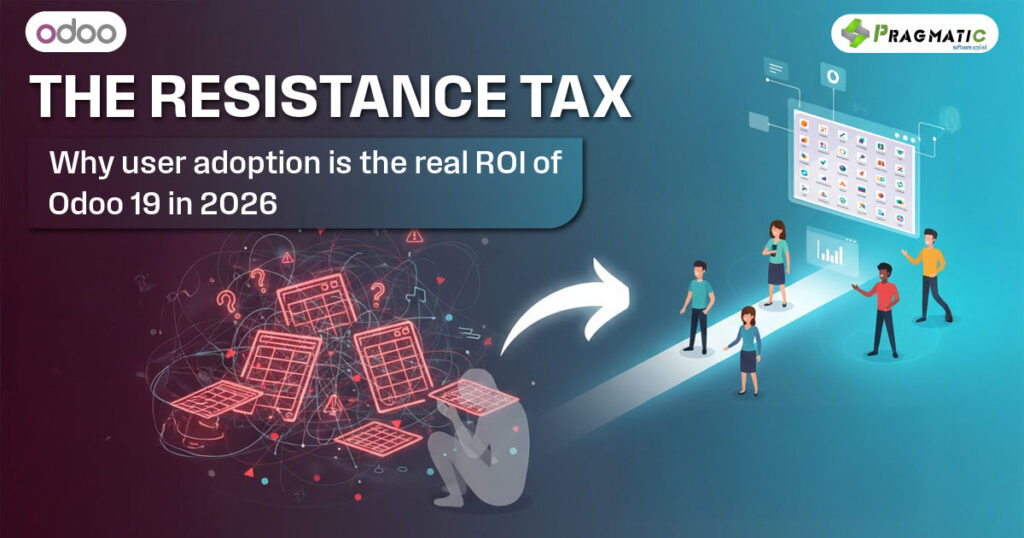
But there’s a hidden cost that quietly destroys ERP ROI after go-live. We call it the Resistance Tax.
It’s the time lost when the team avoids the system.
It’s the reporting delays caused by “we’ll update it later.”
It’s the rework created by parallel trackers and private spreadsheets.
It’s the leadership overhead of reconciling multiple versions of truth.
And here’s the uncomfortable part: ERP rarely fails loudly. It fails quietly. Adoption slips, data quality drops and decision-making slows.
In 2026, the most expensive ERP is not the one with the highest license. It’s the one your team doesn’t truly use.
The 2026 ERP reality : Feature inflation vs operational clarity
ERP vendors are racing to add more : AI, analytics layers, deeper configuration, more dashboards.
But across community conversations, a recurring frustration shows up : many businesses don’t need “more features” as much as they need a system their teams can operate confidently every day. People openly discuss struggling with Odoo for long periods when they don’t have strong implementation guidance, especially in small teams.
CEOs don’t need an ERP that impresses in a keynote.
They need a system that :
- Reduces operational uncertainty
- Produces trustworthy numbers
- Aligns departments
- Survives growth and upgrades without turning into a rebuild project
That’s why adoption is a boardroom concern, not an “end-user training” concern.
Where ERP adoption breaks in the real world
From our experience (and reinforced by what shows up in forums and Reddit), adoption breaks for predictable reasons:
1) Interface overload
Too many fields. Too many screens. Too many “optional” steps that feel mandatory.
2) Inconsistent navigation
Users feel like every department runs a different product inside the same ERP. That creates hesitation, errors and avoidance.
3) Workarounds become normal
If a process feels slower in the ERP than outside it, teams will build a parallel system. That’s when “shadow spreadsheets” appear.
4) Upgrade fear
When teams know upgrades might break flows, adoption becomes cautious. People delay changes. They avoid using advanced features.
Upgrade frustration is not theoretical -many users describe upgrades as painful, even when they believe they have limited customization. And the complexity multiplies when third-party apps are involved.
Why Odoo 19 lowers resistance : Consistency, speed, predictable workflows
Odoo’s advantage has always been its unified model : One system across sales, inventory, accounting and operations.
What Odoo 19 improves is the day-to-day feel of that system – reducing friction with performance-focused changes like cached browsing data and cached translations designed to improve navigation speed.
When systems are faster and more predictable, users behave differently :
- They stop “waiting to update later”
- They trust the system in the moment
- They rely less on exports and manual trackers
The hidden ROI killers: shadow spreadsheets and duplicate systems
If you want a simple test for whether ERP is delivering ROI, ask this :
Where does your team go when they want the “real number”?
If the answer is :
- A personal tracker
- A spreadsheet on someone’s desktop
- A WhatsApp note
- A weekly reconciled sheet
…you’re paying the Resistance Tax.
The result isn’t only inefficiency. It’s management risk :
- Inventory surprises
- Margin leakage
- Delayed invoicing
- Inconsistent customer commitments
- Leadership decisions based on partial information
A unified ERP only becomes a “single source of truth” when the team consistently writes data into it.
Customization vs sustainability : Avoid the upgrade trap
Odoo is extremely flexible, which is why it’s so popular.
However, the more external modules and modifications in the ecosystem, the more moving parts you inherit during upgrades.
So the strategy for 2026 shouldn’t be “customize everything.”
It should be :
Clean Core + Controlled Extensions
That means :
- Use standard Odoo wherever it already matches the business need
- Customize only where there is clear ROI and ongoing ownership
Keep upgrades as a planned operational routine, not a multi-month crisis
The CEO playbook : 5 implementation choices that reduce the Resistance Tax
1) Role-based screens (not role-based training alone)
Most resistance comes from clutter. If your sales rep sees accounting complexity daily, adoption drops. We design views so each role sees what they need to do the job well.
2) Workflow alignment (not “demo alignment”)
ERP should match real operational sequences: receiving, putaway, picking, invoicing, approvals. Not the vendor’s ideal workflow.
3) Training by outcomes
Train by what the person must achieve: “close an order,” “receive stock,” “approve payment,” not “here are 38 features in inventory.”
4) Make adoption measurable
Track simple metrics early : Percentage of orders fully processed in Odoo, inventory adjustments per week, reconciliation time, time to invoice and report usage.5) Choose the right deployment early
If you’re scaling, deployment choices matter. Odoo 19’s performance improvements help, but the architecture you choose determines your ceiling.
Why Pragmatic Techsoft
Odoo is the platform. Adoption is the outcome.
At Pragmatic Techsoft, we focus on reducing resistance from Day 1 through :
- Clean core implementation strategy
- Role-based UI and permissions
- Minimal clutter, maximal relevance
- Upgrade-friendly architecture
- Practical workflows that fit the business, not the demo
The goal is not “go live.”
The goal is stay live – with confident daily usage.
In 2026, ERP ROI isn’t decided by feature checklists.
It’s decided by whether your team genuinely operates inside the system. If you want Odoo 19 to pay for itself, reduce the Resistance Tax :
- Simplify the experience
- Align workflows
- Protect upgrade paths
- Make adoption measurable
If you’re evaluating Odoo 19 (or already on Odoo and adoption feels uneven), we can do a short discovery to map where resistance is coming from and what to fix first.
FAQs
1) We already bought ERP. Why is adoption still low?
Because most rollouts over-focus on configuration and under-focus on daily habit loops : what users see, what they must do and how quickly they get value back.
2) Should we force adoption with stricter controls?
Controls help, but design beats enforcement. If the system feels heavy, strictness creates resentment. If the system feels clean, controls feel natural.
3) Is upgrading worth it if we fear disruption?
Sometimes yes — but only with a plan. The mistake is upgrading without reducing customization footprint first. Community upgrade frustrations often come from unexpected “small” issues that snowball.
4) What’s one sign Odoo is working well?
When leadership meetings stop debating numbers and start debating decisions.
5) What’s the fastest ‘adoption win’ you can create?
Role-based simplification. Remove fields, hide noise, create a clean daily workflow. People adopt what feels clear.