

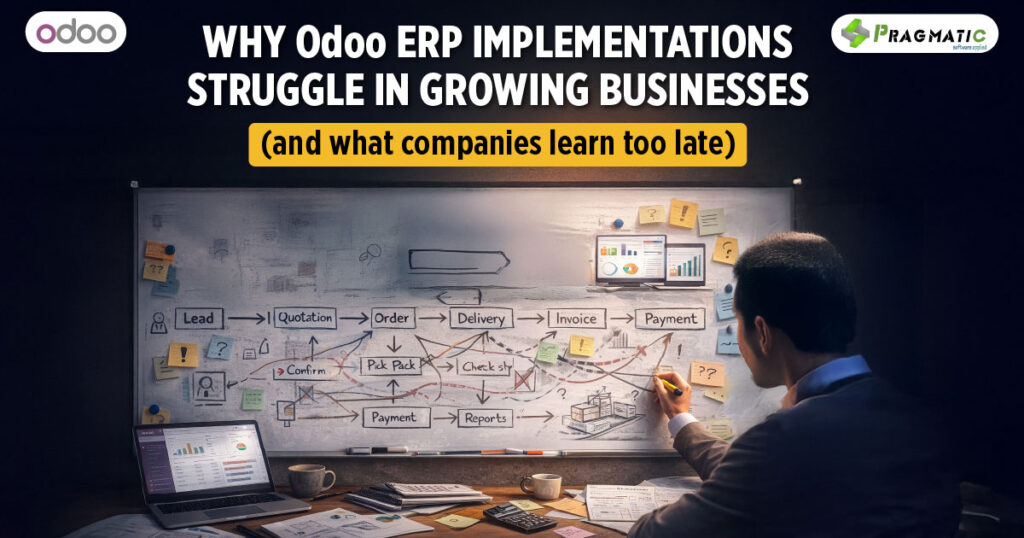
The expectation vs reality of ERP systems
When businesses first explore ERP systems, the expectation is usually straightforward.
Install the system.
Connect the departments.
Everything becomes more efficient.
In theory, that sounds logical.
But companies that implement ERP systems quickly realize something important: ERP does not simply automate operations. It restructures them.
And restructuring operations can be uncomfortable.
Processes that once relied on informal coordination suddenly require defined workflows.
Departments that previously worked independently must now operate through shared data.
That’s why many ERP challenges aren’t technical problems. They’re operational adjustments.
Odoo is one of the most flexible ERP platforms available today, which is exactly why it’s popular among growing businesses. But flexibility also means companies must make thoughtful decisions about how their processes should work.
And that’s where many implementations begin to encounter friction.
Why businesses choose Odoo in the first place
Most companies that adopt Odoo are not starting from scratch.
They already have systems in place :
- Accounting software such as Tally
- Spreadsheets for inventory
- CRM tools for customer management
- Manual workflows across departments
Over time, these systems become difficult to coordinate.
Managers begin asking questions like :
- Why do our reports take so long to prepare?
- Why does inventory show different numbers in different places?
- Why do departments maintain separate versions of the same information?
Odoo becomes attractive because it promises something many organizations want: a unified operational system.
But moving from disconnected tools to a unified platform requires more than installing software.
It requires rethinking how work flows through the business.
Where implementations start getting complicated
Most ERP projects begin smoothly.
Initial demonstrations look promising.
Modules align well with operational needs.
Then implementation begins.
And this is when businesses begin discovering how many operational assumptions existed inside their processes.
Let’s look at some of the challenges companies commonly encounter.
Problem #1 : Trying to replicate old processes inside a new system
One of the most common mistakes businesses make during ERP implementation is attempting to recreate their existing processes exactly as they are.
This usually happens because teams are comfortable with the way things currently work.
But ERP systems are designed around structured workflows.
Trying to force the system to behave like older tools often leads to unnecessary customization and complexity.
In many cases, the more productive approach is to review processes and ask:
“Is the current workflow still the best way to operate?”
ERP implementation often becomes an opportunity to simplify operations.
Problem #2 : Underestimating data cleanup and migration
Before ERP adoption, business data often lives across multiple formats :
- Spreadsheets
- Legacy systems
- Accounting software
- Manual records
When organizations migrate this information into ERP systems, they frequently discover inconsistencies.
Duplicate customers.
Incomplete product records.
Conflicting inventory balances.
Cleaning this data takes time, but it is essential for ERP systems to function reliably.
Companies that invest effort into data preparation typically experience much smoother system adoption.
Problem #3 : Inventory workflows becoming confusing
Inventory is one of the most powerful features of ERP systems, but it is also one of the most misunderstood.
In many businesses, inventory operations previously relied on informal coordination between warehouse staff and sales teams.
ERP systems introduce structured processes such as :
- Stock reservations
- Warehouse movements
- Procurement rules
- Inventory adjustments
If these workflows are not clearly understood, teams may feel that the system is complicated when in reality the system is simply enforcing operational discipline.
Proper training and process clarity usually resolve these challenges.
Problem #4 : Over-customization too early in the project
Because Odoo is highly customizable, companies sometimes begin modifying the system before fully understanding how the standard workflows operate.
Customization can be valuable, but early customization often introduces unnecessary complexity.
A common recommendation from experienced implementers is to first use standard workflows wherever possible.
Once teams gain operational familiarity, targeted customization becomes much easier and more effective.
Problem #5 : Reporting expectations vs ERP structure
Managers often expect ERP systems to instantly produce every report they currently use.
However, ERP systems organize data differently than spreadsheets.
Reports may need to be redesigned based on how transactions are recorded inside the system.
Once the reporting structure is understood, ERP systems often provide deeper insights than previous tools, but the transition requires adjusting expectations.
Problem #6 : Teams resisting new operational workflows
ERP systems introduce structured workflows.
For example :
- Sales orders must follow defined approval steps
- Inventory movements must be recorded systematically
- Procurement may require proper purchase order processes
For teams accustomed to informal coordination, this structure can initially feel restrictive.
However, once teams become comfortable with the system, they often discover that these workflows reduce confusion and improve coordination.
Problem #7 : Departments expecting different outcomes from ERP
ERP implementations involve multiple departments.
Each group often approaches the system with different expectations.
👉Sales teams want faster order processing
👉Finance teams want accurate financial records
👉Operations teams want inventory visibility
Successful ERP implementations align these expectations so that the system supports the organization as a whole rather than optimizing for one department.
Problem #8 : Integration complexity with existing systems
Even after ERP adoption, businesses may continue using specialized tools.
For example :
- eCommerce platforms
- Logistics software
- CRM systems
Connecting these systems requires thoughtful integration design.
Poorly planned integrations can create synchronization issues or data delays.
Proper integration architecture ensures information flows smoothly between systems.
Problem #9 : Lack of internal ERP ownership
ERP systems require internal ownership. When no individual or team is responsible for system governance, confusion can arise around :
- Process definitions
- Data standards
- System updates
Many successful implementations designate internal ERP champions who help guide adoption and maintain process clarity.
Problem #10 : Expecting ERP to fix operational discipline
ERP systems improve operations, but they cannot replace operational discipline.
If processes are unclear, approvals inconsistent or data poorly maintained, the ERP system will simply reflect those issues.
Organizations that approach ERP implementation as both a technology project and a process improvement initiative typically see the best results.
What successful ERP implementations do differently
Companies that achieve strong results with ERP systems tend to approach implementation with a few consistent principles.
They focus on process clarity before customization.
They invest time in data preparation.
They train teams thoroughly.
They treat ERP adoption as an operational transformation rather than a software installation.
When these factors align, ERP systems can significantly improve visibility and coordination across the business.
About Pragmatic Techsoft
Pragmatic Techsoft works with organizations that are navigating operational growth and complexity.
With more than 17 years of experience in enterprise solutions, the company supports businesses through :
- Odoo ERP implementation and consulting
- eCommerce integrations including Shopify, WooCommerce and more
- Custom Odoo module development
- Automation of manufacturing, inventory and operational workflows
The goal is always to align ERP systems with practical business operations so that organizations can scale with greater clarity and control.
Takeaways
ERP systems promise operational efficiency, but achieving that outcome requires thoughtful implementation.
Many of the challenges businesses encounter are not technical limitations but adjustments to how processes and information flow through the organization.
Understanding these common issues early can help companies approach ERP adoption with clearer expectations and better preparation.
For many organizations, that preparation is what ultimately determines whether ERP becomes a powerful operational tool or simply another system to manage.
Don’t leave your growth to chance
An ERP implementation is more than a software install; it is the new backbone of your business. In an ecosystem where “experience” is often claimed but rarely proven, Pragmatic Techsoft stands apart.
With 17+ years of experience and over 400 successful implementations across 50 countries, we aren’t just “users” of the system – we are Odoo pioneers. We have worked with Odoo since its very first version, navigating every major update from the early days of OpenERP to the cutting-edge capabilities of Odoo 18 and 19.
Why the right partner matters :
- Version versatility : We know the legacy code and the modern API. Whether you are migrating from an older version or starting fresh, we ensure your data and workflows transition without friction.
- Beyond the “standard” : We’ve developed over 180+ custom apps in the Odoo Appstore. We know where the standard features end and where strategic customization needs to begin.
- Operational discipline : We don’t just map your old, broken processes into a new system. We use our decades of industry-specific knowledge to help you build workflows that scale.
Your business is too important for “trial and error.” Choose a partner who has seen it all and solved it all.
💬Book a free strategy consultation with our Odoo experts today
FAQs
1) Why do some Odoo implementations struggle?
Most challenges arise from unclear processes, poor data preparation, or unrealistic expectations about how quickly teams will adapt to new workflows.
2) Is Odoo suitable for small and mid-sized businesses?
Yes. Odoo’s modular structure allows businesses to adopt specific modules as their operational needs evolve.
3) How long does an Odoo ERP implementation take?
Timelines vary depending on project scope, number of modules, data readiness, and customization requirements.
4) Do companies need to customize Odoo heavily?
Not necessarily. Many organizations operate successfully using standard modules with minimal customization.
5) What is the most important factor for ERP success?
Clear processes, clean data, and strong internal ownership typically have the greatest impact on successful ERP adoption.