
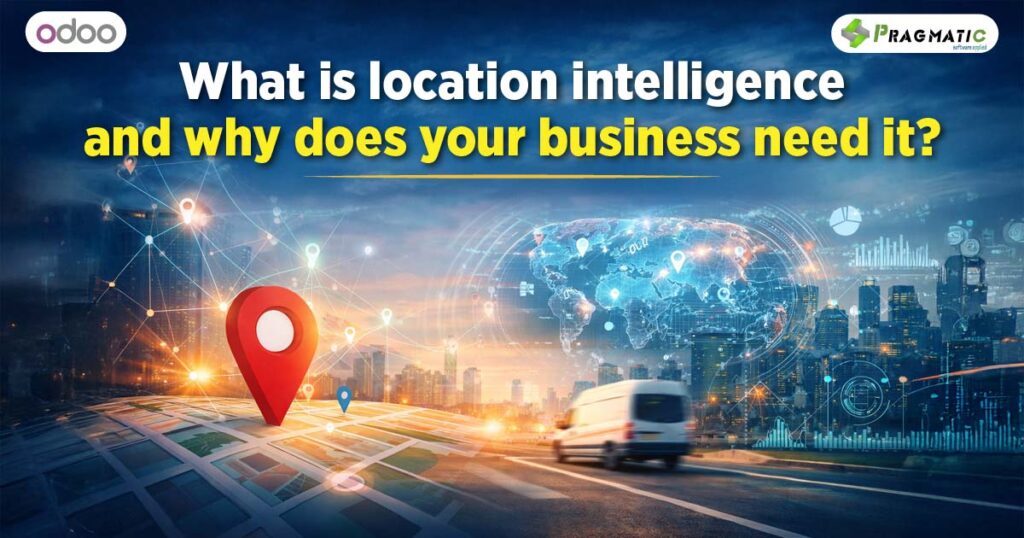
What is Location Intelligence? (And Why It Matters More Than Ever)
Most businesses underestimate the impact of location intelligence.
At its core, it means using location data like addresses, maps and routes – in a way that actually improves how your business operates.
Most systems today store addresses as text. But text alone doesn’t help you make decisions. It doesn’t tell you how accurate that address is, how easy it is to reach, or what the best route looks like.
Location intelligence changes that.
It turns a basic address into something usable. Something your system can understand, verify and act on.
Location intelligence helps businesses operate more efficiently by turning location data into actionable insights for deliveries, service visits and planning.
Why businesses are suddenly paying attention
A few years ago, this wasn’t a major concern.
Today, it is.
Customer expectations have changed. People expect faster deliveries, accurate timelines and fewer mistakes. At the same time, businesses are handling more orders, more locations and tighter margins.
Even small inefficiencies now add up quickly.
Industry observations suggest that a large percentage of delivery issues are not caused by execution, but by poor address data and lack of proper routing. When an address is slightly incorrect or unclear, it can lead to delays, additional costs and customer frustration.
And when this happens repeatedly, it becomes a pattern – one that businesses often don’t notice until it starts affecting their bottom line.
The hidden gap in most business operations
Most business owners assume they already have this covered.
After all :
- Addresses are stored in the system
- Teams use Google Maps
- Deliveries are being completed
So where’s the problem?
The issue is not whether you use location.
It’s how you use it.
In most businesses, location exists in fragments.
Your system stores the address.
Your team checks it manually.
Your driver uses Google Maps separately.
Nothing is truly connected.
This means every step depends on people interpreting and correcting information, instead of the system handling it.
That’s where things start to break down – quietly, but consistently.
How location intelligence impacts your daily workflow
When you look closely, location plays a role in almost every operational step.
Take order processing, for example. When a customer enters an address, your system should ideally verify it immediately. But in many cases, incorrect or incomplete addresses slip through.
Then comes delivery planning. Without route optimization, deliveries are often assigned based on convenience rather than efficiency.
Customer communication is another area. If your system doesn’t have accurate location data, it becomes difficult to provide reliable delivery timelines.
Even in field service, technicians often spend unnecessary time finding the correct location, calling customers or navigating unclear directions.
None of these issues seem major individually. But together, they create friction across your entire operation.
Real business use cases
📦 Ecommerce
A customer places an order. Everything looks correct. But the address is slightly off.
The delivery fails. Now you’re dealing with a second attempt, additional cost, and an unhappy customer.
With proper location intelligence, that address would have been validated instantly, avoiding the issue entirely.
🚚 Logistics
A driver has multiple deliveries to complete.
Without route optimization, they follow a sequence that isn’t efficient. This leads to longer travel time and higher fuel costs.
With location-based routing, deliveries are planned in the most efficient order, saving both time and money.
🧑🔧 Field Service
A technician is assigned a service request.
Instead of heading directly to the location, they spend time confirming directions or navigating unclear addresses.
With accurate location mapping, they can reach the site directly and focus on the job.
The true cost of ignoring location intelligence
Most of these inefficiencies don’t show up as obvious losses.
They appear as :
- Slight delays
- Extra fuel usage
- Repeated calls
- Small operational inefficiencies
But over time, these add up.
Even a small percentage of failed deliveries or inefficient routing can have a noticeable impact on profitability, especially as your business scales.
More importantly, it affects customer experience – something that’s becoming harder to recover once lost.
Where does Odoo fit into all this?
At this point, the question becomes practical :
Where does all of this actually happen?
Most businesses use multiple tools for different functions – one for sales, one for customer data, another for inventory and separate tools for navigation.
This creates gaps. Information doesn’t flow smoothly, and teams end up relying on manual coordination.
This is where a system like Odoo comes in.
Odoo brings your core business functions into one place – from sales and CRM to inventory and invoicing.
When everything is connected, your system has context.
And that’s exactly what location intelligence needs.
Because instead of using maps separately, you integrate them into the same system where your operations are happening.
How modern businesses are solving this problem
Businesses that are improving their operations today are not adding more tools.
They’re simplifying.
They’re moving towards systems that :
- Capture accurate data at the source
- Reduce manual effort
- Connect different parts of the business
When location becomes part of the system itself, a lot of manual work disappears.
There’s less need for corrections, fewer delays, and better coordination across teams.
What changes when your system understands location
The difference is subtle at first, but significant over time.
Instead of constantly fixing issues, your team spends more time executing work efficiently.
Deliveries become more predictable.
Routes become more optimized.
Customer communication becomes clearer.
Your system starts working proactively, rather than reacting to problems.
From guesswork to clarity : Key takeaways
Location intelligence is not about adding another feature to your business.
It’s about improving how your business functions at a fundamental level.
As operations become more complex, the ability to understand and act on location data becomes increasingly important.
And in many cases, the difference between smooth operations and constant firefighting comes down to this one factor.
About Pragmatic Techsoft
At Pragmatic Techsoft, we have been focussing on helping businesses simplify and improve their operations through well-implemented Odoo solutions from 17+years.
We’ve worked with companies across industries and one common challenge we noticed was this :
Businesses were using Google Maps – but not as part of their system.
That’s why we built the integration between Google maps and Odoo.
The idea was simple :
To bring location directly into the system where your business operates.
This allows businesses to :
- Validate addresses as they are entered
- View exact customer locations within Odoo
- Generate routes directly from orders
- Reduce dependency on manual coordination
Our goal has always been to build solutions that solve real operational problems – not just add features.
👉 If you’re looking to reduce delivery issues and manual effort, connect with our team and explore how this can work for you.
FAQs
1. Is location intelligence only useful for delivery-based businesses?
No. Any business that deals with customers, service locations, or multiple branches can benefit from it.
2. Can small businesses benefit from this?
Yes. In fact, smaller businesses often feel the impact of inefficiencies more directly.
3. Do I need technical expertise to use location intelligence?
Not necessarily. With the right tools and integrations, it can be implemented without heavy technical involvement.
4. How does location intelligence improve decision-making?
It provides clarity on where your customers are, how operations are distributed, and where inefficiencies exist.
5. What’s the first step to getting started?
Start by ensuring accurate address capture and gradually integrate location into your operational workflows.