
Most coffee manufacturers believe they understand their cost structure. They know the price per kilogram of green beans. They know their packaging cost. They know roughly what electricity and labor cost per month.
But very few can confidently answer this question :
What does one finished pack truly cost us to produce?
Not estimated. Not assumed. Not averaged.
The real cost.
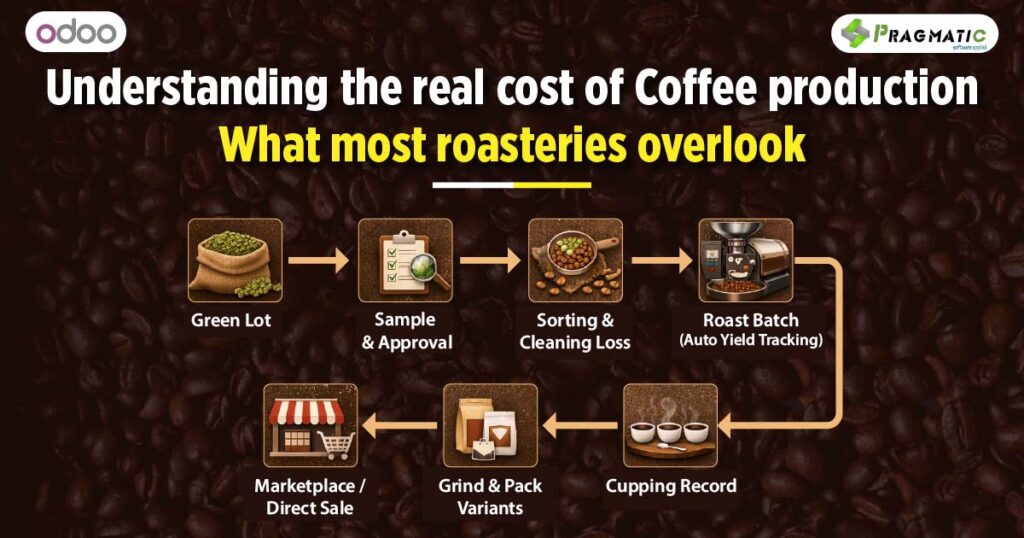
Coffee manufacturing is a process of transformation. Raw material enters as green beans. It moves through sorting, roasting, cooling, grinding, packing and storage before it reaches a customer. Each step changes the product. Each step affects weight, quality and cost.
Yet in many growing roasteries, these steps are tracked separately, if at all.
The gap between processes is where cost hides.
Green beans often represent the largest portion of operating expenses. Industry analysis of large-scale coffee plants consistently show raw material accounting for the majority of operational cost.
But production cost doesn’t stop there.
Individually, these seem small.
Together, they determine whether margins stay stable or slowly erode.
If these losses are not systematically measured and tied back to batches, they become invisible.
And invisible cost is the hardest cost to manage.
In conversations with coffee manufacturers, a familiar pattern appears.
Green lots are purchased from farms. Samples are roasted and approved. Bulk orders are placed. The beans arrive. Production begins.
But documentation is fragmented.
Sorting loss is noted mentally or written in a notebook.
Roast yield is observed but rarely analyzed per batch.
Cupping sessions are recorded on paper and stored in files.
Production planning happens through WhatsApp messages or whiteboards.
Accounting software handles sales and invoices but has no visibility into what happened on the shop floor.
The business runs. Orders are fulfilled. Customers are satisfied.
But when questions arise – such as why margins fluctuate, or why stock does not match physical counts – answers take time.
Because the data exists in pieces, not as a connected story.
Coffee manufacturing today is not just about roasting whole beans.
Manufacturers are producing multiple grind variants for espresso, pour-over, moka pot and cold brew. They are offering drip bags, nitrogen-flushed packaging, specialty blends and marketplace-ready SKUs.
Global coffee markets continue to evolve. Demand for convenient formats and premium variants is increasing across retail and foodservice segments. Emerging markets are expanding consumption and online channels are reshaping distribution.
With growth comes complexity.
One roast batch can produce multiple finished SKUs.
One green lot can move through multiple production stages.
One sales channel may require different packaging and fulfillment rules than another.
Without structured production tracking, complexity creates confusion.
And confusion affects profitability.
Spreadsheets are useful. They help track numbers. They provide flexibility. They are familiar.
But spreadsheets do not connect processes automatically.
They do not update inventory in real time when a roast batch is completed.
They do not record scrap automatically against stock.
They do not reflect machine downtime when planning production.
They do not generate cost entries linked directly to manufacturing activity.
As volume grows, manual systems demand more effort. More reconciliation. More cross-checking.
And more time spent reconciling numbers means less time improving operations.
Scale exposes system weaknesses.
What worked at 200 kilograms per week struggles at 2,000.
Efficient coffee manufacturing is not about removing craftsmanship. It is about supporting it with structure.
It looks like this –
Green lots are received with traceability.
Sample approvals are recorded digitally and linked to procurement decisions.
Sorting loss is recorded against inventory so stock levels remain accurate.
Roast batches capture input weight and output weight, automatically calculating yield.
Grinding and packaging are linked to the originating roast batch.
Cupping notes are stored against specific lots and accessible instantly.
Production is scheduled based on machine capacity, labor availability, and delivery commitments.
Inventory valuation updates automatically as manufacturing orders are completed.
Accounting reflects material, labor, and work center costs in real time.
This is not over-automation. It is clarity.
When purchasing, inventory, production, quality and accounting operate independently, inefficiencies multiply.
An integrated manufacturing system like Odoo Manufacturing Management connects these functions.
Material Resource Planning ensures procurement aligns with production demand.
Master Production Scheduling allows manufacturers to plan realistically against available resources and downtime.
Work centers track operational steps and time usage.
Scrap and unbuild orders record loss transparently.
Lot and serial tracking enable full traceability from green bean to finished pack.
Quality checkpoints integrate cupping sessions and inspection approvals directly into production flow.
Instead of juggling separate tools, manufacturers operate within one connected environment.
That connectivity reduces errors and increases decision confidence.
Across food and beverage industries, manufacturers are moving toward integrated production systems.
Not because they are fashionable. But because complexity demands it.
As SKU diversity increases and channel distribution expands, disconnected systems create friction.
Integrated manufacturing platforms are no longer reserved for enterprise giants. Scalable solutions now allow mid-sized manufacturers to adopt structured production planning without overwhelming investment.
The advantage is not just operational.
It is strategic.
When you can see yield patterns, track loss trends and analyze production efficiency, you make informed decisions about pricing, procurement and capacity expansion.
At Pragmatic Techsoft, we have been implementing Odoo-based manufacturing solutions for over 17 years.
We work with manufacturers who begin with fragmented systems and help them build structured, scalable operations.
Our Odoo Manufacturing Management implementations cover:
Master Production Scheduling for realistic planning
Make-to-Stock and Make-to-Order workflows
Work center management with downtime tracking
Lot-based traceability across the full production lifecycle
Integrated Quality Management for inspections and cupping
Real-time inventory valuation and cost posting
Material Resource Planning to automate procurement triggers.
For coffee manufacturers, this means :
Every roast is recorded as a manufacturing order. Every loss is measurable. Every batch is traceable. Every production plan considers real capacity.
And every financial entry reflects operational reality.
The result is not just better software.
It is better control.
The real cost of coffee production is rarely hidden in the green bean price.
It lives in the gaps between processes.
Between sorting and roasting. Between roasting and packaging. Between production and accounting. Between planning and execution.
As coffee manufacturers grow, operational clarity becomes more important than ever.
Systems do not replace experience. They enhance it.
💬If you are ready to understand your true production cost, improve yield visibility and bring structure to your manufacturing flow, Pragmatic Techsoft can help you design a system that grows with your business.
Because owning your coffee manufacturing means owning every gram.
1. What is the most overlooked cost in coffee manufacturing?
Sorting waste, roast yield loss and untracked grinding variance are often underestimated because they are not consistently recorded batch-wise.
2. How can coffee manufacturers improve production visibility?
By connecting purchasing, production, quality control, and accounting into a unified manufacturing system with batch-level tracking.
3. Why is batch traceability important in coffee production?
It ensures quality consistency, supports regulatory compliance, and builds customer trust by linking finished products back to their source.
4. What is Master Production Scheduling in manufacturing?
It is a structured approach to planning production based on demand, resource availability and capacity constraints.
5. Is integrated manufacturing suitable for mid-sized coffee businesses?
Yes. Modern scalable systems are designed to support growing manufacturers without requiring enterprise-level infrastructure.





Leave a Reply
You must be logged in to post a comment.