

Lean manufacturing has been a cornerstone of operational excellence for decades. The philosophy is simple : eliminate waste, improve efficiency and continuously optimize processes.
Many manufacturers invest significant time and resources into Lean initiatives – Kaizen workshops, process mapping sessions and efficiency improvement programs. On paper, these initiatives promise dramatic improvements in productivity and cost control.
Yet in practice, many lean programs stall or fail to deliver long-term results.
This disconnect is becoming increasingly clear in the manufacturing world today.
While the principles of Lean remain powerful, the environment in which factories operate has changed dramatically. Modern production involves complex supply chains, fluctuating demand and increasingly customized products.
To keep up, Lean manufacturing must evolve from manual observation to data-driven visibility across the shop floor.
Manufacturers today are realizing that Lean cannot succeed without real-time operational insight.
When Lean initiatives struggle, the root cause is rarely the philosophy itself. Instead, it often comes down to execution challenges.
Many factories still operate with limited real-time visibility into what is actually happening on the shop floor. Production status updates may rely on manual reporting, spreadsheets, or delayed data collection.
The result is a familiar pattern :
Managers believe processes are running efficiently, but problems surface later. Production delays appear suddenly. Quality issues are detected after large batches are completed. Machines sit idle while teams scramble to understand what went wrong.
In many cases, Lean initiatives attempt to solve these problems through process changes alone. But without real-time visibility, those improvements are difficult to sustain.
Manufacturing leaders increasingly recognize that Lean must now be supported by digital systems capable of capturing and analyzing shop-floor data in real time.
One of the most significant challenges in manufacturing today is the gap between planning and execution.
Production plans may be well designed, but the actual execution on the factory floor can vary significantly. Small disruptions accumulate throughout the day – machine stoppages, material shortages, scheduling changes or operator delays.
Without digital visibility, these disruptions often go unnoticed until they impact delivery timelines or production output.
Research into modern manufacturing challenges shows that many facilities struggle with complex operational disruptions, from supply chain volatility to workforce shortages, all of which threaten efficiency and profitability.
The reality is that Lean tools such as value stream mapping or process audits provide only snapshots of the system. What manufacturers increasingly need is continuous, real-time insight into operations.
This visibility gap is precisely where many Lean initiatives break down.
As manufacturing becomes more complex, the ability to capture and analyze shop-floor data is becoming a core requirement for operational excellence.
Digital shop-floor systems collect information directly from production activities – machine performance, operator tasks, production progress and quality checks.
This data allows manufacturers to answer critical operational questions :
In modern Lean environments, decisions are increasingly driven by continuous data flows rather than periodic manual reports.
The evolution toward digital Lean manufacturing is accelerating globally. Industry research highlights how technologies like IoT sensors and advanced analytics are enabling real-time monitoring of production systems and significantly reducing downtime.
For manufacturers pursuing Lean, this shift is transformative.
Instead of reacting to problems after they occur, organizations can detect inefficiencies as they develop and respond immediately.
Digital shop-floor visibility goes far beyond simple production dashboards.
In a modern manufacturing environment, digital tools allow operators and managers to interact with production systems directly from the shop floor.
Production orders can be tracked in real time. Operators can record progress as tasks are completed. Maintenance alerts can be triggered automatically when machines show signs of failure.
Quality checks can also be integrated directly into production workflows, ensuring that issues are identified before defects move further down the line.
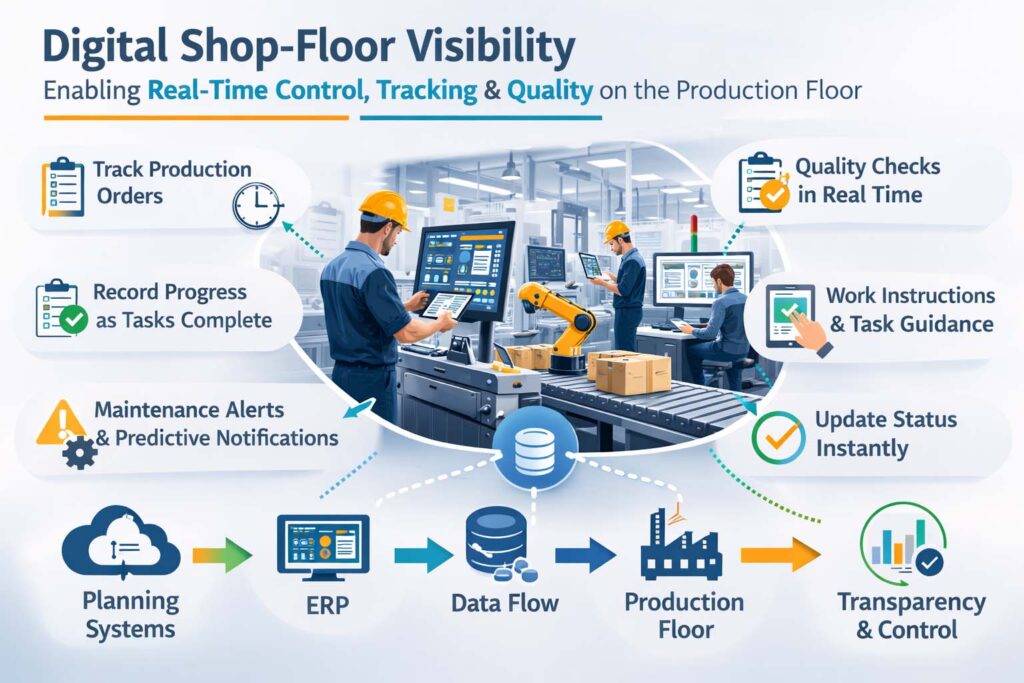
In many factories, tablets or industrial workstations are now placed directly at work centers, enabling operators to view instructions, record work completion and update production status instantly.
These capabilities are becoming essential for maintaining operational transparency.
The result is a manufacturing environment where data flows continuously between planning systems and the production floor.
Digital shop-floor visibility is rarely achieved through standalone systems alone. Instead, the most successful implementations integrate shop-floor data into a broader enterprise platform.
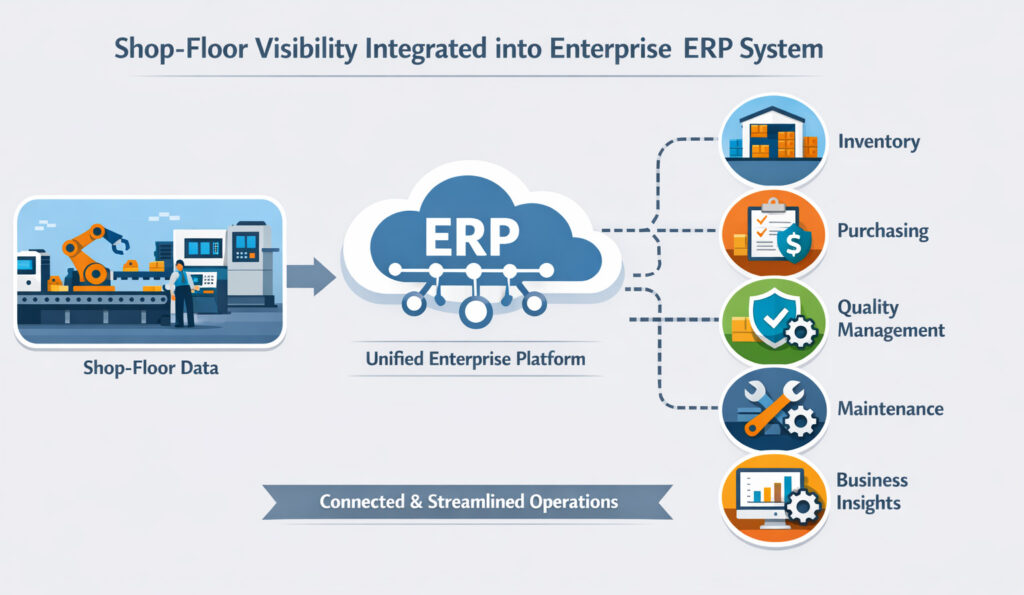
Modern ERP systems play a crucial role in connecting production activities with other business functions such as inventory, purchasing, quality management and maintenance.
This integration allows manufacturers to move beyond fragmented systems and create a unified operational environment.
Production plans can automatically adjust based on material availability. Maintenance teams can respond quickly to machine issues detected during production. Quality inspections can be triggered directly from work orders.
Such integration enables factories to operate with far greater agility.
The shift toward connected operations is increasingly viewed as a key driver of manufacturing competitiveness.
One example of this transformation can be seen in the evolution of modern ERP platforms like Odoo.
Recent updates to Odoo’s manufacturing capabilities emphasize real-time production visibility and improved shop-floor management. The system provides a visual interface where manufacturing employees can process work orders, track production progress, and monitor time spent on tasks directly from the shop floor.
Manufacturing teams can access work orders, update production status and trigger maintenance requests from a centralized control panel placed directly on the shop floor.
These features are designed to reduce administrative delays while giving managers immediate insight into factory operations.
Recent platform enhancements have also improved production planning, scheduling precision and resource allocation – allowing manufacturers to adapt more quickly to operational changes.
The result is a production environment where Lean initiatives can be supported by continuous operational visibility.
Instead of relying solely on process documentation, organizations gain access to live operational data that supports faster decision-making and continuous improvement.
For manufacturers seeking to strengthen their Lean programs, the path forward is increasingly clear.
Lean manufacturing must evolve beyond traditional process improvement methods and incorporate digital capabilities that provide real-time insight into operations.
This transformation does not require replacing Lean principles. Instead, it involves enabling those principles with modern technology.
Digital shop-floor systems provide the visibility needed to sustain Lean initiatives over time. By connecting production data, machine performance and operational workflows, manufacturers can detect inefficiencies earlier and resolve them faster.
In many ways, digital shop-floor visibility represents the next stage in Lean manufacturing evolution.
Factories that successfully combine Lean principles with real-time operational intelligence are positioning themselves to operate more efficiently, respond faster to market changes and maintain higher levels of product quality.
Lean manufacturing has always been about creating clarity in complex production environments. But in today’s manufacturing landscape, clarity cannot rely solely on observation and manual reporting.
It requires real-time visibility.
Digital shop-floor systems, integrated ERP platforms, and connected manufacturing workflows are helping organizations bridge the gap between planning and execution.
This is where modern manufacturing technology plays a critical role.
At Pragmatic Techsoft, we work closely with manufacturers to implement solutions that connect production planning, shop-floor operations, inventory management, quality control and maintenance into a unified system.
By leveraging platforms such as Odoo, manufacturers can move from reactive operations to proactive decision-making – turning Lean principles into measurable operational results.
The factories that succeed in the coming decade will not simply adopt Lean philosophies. They will build digitally visible operations where every process, machine and work order contributes to continuous improvement.
And that journey begins with visibility.
1) Why do many Lean manufacturing initiatives fail in small and mid-sized factories?
Many initiatives struggle because improvements are designed during workshops but cannot be sustained in daily operations. Without systems that capture real-time production data, inefficiencies often reappear and remain undetected until they impact delivery timelines.
2) What is shop-floor visibility in manufacturing?
Shop-floor visibility refers to the ability to monitor production activities, work orders, machine performance, and operator tasks in real time. This visibility enables faster decision-making and improves coordination between production, planning, and management teams.
3) How does digital shop-floor data improve manufacturing performance?
Digital data helps manufacturers identify bottlenecks, monitor machine utilization, track production progress, and detect quality issues early. This allows teams to address problems quickly and maintain consistent production performance.
4) Can ERP systems replace traditional shop-floor management tools?
Modern ERP platforms increasingly integrate shop-floor capabilities directly into their systems. This allows manufacturers to manage production planning, work orders, inventory, and quality control from a single environment rather than relying on disconnected tools.
5) What should manufacturers consider when adopting digital shop-floor systems?
Organizations should focus on scalability, integration with existing processes, ease of use for shop-floor operators, and real-time data capabilities. Successful adoption also requires aligning digital tools with the company’s operational workflows and improvement initiatives.





Leave a Reply
You must be logged in to post a comment.