
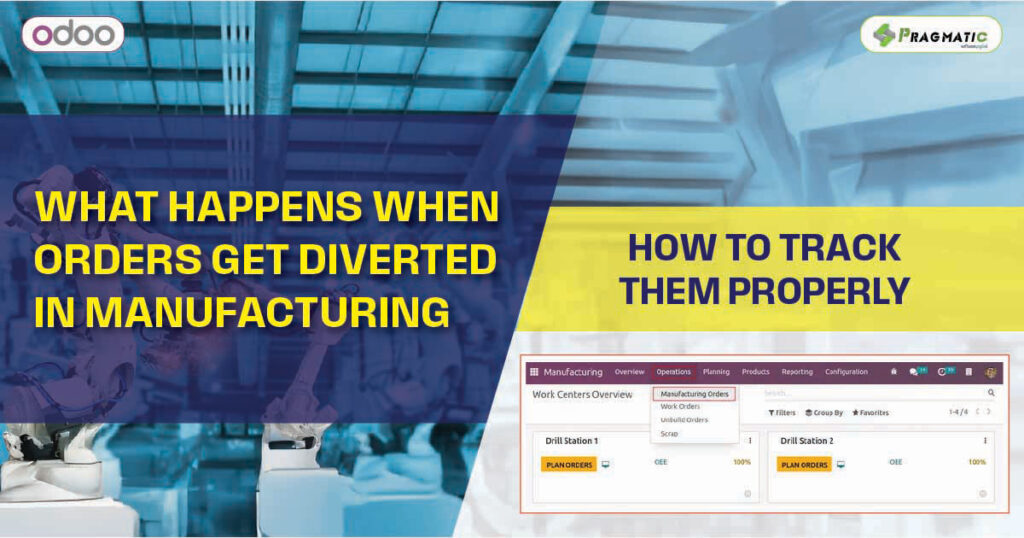
Introduction
Manufacturing plants operate in dynamic environments – machines, people, demand, supply and customer priorities change every single day. Orders that begin for one customer may need to be redirected to another because a payment is delayed, a priority client needs faster delivery or a subcontracted component hasn’t arrived in time.
This shifting is normal. It keeps business agile.
The challenge is that most factories lack a structured system to track these diversions.
Orders move, but documentation doesn’t always follow.
Material gets consumed, but costing doesn’t update.
QA completes checks, but dispatch labels change later.
Over time, this results in misplaced batches, inaccurate stock valuation, delayed deliveries and lost margin clarity. This blog explains why diversions happen, what goes wrong operationally and how manufacturers can set up a robust tracking approach – with or without ERP and how Odoo makes this process far more controlled and visible.
What Is an Order Diversion?
Order diversion refers to reassigning material, WIP or final goods from one customer order to another. It can occur at the raw material stage, during production or after completion but before dispatch.
In simple terms –
❗Order A becomes Order B midway
❗Finished goods for one customer get shipped to another
❗Work order ownership changes after production has already begun
Done right, diversion increases responsiveness.
Done poorly, it creates long-term traceability problems.
Why Diversions Happen More Often Than We Think
Manufacturing rarely follows a linear calendar. The reason isn’t inefficiency – it’s business reality.
Common triggers include :
| Reason for diversion | What it means in practice |
| Payment delay / credit risk | WIP for Customer A allocated to Customer B to maintain cash flow |
| Rush / priority orders | Lead times rebalanced to protect high-value relationships |
| Subcontracting delay | Semi-finished parts reassigned to keep lines running |
| Forecast mismatch | Demand variation forces internal reshuffling |
| Stockout of components | Available inventory gets distributed dynamically |
Diversions are not a failure -they are a mechanism to survive real-life commercial unpredictability.
But when tracking is weak, agility becomes disorder.
The hidden operational impact of poorly tracked diversion
Every diversion appears small, but each one carries multiple consequences if not recorded carefully.
| Impact Area | Result of Poor Tracking |
| Inventory Accuracy | System stock ≠ Real stock |
| Production History | No clear genealogy of product flow |
| Quality Traceability | QC documents mismatch final recipient |
| Costing | Consumption logged incorrectly – wrong margins |
| Delivery Commitments | Dispatch for the wrong customer or delayed shipment |
| Audit & Compliance | Hard to produce traceability or variance data |
Small daily diversion errors become yearly financial leakage.
Most manufacturers only feel the effects at month-end or during audits – when it’s too late to correct.
The real problem – Lack of traceability
The issue isn’t diversion. It’s an untracked diversion.
When changes happen informally :
- WhatsApp replaces documentation
- Excel replaces a single source of truth
- Verbal instructions override system data
Then everything that follows becomes reactive:
❌ Reconciliations are manual
❌ Decision-making depends on memory
❌ Data becomes unreliable
Traceability is the real differentiator between controlled flexibility and operational confusion.
6. Why ERP becomes a necessity
Spreadsheets can record data. ERP systems create structured accountability.
If a diversion happens, an ERP can :
- Log who diverted it
- Capture when and why
- Reassign material/Work Order ownership
- Reflect costing impact
- Update delivery commitments
- Keep quality and traceability intact
ERP turns diversion from a side-effect into a planned decision – one that leadership can see, measure and improve upon.
How Odoo helps Manufacturers track diversion properly
Odoo is designed for real manufacturing movement, not just high-level reporting. Its strength lies in linking the entire chain:
Sales → Inventory → MRP → Work Orders → QC → Delivery → Costing
Key capabilities for diversion-heavy environments :
| Odoo Feature | Benefit |
| Work Order reassignment/multi-routing | Track ownership changes with audit trail |
| Real-time inventory reservation | Prevents double allocation & confusion |
| Batch/lot tracking | Quality remains traceable even post-diversion |
| BOM + Subcontracting integration | No broken history across stages |
| Cost and consumption reporting | Margin leakage becomes visible |
| Replenishment automation | Stockouts less likely, diversions reduce |
Where Excel only shows numbers —
Odoo shows reality.
A practical framework Manufacturers can adopt
A simple structure improves traceability even without ERP.
✔ Step 1 : Unique Work Order Identification
No duplicate codes. Every WO must be individually recognizable.
✔ Step 2 : Mandatory Diversion Log
Customer A → Customer B must be written digitally or physically.
✔ Step 3 : Diversion Reason Tagging
Priority, credit hold, breakdown, planning variance – classify cases.
✔ Step 4 : QC & Dispatch Visibility
Final batch mapping must match final sales order, not original.
✔ Step 5 : Weekly Consumption Variance Review
Issued vs consumed vs diverted must reconcile consistently.
This ensures discipline before digitization.
Steps you can implement immediately without ERP
If ERP adoption will take time, here are rapid actions :
| Immediate Step | Result |
| Single diversion register accessible to all departments | Communication gaps reduce |
| Visual production status board | Everyone sees ownership status |
| Material issue/return tracking discipline | Consumption accuracy improves |
| Final dispatch verification checklist | Wrong-customer shipping drops sharply |
| Even basic structure prevents margin erosion. |
Why Pragmatic Techsoft is the right implementation partner
Manufacturers don’t struggle because people aren’t working – they struggle because systems don’t communicate. Order diversion is a perfect example: a reasonable business decision becomes complex when data trails break.
Pragmatic Techsoft brings 17+ years of Odoo-driven manufacturing implementation experience across industries such as :
- Electrical & electromechanical components
- Industrial automation and sensor manufacturing
- Fabrication, casting, machining & precision assembly
- Automotive supply chain & ancillary units
- Process and discrete manufacturing environments
We help factories convert chaos into clarity through :
- Structured BRD discovery before implementation
- Odoo MRP, Subcontracting, Inventory & QC setup
- End-to-end Work Order traceability
- Diversion tracking + costing visibility
- Shop floor digitization and reporting dashboards
When systems record what humans cannot track at scale, decisions improve and execution strengthens.
If order diversions are frequent in your plant, the right time to fix visibility is now.
Let’s assess your workflow, walk you through Odoo, and design a tailored solution for sustainable control.
📩 Book a consultation.
A one on one session that’s totally free and absolutely zero commitments – wherein our team will guide you effectively on the gaps and possibilities you can explore with Odoo.
Remember : One conversation could be the turning point!
FAQs
1. Why do order diversions create confusion in manufacturing?
Because material, WIP and finished goods shift ownership, but documentation doesn’t always update – causing traceability gaps.
2. Can ERP prevent diversions?
No – diversion will still occur. ERP ensures it is tracked, logged and reflected in costing, inventory and delivery planning.
3. How does Odoo help with diversion control?
It maintains Work Order history, inventory reservation, lot traceability and cost impact visible end-to-end – even after changes.
4. What is the biggest risk of untracked diversion?
Mis-shipment, costing inaccuracy, incorrect QA documentation and delayed commitments – all of which reduce margins quietly.
5. What should manufacturers do before ERP?
Create a diversion log, standardize W.O. coding, enforce material tracking and conduct weekly variance checks.