
Overview
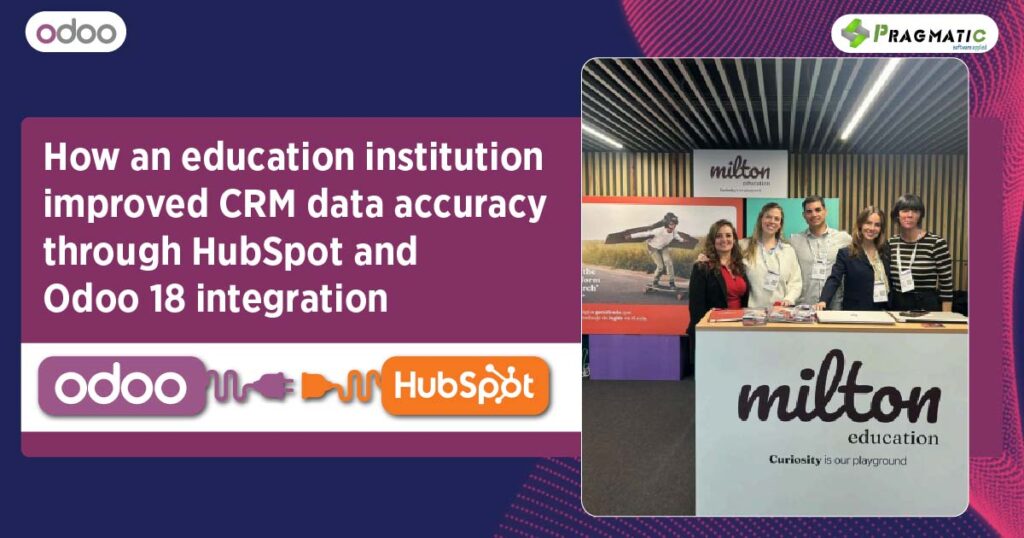
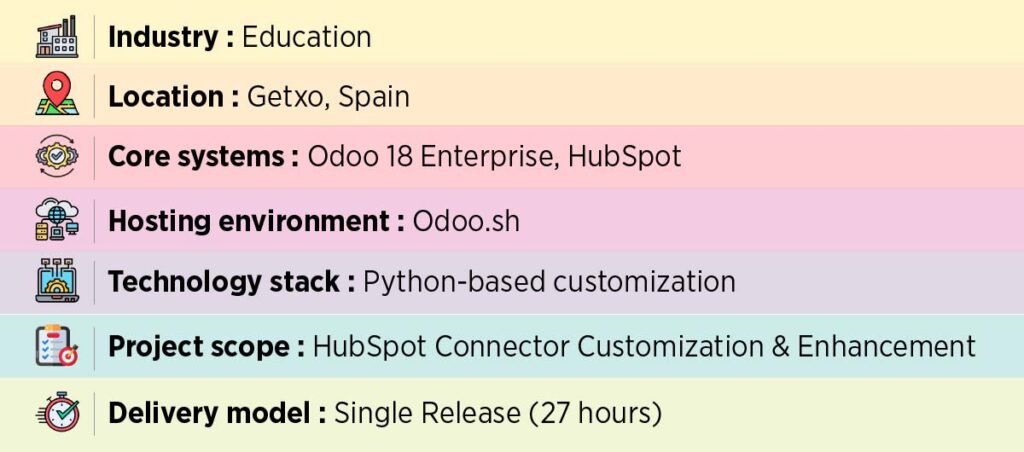
Milton Education is an English language education provider delivering structured programs across pre-primary, primary, and secondary institutions in Spain. With ongoing engagement across multiple schools and institutions, maintaining accurate and well-structured CRM data is essential to their daily operations.
The organization was already operating on Odoo 18 Enterprise with an active HubSpot integration. The systems were technically synchronized and functioning as designed.
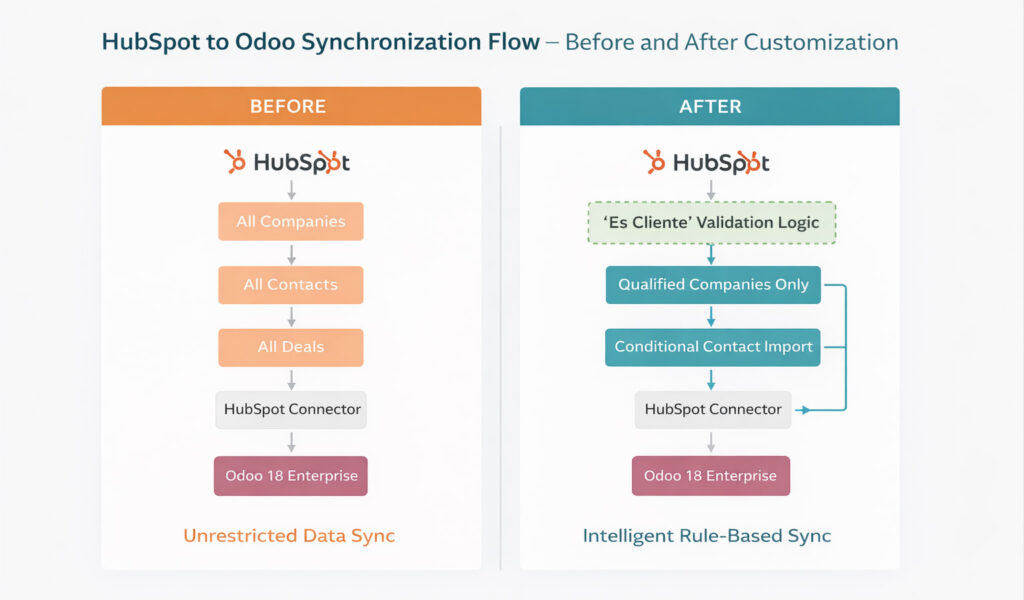
However, the integration was importing all companies, contacts, and deals from HubSpot into Odoo — including records that were not relevant to Milton Education’s active client base.
The objective of this project was to introduce business-defined filtering logic within the existing HubSpot Connector to ensure that only qualified client data entered Odoo, without altering the core integration architecture or performing any data migration.
Core business challenges
1. Unrestricted record synchronization
The existing connector imported :
- All HubSpot companies
- All associated contacts
- All deals
There was no mechanism to distinguish qualified clients from general leads or marketing records. As a result, irrelevant data entered Odoo automatically.
2. CRM clutter and manual cleanup
Because non-client records were synchronized, internal teams were required to manually filter and clean data after import. This created :
- Additional administrative effort
- Reduced clarity in the CRM
- Less precise pipeline visibility
- Operational inefficiency
The integration was technically functional, but it lacked business-level precision.
3. Reduced reporting clarity
When CRM records include non-client entities, reporting accuracy and sales visibility become harder to interpret. Without filtering logic, Odoo did not reliably reflect Milton Education’s actual client relationships.
4. Requirement for stability and minimal disruption
Milton Education required :
- No changes to the base integration structure
- No data migration
- No system restructuring
- Minimal operational disruption
The solution needed to enhance precision while preserving system stability.
Execution approach by team Pragmatic Techsoft
After reviewing the integration workflow, the core issue was identified : the HubSpot Connector lacked a validation layer based on business-defined criteria.
The solution was to embed controlled, conditional logic directly into the import workflow.
1. Implementation of “Es Cliente” filtering logic
A custom validation rule was introduced to ensure that only companies, deals, and contacts marked as “Es Cliente” in HubSpot were allowed to sync into Odoo.
This shifted the integration from unrestricted data intake to qualification-based synchronization.
Irrelevant records were blocked before entering the system, eliminating the need for post-import filtering.
2. Conditional relational mapping
To preserve data integrity :
- Related contacts were imported only when the parent company met the defined qualification criteria.
- Contacts linked to non-qualifying companies were excluded from synchronization.
This ensured that CRM relationships remained accurate and structured.
3. Embedded customization within existing framework
The enhancement was implemented using Python on Odoo.sh and embedded directly within the existing HubSpot Connector.
Key principles maintained
- No modification to the core integration architecture
- No impact on two-way synchronization stability
- No restructuring of the environment
- No data migration
The customization strengthened data control without increasing system complexity.
IMPACT
Following implementation, the CRM synchronization process became controlled, structured and aligned with Milton Education’s operational needs.
Operational impact
- Irrelevant records were prevented from entering Odoo at the source
- Manual post-import cleanup was eliminated
- CRM data became cleaner and more reliable
- Sales pipeline visibility improved
- Reporting structures aligned with actual client relationships
Strategic impact
- The CRM now reflects qualified client data only
- The integration architecture remains stable and future-ready
- Additional business logic can be incorporated if required
- Operational clarity improved without increasing system complexity
The integration evolved from volume-based syncing to intelligent, rule-driven synchronization.
Strategic conclusion
This project demonstrates that effective CRM integration is not about synchronizing more data – it is about synchronizing the right data.
By introducing business-defined filtering logic into the HubSpot–Odoo connector, Milton Education gained greater control over CRM accuracy while preserving system stability.
The result was a structured, precise and reliable CRM environment aligned with real client relationships – achieved through targeted customization rather than system overhaul.
For organizations operating HubSpot alongside Odoo Enterprise, embedding intelligent filtering logic within the integration layer can significantly improve CRM clarity and operational efficiency without disrupting existing workflows.