

Why Inventory movement matters more than inventory count
When businesses discuss inventory management, the conversation often begins with a simple question :
How much stock do we have?
But as operations grow, a more important question emerges :
Which stock should move first?
This decision directly impacts product quality, regulatory compliance, operational efficiency and financial reporting.
For example :
- A pharmaceutical distributor must ensure medicines nearing expiry are shipped first.
- A food distributor must rotate perishable goods to reduce waste.
- A manufacturer must ensure raw materials are used in the correct sequence.
These operational decisions are governed by inventory removal strategies.
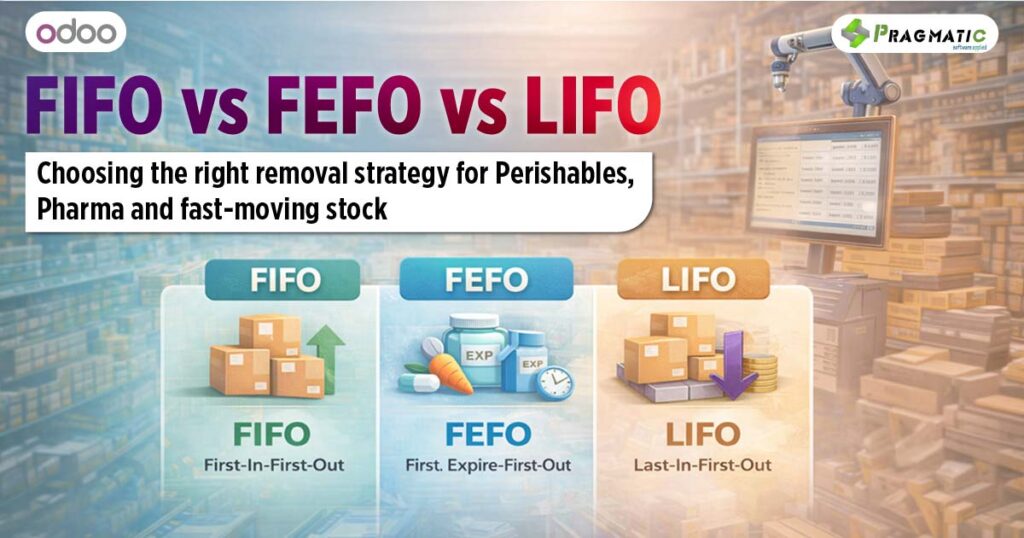
Three of the most widely used methods are :
- FIFO (First-In-First-Out)
- FEFO (First-Expire-First-Out)
- LIFO (Last-In-First-Out)
Each approach prioritizes inventory differently and is suited to specific industries and operational conditions.
With global supply chains becoming more complex and customer expectations increasing, companies are rethinking how inventory flows through warehouses. New technologies such as AI-driven forecasting, IoT sensors and warehouse automation are transforming how businesses track and manage stock movement.
Understanding the differences between these inventory strategies helps organizations build more resilient and efficient operations.
The growing complexity of inventory operations
Modern supply chains operate very differently from those of a decade ago.
Businesses today manage inventory across :
- Multiple warehouses
- Online and offline sales channels
- Global supplier networks
- Complex regulatory environments
At the same time, customer expectations for speed and product freshness have increased dramatically.
Large retailers and manufacturers are increasingly investing in data-driven inventory systems and predictive analytics to prevent stockouts and optimize supply chains.
Emerging technologies such as AI-powered demand forecasting and warehouse robotics are also shaping the future of inventory management.
Despite these advances, many operational challenges still come down to a fundamental principle : inventory must move in the correct sequence.
Without structured stock rotation strategies, businesses risk :
- Expired products reaching customers
- Inventory aging in warehouses
- Inaccurate cost valuation
- Inefficient warehouse operations
This is where removal strategies such as FIFO, FEFO and LIFO play a crucial role.
What is FIFO (First-In-First-Out)?
FIFO stands for First-In-First-Out, meaning the earliest inventory received is the first inventory used or shipped.
In practice, this means older stock is always prioritized during order fulfillment.
For example –
A warehouse receives two shipments of the same product.
Batch A – received in January
Batch B – received in February
Under FIFO rules, Batch A is picked first because it entered the warehouse earlier.
FIFO is the most widely used inventory rotation method because it naturally reduces the risk of aging stock and aligns well with operational workflows.
Industries where FIFO is commonly used
- Retail distribution
- Consumer goods
- Electronics
- Manufacturing supply chains
FIFO works best when products do not have strict expiration dates but still benefit from natural stock rotation.
For many warehouses, FIFO is considered the default inventory flow strategy.
What is FEFO (First-Expire-First-Out)?
FEFO stands for First-Expire-First-Out.
Instead of prioritizing the arrival date of inventory, FEFO prioritizes the expiration date.
Under this strategy, the system always selects the batch that will expire soonest.
Example :
Batch A – Received earlier, expires in December
Batch B – Received later, expires in October
With FEFO, Batch B is shipped first because its expiry date is earlier.
This method is particularly important for industries dealing with perishable or regulated products.
Research and industry practice show that FEFO significantly reduces spoilage and ensures compliance with safety standards.
Industries that rely on FEFO
- Pharmaceuticals
- Food and beverage distribution
- Cosmetics
- Chemicals
- Cold chain logistics
For businesses operating under regulatory frameworks such as GMP or food safety standards, FEFO is often mandatory to ensure consumer safety.
What is LIFO (Last-In-First-Out)?
LIFO stands for Last-In-First-Out.
This method prioritizes the most recently received inventory first.
In other words, the newest stock is used or shipped before older stock.
Example :
Batch A – purchased at $100
Batch B – purchased at $120
If prices are increasing, LIFO ensures the latest cost is reflected in cost of goods sold (COGS).
Because of this, LIFO is often discussed in the context of inventory valuation and accounting, rather than warehouse rotation.
Industries where LIFO may appear
- Commodities
- Raw materials
- Bulk industrial goods
However, LIFO has limitations. Many international accounting standards do not allow LIFO valuation, which restricts its use in global reporting frameworks.
Operationally, most warehouses still rely on FIFO or FEFO even if LIFO is used for accounting purposes.
FIFO vs FEFO vs LIFO : Understanding the key differences
While FIFO is the most common approach, FEFO is increasingly important in industries where product freshness and safety are critical. The choice between these strategies depends largely on product characteristics and compliance requirements
When should businesses use each strategy?
Selecting the right inventory method requires understanding the nature of the products and operational workflows.
Use FIFO (First-In-First-Out) when :
- Products have long shelf life
- Stock rotation maintains product quality
- Operations prioritize simplicity and efficiency
FIFO works best when products do not expire quickly but should still move in a natural sequence.
For instance –
A consumer electronics distributor receives batches of mobile phone accessories every month.
Batch A arrives in January; Batch B arrives in February
Using FIFO, the warehouse ships January stock first before moving to February stock.
This prevents older items from sitting in storage for long periods and ensures continuous stock movement.
Other industries commonly using FIFO
- Retail chains
- Apparel distributors
- Hardware suppliers
- Automotive spare parts dealers
Use FEFO (First-Expire-First-Out) when –
- Products have expiration dates
- Regulatory compliance is required
- Quality and safety are critical
FEFO ensures that products with the earliest expiry date leave the warehouse first, regardless of when they were received.
Let’s take an example –
A pharmaceutical distributor stores two batches of antibiotics.
Batch A received in January – expires in December
Batch B received in March – expires in September
Even though Batch B arrived later, FEFO ensures Batch B is shipped first because it expires sooner.
This prevents expired medicines from reaching pharmacies or hospitals.
Other industries commonly using FEFO
- Food processing companies
- Dairy distributors
- Cosmetic manufacturers
Vaccine and cold-chain logistics providers
Use LIFO (Last-In-First-Out) when :
- Inventory valuation matters more than rotation
- Products are commodities or bulk materials
- Cost fluctuations are significant
LIFO is typically used in situations where the latest purchase cost should be reflected in financial calculations.
For example –
A steel trading company purchases raw steel sheets.
Batch A purchased at $500 per ton
Batch B purchased later at $650 per ton
If prices are rising, LIFO ensures the most recent cost ($650) is used when calculating the cost of goods sold.
This helps companies reflect current market costs in their financial reporting.
Other industries where LIFO may appear –
- Oil and gas commodities
- Construction materials
- Mining resources
- Metal trading
Most operational warehouses rely on FIFO or FEFO, while LIFO is more commonly used for accounting or valuation purposes rather than physical stock movement.
Choosing the right strategy depends on :
- Product characteristics
- Industry regulations
- Financial reporting requirements
- Warehouse processes
When implemented correctly, the right removal strategy can significantly improve inventory accuracy, compliance and operational efficiency.
In many real-world scenarios, businesses may combine strategies depending on product categories.
A manufacturer may use FIFO for raw materials and FEFO for finished food products.
The role of Technology and Automation in inventory rotation
As warehouse operations scale, manual stock rotation becomes difficult to maintain.
Modern supply chains increasingly rely on data-driven systems to manage inventory movement.
For example :
- Retailers are adopting AI-driven inventory systems to predict shortages and optimize stock allocation.
- Cold-chain logistics companies are also using AI to determine optimal pallet placement and predict storage duration for temperature-sensitive products.
At the warehouse level, technology helps automate inventory rotation through :
- Barcode scanning
- Lot and batch tracking
- Automated picking rules
- Real-time inventory visibility
Modern ERP systems can configure these strategies so that when a sales order is confirmed, the system automatically identifies the correct stock batch based on the defined rules.
This eliminates manual decision-making and ensures consistent warehouse operations.
Practical challenges businesses face while implementing stock rotation
Even when businesses choose the correct strategy, implementation can still present challenges.
Data accuracy
Incorrect batch data or expiry dates can lead to incorrect stock allocation.
Warehouse layout
If storage locations are not designed for rotation, staff may unintentionally pick newer inventory first.
Lack of inventory visibility
Without real-time stock updates, warehouses may allocate the wrong inventory.
Manual processes
Organizations relying on spreadsheets or disconnected systems often struggle to enforce consistent removal rules.
These operational challenges highlight the importance of integrated inventory systems and standardized processes.
Designing Inventory Systems That Scale
Inventory management is no longer just about counting products in a warehouse.
It is about designing systems that ensure the right products move at the right time.
Understanding the differences between FIFO, FEFO and LIFO helps businesses :
- Reduce waste and spoilage
- Improve operational efficiency
- Meet regulatory requirements
- Maintain accurate financial reporting
As supply chains grow more complex and customer expectations increase, businesses must move beyond manual inventory processes and adopt structured systems that support visibility and automation.
At Pragmatic Techsoft, we work with organizations across manufacturing, distribution and retail to help design operational workflows that align with real business processes.
With more than 17 years of experience in ERP implementation and digital transformation, our focus is on helping companies build systems that support long-term growth and operational clarity.
If your organization is evaluating how to improve inventory visibility or streamline warehouse processes, our team would be happy to explore how the right architecture and processes can support your next phase of growth.
FAQs
1) Is FIFO better than FEFO?
Neither is universally better. FIFO works well for products without strict expiration dates, while FEFO is essential for perishable or regulated products.
2) Can warehouses use FIFO and FEFO together?
Yes. Many businesses apply different strategies across product categories depending on shelf life and compliance requirements.
3) Why do inventory rotation strategies matter for compliance?
Industries such as pharmaceuticals and food distribution must ensure products nearing expiry are not shipped after expiration. FEFO helps enforce these safety standards.
4) Does warehouse automation affect inventory rotation?
Automation improves enforcement of rotation rules by ensuring picking processes follow predefined inventory strategies.
5) How does real-time inventory visibility improve stock rotation?
Real-time data ensures that warehouses always allocate the correct batch based on current inventory conditions, reducing errors and waste.