

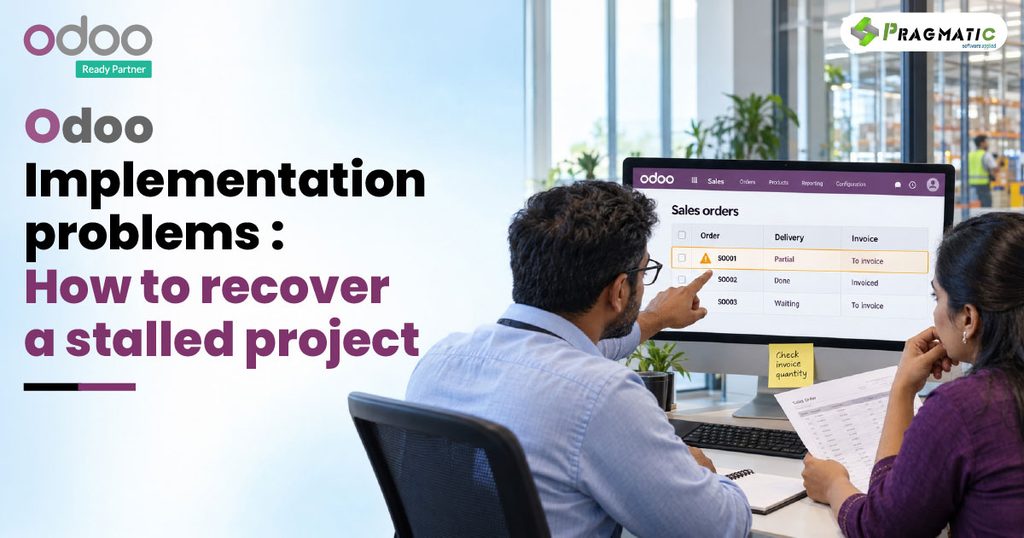
Before you approve another round of changes
You have paid for the implementation.
Now you are being asked to approve more work.
What will be different this time?
Purchasing still relies on spreadsheets. Accounts cannot explain a difference in the reports. Another demonstration looks promising, but everyday transactions still need someone to step in.

Before committing more budget, establish which processes are unreliable, what is causing the problem and how the next round of work will resolve it.
A recovery plan should give you enough evidence to make that decision.
How do you recover a stalled Odoo implementation?
Recovering a stalled Odoo implementation starts with assessing workflows, data, configuration, customisations, integrations and project ownership.
Prioritize business-critical blockers, agree a recovery scope and test complete transactions in an isolated environment. Release changes after the agreed checks and user sign-off.
The plan should answer four questions –
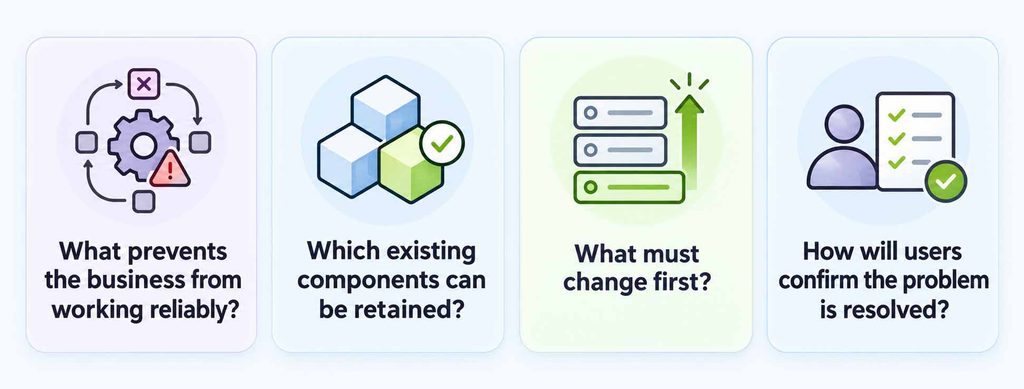
For a live system, contain urgent disruption while investigating the cause.
💡Keep any temporary workaround documented, with an owner and a review date.
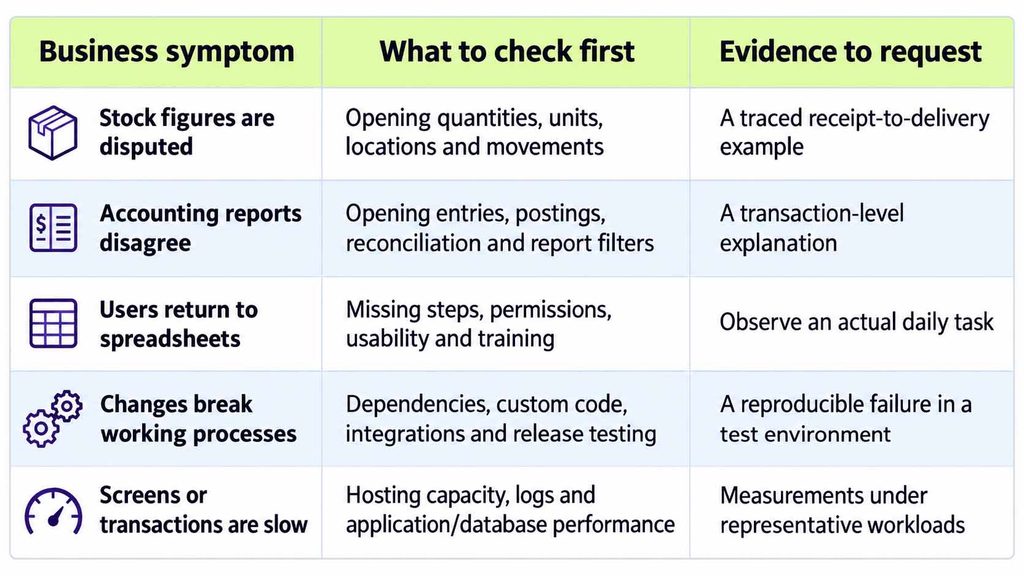
What is actually stopping the work?
“Odoo is not working” describes frustration. It does not identify the cause.
A blocked invoice could involve missing data, access permissions, configuration or custom code. Each needs a different response.
Start with a specific transaction and follow the evidence.
Separate defects from new requirements. A broken agreed workflow and a newly requested feature should not enter the recovery plan with the same priority.
What should an Odoo recovery assessment deliver?
The assessment should produce a prioritised plan with enough detail to approve the next step.
Establish 🔽
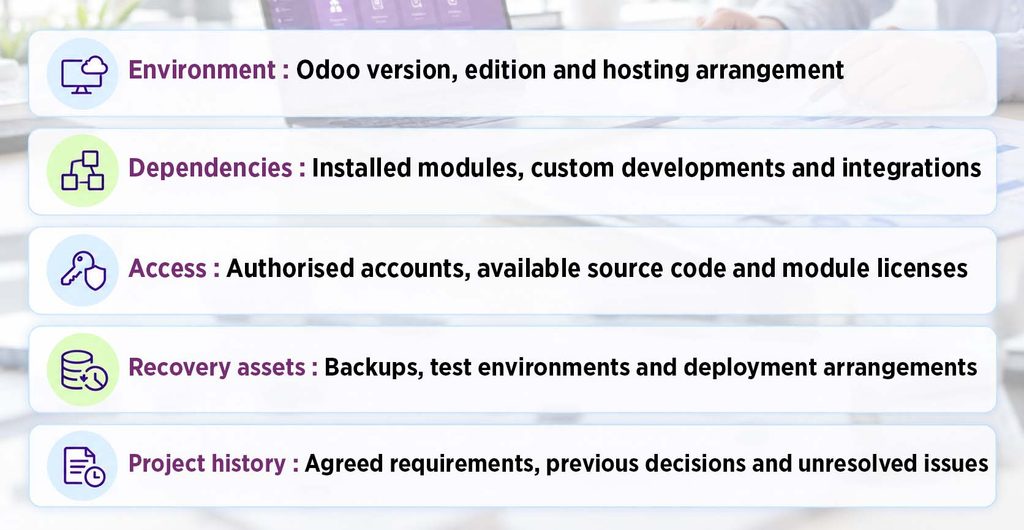
For each priority issue, record the affected transaction, business impact, confirmed or suspected cause, proposed remedy, dependencies, owner and acceptance test.
Then divide the work into –
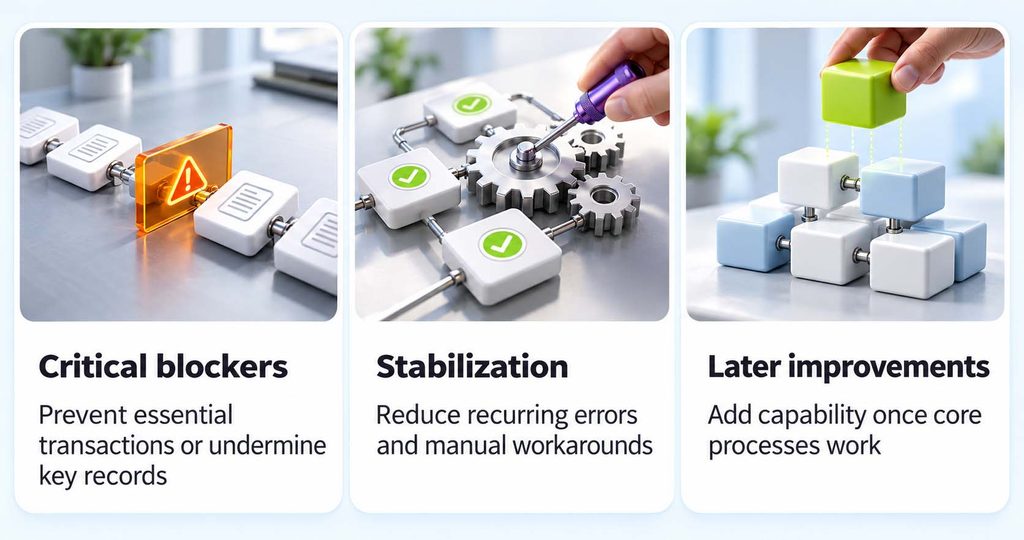
Agree scope, exclusions, phased estimates, milestones and how additional requirements will be approved. Where the cause remains uncertain, approve a diagnostic step before committing to a particular fix.
Should you repair, simplify or rebuild?
Choose the intervention that the findings support.
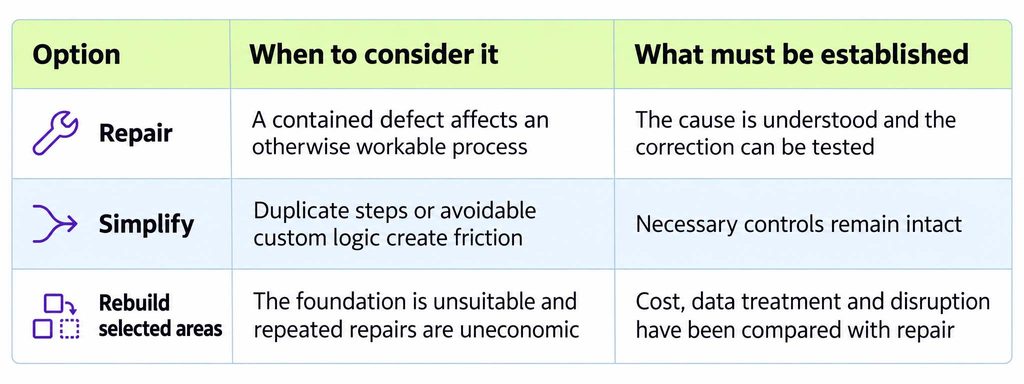
A rebuild need not replace the entire implementation. Some workflows, modules and data may remain usable.
Customization is not automatically the problem either. Assess whether it serves a necessary requirement and can be maintained reliably.
An upgrade is a separate decision.
A newer version may address a specific limitation, but it will not automatically correct poor data, unclear responsibilities or unsuitable process design. Custom modules and integrations need compatibility checks when upgrading.
For the broader decision, read Pragmatic Techsoft’s perspective on reviewing or replacing an ERP.
How do you prove that a fix works?
Test the complete business workflow, including exceptions and handovers between teams.
Consider a manufacturer investigating differences between delivered and invoiced quantities.
A difference is not automatically a defect.
Odoo supports invoicing ordered or delivered quantities. First check whether the configured policy matches the agreed business process.
Trace one order through –
- The ordered quantity and invoicing policy
- A partial delivery and remaining quantity
- Invoice creation and accounting entries
- A return and any corresponding credit note required
- Payment and reconciliation
This helps distinguish expected behaviour from a configuration, data, customization or user-practice problem.
For purchasing, test the applicable sequence from approval through receipt, vendor billing and payment.
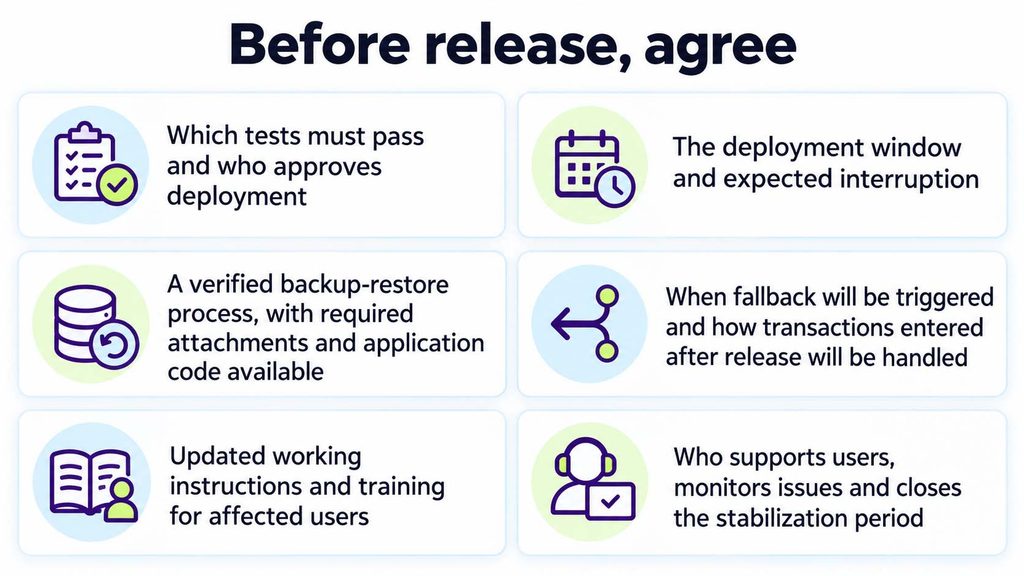
Use an isolated test environment. Verify that emails, payment connections, scheduled actions and integrations cannot affect live operations.
After changes, re-test related processes that previously worked. Users from each affected team should complete their steps and verify the handovers.
Acceptance means the team can complete the agreed scenarios and explain the results.
Who owns the recovery after release?
Assign a business owner to approve the process and a delivery owner to coordinate the work.
Measure progress against a baseline. Track unresolved reconciliation differences, manual corrections, recurring workarounds and transaction completion time.
Ticket counts alone cannot show whether the business is working reliably.
Make the next investment count
Before approving more changes, ask for a clear explanation of the problem, the proposed remedy and the evidence that will demonstrate success.
Pragmatic Techsoft brings together Odoo implementation, customisation, integration, migration and support expertise.
Our Odoo implementation approach includes business review, gap analysis, agile methodology, user training and pilot testing.
That combination matters when a project needs both technical investigation and an understanding of how work moves between teams.
Book a free 30-minute consultation
💬If your implementation has stalled, bring us your current setup, three disruptive issues and the outcome your team needs. We can help assess the blockers, identify what can be retained and define the next steps.
Frequently asked questions
Does a stalled Odoo implementation always need a rebuild?
No. A contained repair, corrected configuration, cleaner data or simpler workflow may be sufficient. Compare these options before approving a rebuild.
Can another Odoo partner take over an existing project?
Yes, where the necessary access and handover arrangements can be established. Review source-code availability, licences, documentation and contractual responsibilities. Missing assets can affect scope and timing.
Will upgrading Odoo resolve the problems?
Not automatically. An upgrade may address a version-specific issue, but process design, data quality and ownership still need assessment. Test custom-module and integration compatibility before proceeding.
How much does Odoo implementation recovery cost and how long does it take?
Both depend on the causes, dependencies and testing requirements. Request separate estimates for assessment, essential fixes, data correction, training and release support. A reliable plan follows diagnosis.
What should we prepare before requesting a recovery review?
Bring your Odoo version, edition, hosting details and three disruptive issues. Include example transactions, expected versus actual results, available documentation and details of custom modules or integrations.