
Your ERP choice isn’t the biggest decision you’ll make
When manufacturers evaluate ERP systems, most conversations focus on front-facing functionality.
- Can it handle multi-level production?
- Can it manage dynamic inventory routing?
- Can it automate procurement?
- Can it enforce quality control checkpoints?
These are vital operational questions.
But many businesses overlook another decision that has just as much impact on long-term success : where and how the ERP will actually run.
The deployment model chosen today shapes how easily the business can adapt tomorrow. It affects customization flexibility, integration boundaries, upgrade complexity, cybersecurity responsibilities, infrastructure ownership and internal IT overhead.
As manufacturers invest in automation, traceability, and connected operations, ERP hosting is no longer just a technical decision. It is a strategic business foundation.
Why more manufacturers are re-evaluating their ERP strategy in 2026
Manufacturing businesses continue to face pressure to improve visibility, traceability, responsiveness, and cost control.
At the same time, many are expected to achieve this without adding significant administrative headcount.
Modern operations are expected to :
- Track raw materials and work-in-progress inventory in real time
- Improve production scheduling and reduce downtime
- Maintain product quality while minimizing waste
- Coordinate procurement, warehousing, and fulfillment across multiple locations
That means the question is no longer only which ERP to choose.
The bigger question is which ERP architecture can keep supporting the business as operations become more complex.
What modern manufacturing operations actually need from an ERP
Whether the business produces food products, industrial components, chemicals, consumer goods or regulated devices, the operational requirements are increasingly similar.

Odoo 19 includes manufacturing-related capabilities across Manufacturing, Inventory, Quality, Maintenance, Planning, Purchase and PLM workflows, making it a strong fit for many growing manufacturers.
The bigger strategic question is not whether Odoo can support these requirements.
It is how much deployment flexibility the business will need in order to adapt those capabilities over time.
Understanding Odoo’s deployment models
Odoo offers multiple deployment approaches and each one serves a different type of organization.
The right fit depends less on company size alone and more on :
- Operational complexity
- Customization needs
- Integration requirements
- IT maturity
- Long-term growth plans
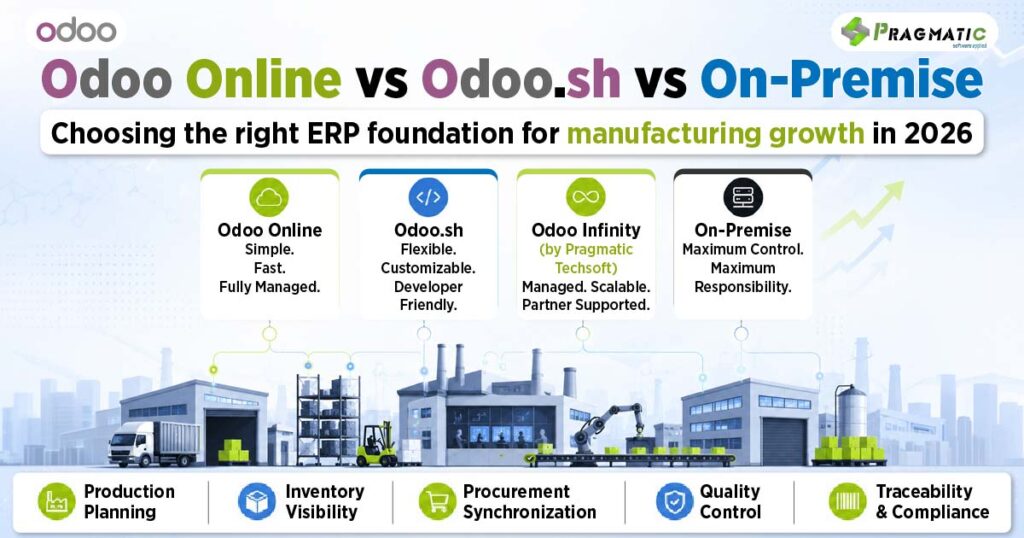
For most manufacturers evaluating Odoo in 2026, the realistic deployment choices are :
- Odoo Online
- Odoo.sh
- Odoo Infinity by Pragmatic Techsoft
- On-Premise / Private Infrastructure
Odoo Online : Simplicity First
Odoo Online is Odoo’s fully managed SaaS environment.
Odoo handles :
- Hosting
- Core updates
- Backups
- Platform-level security
Users simply access the system through a browser.
Best suited for
- First-time ERP adopters
- Standardized workflows
- Businesses with minimal customization requirements
- Companies with little or no internal IT capacity
Note : Important limitation
Odoo Online does not support custom Python modules.
It can support :
- Standard API integrations
- Odoo Studio customizations
But it is not designed for:
- Deep code customization
- Advanced local hardware integrations
For manufacturers with straightforward processes, that simplicity is a major advantage.
As workflows become more specialized, however, those limitations become increasingly visible.
Odoo On-premise : Maximum control, Maximum responsibility
On-Premise gives organizations full control over their Odoo environment.
The ERP can run on :
- Internal servers
- Private cloud infrastructure
- Dedicated hosted servers
Best suited for
- Highly regulated industries
- Businesses with strict data governance policies
- Operations requiring deep local network and hardware control
- Companies with mature IT capabilities
The trade-off is responsibility.
The business becomes responsible for :
- Backups
- Security patching
- Monitoring
- Disaster recovery
- Database performance
- Version upgrades
For some manufacturers, this level of control is essential.
For many SMEs, it becomes an operational burden that distracts from manufacturing priorities.
Odoo.sh : The middle ground many manufacturers choose
Odoo.sh is Odoo’s dedicated cloud platform for hosting Odoo solutions.
It supports :
- Custom code
- Git-based deployment workflows
- Multiple addons folders
- Python dependencies
- Production, staging and development environments
Important Platform Constraints
Odoo.sh does not support :
- Installing system packages
- PostgreSQL extensions
- Long-running background processes
- Daemonized services
Development and staging builds are also limited in worker capacity and scheduled action behavior.
Best suited for
- Growing manufacturers needing custom modules
- Businesses with custom workflows
- Companies integrating Odoo with external systems
- Teams wanting flexibility without managing infrastructure
For many manufacturers, Odoo.sh offers an attractive balance between flexibility and simplicity.
Odoo Infinity managed by Pragmatic Techsoft
A managed alternative for scaling manufacturers
For manufacturers wanting managed hosting with code-level flexibility beyond standard Odoo.sh packaging, Odoo Infinity can be another alternative.
Odoo Infinity’s offers :
- Managed hosting
- Scalability
- CI/CD support
- Server monitoring
- Git-based deployment workflows
- Support for Community and Enterprise editions
Best suited for
- Manufacturers wanting managed hosting plus implementation-partner involvement
- Businesses evaluating Community and Enterprise deployments
- Teams wanting flexibility and monitoring without on-premise responsibility
- Organizations looking for a Pragmatic Techsoft-managed hosting proposition
Important note :
Odoo Infinity is Pragmatic Techsoft’s managed hosting option. Find the documentation here.
The architectural comparison

This comparison matters because manufacturers rarely stay operationally static.
The real value of a deployment model is not how well it fits today, but how efficiently it absorbs change later.
Real Manufacturing Scenarios: Which Deployment Fits Best?
Scenario 1 : Standardized Single-Site Operator
A food processor or packaging business with :
- One facility
- Standard workflows
- Limited customization
is often best served by Odoo Online.
The lower overhead and faster time-to-value can outweigh the lack of deep customization.
Scenario 2 : Multi-Warehouse Industrial Manufacturer
A manufacturer with :
- Multiple warehouses
- Custom approval flows
- Engineering change requirements
- External software integrations
is often a strong fit for Odoo.sh.
It provides enough flexibility for custom development while preserving structured cloud deployment.
Scenario 3 : Regulated and Hardware-intensive operation
Industries such as:
- Pharmaceuticals
- Medical devices
- Highly regulated manufacturing
may need –
- Infrastructure-level control
- Local network dependency
- Strict internal governance
In those cases, On-Premise is often the most appropriate fit.
Scenario 4 : Partner-managed scaling environment
Manufacturers wanting :
- Code flexibility
- Managed hosting
- CI/CD support
- Close implementation-partner involvement
may find Odoo Infinity attractive.
The hidden cost most ERP evaluations miss [Adaptation drag]
Most ERP evaluations focus on :
- Licensing costs
- Implementation costs
- Annual support costs
Those matter.
But they do not determine whether the ERP remains effective over time.
A more strategic metric is adaptation drag.
This is the cost, time, and friction involved in changing the ERP when the business changes.
Examples include :
- New plants
- New product lines
- New compliance requirements
- New integrations
- New operational controls
A deployment model that is inexpensive today but difficult to adapt tomorrow can become far more expensive over time.
Six questions every manufacturing leader should ask before deciding
- How likely are our production, inventory or approval processes to change within the next three years?
- Will we require custom workflows or code-level customization?
- Do we need integrations with legacy systems, external platforms or shop-floor devices?
- Do we have the internal capability to manage infrastructure securely and reliably?
- How quickly do we expect to scale users, warehouses, plants or transaction volume?
- Do we want a fully Odoo-managed platform, a partner-managed environment or full infrastructure ownership?
These questions usually make the right deployment path much clearer than a feature checklist alone.
Looking ahead : Preparing for Odoo 20 and future growth
Odoo.sh’s lifecycle policy currently lists Odoo 19, released in September 2025, as supported through October 31, 2031.
That matters because deployment decisions are closely tied to upgrade strategy.
The more customization and infrastructure ownership involved, the more planning is required to adopt future Odoo versions smoothly.
Manufacturers should therefore look beyond current functionality and evaluate how easily their chosen architecture can evolve.
Partnering for long-term structural success
The best ERP foundation is not the most technical one.
It is the one that supports operational growth without forcing the business to rebuild systems every time complexity increases.
Pragmatic Techsoft’s value lies in understanding manufacturing operations first and aligning Odoo architecture to those operational realities.
That conversation becomes more strategic when businesses evaluate not only Odoo Online, Odoo.sh, and On-Premise, but also managed hosting options such as Odoo Infinity.
The best ERP foundation is the one you won’t outgrow
Some manufacturers will do best with Odoo Online.
Others will need Odoo.sh.
Some will need infrastructure-level control through On-Premise.
Others may prefer a partner-managed alternative such as Odoo Infinity.
The right answer is not the most complex option.
It is the option that gives the business enough flexibility to evolve without repeatedly rebuilding the systems that support manufacturing execution, inventory control, procurement, traceability and growth.
Ready to choose the right Odoo foundation for your manufacturing business?
If you’re evaluating Odoo Online, Odoo.sh, Odoo Infinity or On-Premise for your manufacturing operations, the best next step is a practical, operation-focused conversation.
Connect with the Pragmatic Techsoft team to discuss –
- Your current production, inventory and procurement workflows
- Your customization and integration requirements
- Your growth plans, number of plants, users, and locations
- Which deployment model balances flexibility, cost and control for your business
We’ll help you decide which foundation supports your operations today and won’t outgrow tomorrow.
📱 Alternatively, you can get in touch with our team via WhatsApp – +91 97656 29686
FAQs
Is Odoo.sh more expensive than Odoo Online?
Usually, yes. Odoo.sh includes hosting and deployment capabilities beyond standard SaaS, including custom code workflows and managed build environments.
Can a business move from Odoo Online to Odoo.sh later?
Yes. Odoo.sh allows importing database dumps, and businesses can migrate their production database to Odoo.sh when requirements evolve.
What are the important technical limits on Odoo.sh?
Odoo.sh does not support :
- System package installation
- PostgreSQL extensions
- Long-running daemonized services
Development and staging environments also have worker limitations.
Is Odoo Infinity an official Odoo deployment model?
No.
Odoo Infinity should be positioned as a Pragmatic Techsoft-managed hosting alternative rather than an official Odoo deployment category.
Which deployment model is best for multi-plant manufacturing operations?
There is no universal answer.
Many multi-plant manufacturers are better served by Odoo.sh, a partner-managed hosting model such as Odoo Infinity, or On-Premise, depending on customization depth, integrations, governance requirements and IT ownership preferences.