
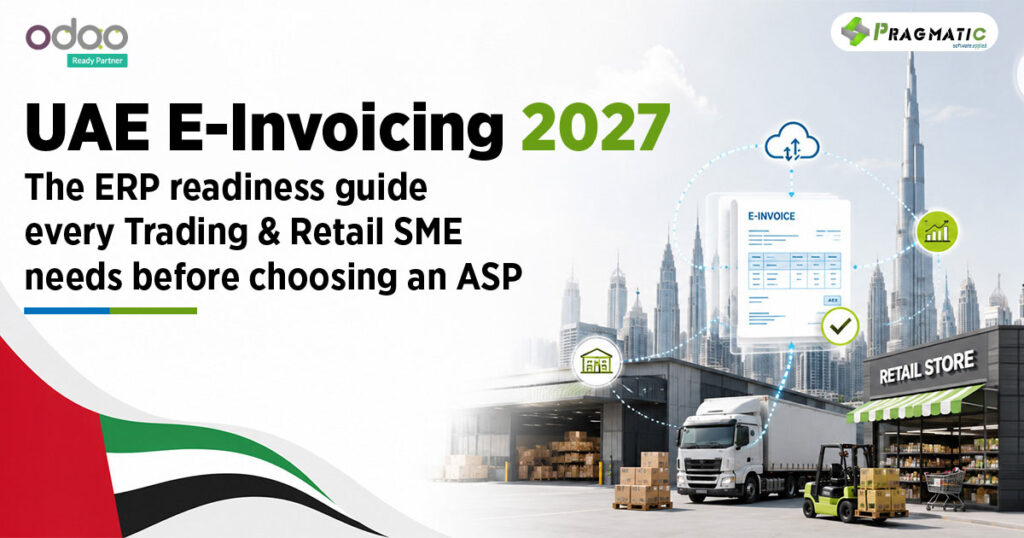
The ASP won’t fix what your ERP gets wrong
Every UAE business talking about e-invoicing right now is focused on the same question : which Accredited Service Provider do we sign with?
It’s the wrong first question.
An ASP’s job is to take the invoice data your business already has, format it correctly and transmit it to the FTA. It doesn’t clean up inconsistent tax codes. It doesn’t fix a customer master with three different spellings of the same client. It doesn’t reconcile a product catalogue that’s been maintained in four different spreadsheets by four different people.
If that data is messy going in, the ASP will transmit it exactly as messy, just faster and in a format the FTA can now audit automatically. E-invoicing doesn’t just digitize your invoices – it makes every inconsistency in your existing records visible to the FTA in near real time.
For a trading or retail business running sales across a shop counter, wholesale accounts and a WhatsApp order book, that’s the actual risk. Not missing the ASP deadline. Having nothing underneath it worth transmitting.
An ASP (Accredited Service Provider) is a government-approved intermediary that every business will need under the UAE’s e-invoicing system.
It doesn’t create your invoices – your business does that, through your accounting or ERP system. The ASP’s job is to take that invoice data, check it’s in the correct structured format, and transmit it securely to the FTA and to your customer’s own ASP, all within moments of the invoice being raised.
It’s like a compliance courier – it delivers your invoice data correctly and on time, but it can’t fix bad data before it hands it over.
What UAE E-Invoicing actually requires
The UAE’s Electronic Invoicing System (EIS) replaces PDF and paper invoices with structured XML invoices, built on formats like PINT-AE, exchanged through a five-party model: Your business, an Accredited Service Provider on your side, the FTA’s e-Billing system, an ASP on the buyer’s side and the buyer.
A valid e-invoice under this system needs to carry a defined set of details – legal names and TRNs for both buyer and seller, a unique invoice number and timestamp, line-item VAT breakdowns, tax totals and a digital signature confirming the ASP validated it.
Every one of those fields has to come from somewhere in your business systems. If your ERP or accounting setup can’t produce them cleanly, that becomes your ASP’s problem to chase down invoice by invoice – which is exactly the bottleneck that turns “e-invoicing” from a formatting exercise into an operational headache.
Credit notes follow the same rules. So do self-billed invoices in arrangements where the buyer issues on behalf of the supplier. None of it works from a PDF anymore.
The real timeline: Who’s in Phase 1 and who isn’t
The rollout is phased and the dates matter more than the general “2027” most SME owners have heard in passing :
- July–December 2026 : Voluntary pilot phase. Businesses can test their setup with no penalty exposure.
- 30 October 2026 : Deadline for businesses with annual revenue of AED 50 million or more to appoint their Accredited Service Provider. This was recently pushed back from an earlier July 2026 deadline.
- 1 January 2027 : Mandatory go-live for that same AED 50 million-plus group.
- After that : Smaller businesses and government entities follow in later phases. The exact dates for that tier haven’t been fixed publicly yet.
If you’re running a trading or retail SME : you’re very likely not in Phase 1. Which means there’s no deadline forcing your hand yet – and that’s precisely the trap.
Businesses that wait for their own deadline to appear will have months, not years, to fix messy master data, retrain staff and integrate an ASP once their phase is announced. Businesses that use this runway now will barely notice when it arrives.
What happens if you miss it
The penalty structure is specific, not symbolic :
- Missing the ASP appointment deadline : AED 5,000 for each month of delay
- Failing to issue and transmit an invoice through the system on time : AED 100 per invoice, capped at AED 5,000 a month
- Same penalty structure for credit notes issued late
- Failing to report a system outage to the Authority within the required window : AED 1,000 per day
- Failing to notify the Authority of changes to your registered business data : AED 1,000 per day
None of this applies while you’re voluntarily testing during the pilot window – which is exactly why testing early, before you’re forced to, is the lowest-risk move available right now.
Who’s exempt – and who isn’t
Mandatory e-invoicing applies to B2B and B2G transactions, for VAT-registered and non-VAT-registered businesses alike, including free zone entities unless specifically carved out. If you invoice other businesses or government entities, you’re in scope regardless of your size or your VAT status.
B2C sales are excluded from the mandate. So are a short list of specific cases : certain sovereign government transactions, international air passenger transport and VAT-exempt financial services, among a few others.
For most trading and retail SMEs, this means : Your wholesale, distributor, and B2G invoices fall under the mandate even before your walk-in retail sales do. If you sell to other businesses at all, this isn’t a “someday” issue.
ERP readiness comes before the ASP
Most of what’s published about UAE e-invoicing right now focuses on picking a provider – a natural angle for companies that are ASPs themselves.
Almost none of it addresses the step that determines whether an ASP relationship actually works : Whether your underlying business system can produce clean, structured, consistent data in the first place.
An ASP maps your invoice data to the FTA’s required fields and transmits it. That mapping only works if your business already has one product master, one customer master, one consistent set of tax codes, and one place where invoices are actually generated – not three spreadsheets and a notebook that gets reconciled once a month.
This is ERP territory, not ASP territory.
It’s the difference between plugging a clean pipe into the FTA’s system and trying to plug in three leaking ones and hoping the ASP absorbs the mess. It won’t. It will just transmit it faster.
A practical Readiness Process for Trading & Retail SMEs
Step 1
Consolidate where invoices actually get created.
If sales happen at a counter, over WhatsApp and through a distributor account, map how many separate places an invoice can currently originate from. Most owners find it’s more than they assumed.
Step 2
Standardize your customer and product master data.
One legal name and TRN per customer. One product record per SKU, not a slightly different version in every branch’s spreadsheet. This alone fixes a large share of what causes invoice-field errors later.
Step 3
Clean up VAT and tax code consistency.
If two staff members categorize the same transaction type differently, that inconsistency now reports itself automatically instead of getting smoothed over at month-end.
Step 4
Bring invoicing, inventory, and accounting onto one system.
An invoice, a stock deduction and a VAT entry should be the same event, generated once, not three separate records someone reconciles by hand later.
Step 5
Test structured invoice generation during the voluntary pilot window.
Even if you’re not in Phase 1, generating a few PINT-AE-compliant test invoices now surfaces data gaps while there’s zero penalty risk.
Step 6
Only then, bring in an ASP.
Once your ERP can reliably produce clean, structured invoice data, connecting an ASP becomes a technical integration step, not a data-cleanup project done under deadline pressure.
Where Pragmatic Techsoft fits
Pragmatic Techsoft is an official Odoo Ready Partner with 17+ years of experience and 400+ implementations across 50+ countries.
Our work with trading and retail businesses sits at exactly the stage described above – before the ASP conversation, not instead of it.
That means structuring Sales, Inventory and Accounting in Odoo so your customer records, product masters and VAT codes are consistent and centralized; consolidating invoicing across counter sales, wholesale accounts and online orders into one source of truth; and preparing your data architecture so that when your business’s e-invoicing phase arrives or when you choose to test during the voluntary pilot – connecting to an ASP is a clean handoff instead of a scramble.
We don’t replace your ASP. We make sure there’s something worth transmitting when they connect.
The business that’s ready isn’t the one with an ASP contract
It’s tempting to treat e-invoicing readiness as a single decision : pick a provider, sign, done.
But an ASP contract signed on top of scattered spreadsheets and inconsistent product records doesn’t produce compliance – it just produces faster, more visible mistakes.
The businesses that will handle this transition without disruption are the ones using the current runway – the pilot window, the fact that most SMEs aren’t in Phase 1 yet – to get their systems in order now.
Not because a deadline is bearing down on them today, but because the deadline is coming and clean data doesn’t get built overnight under pressure.
If you’re running a trading or retail business in the UAE, the question worth asking isn’t “which ASP should we use.”
It’s “if we had to produce a structured, accurate e-invoice tomorrow, could our current system actually do it.” For most SMEs, the honest answer is not yet – and that’s exactly the gap worth closing this year.
💡Connect with Pragmatic Techsoft to implement Odoo, clean up your invoicing and master data and prepare your business for a smooth ASP integration.
FAQs
Do small trading or retail businesses need to comply with UAE e-invoicing right now?
Not on the Phase 1 deadline of 1 January 2027 – that applies to businesses with revenue of AED 50 million or more. Smaller businesses will follow in later phases with dates not yet fixed. But if you invoice other businesses (B2B) or government entities (B2G), you’re in scope eventually regardless of size, so the runway now is worth using rather than waiting on.
Can I keep using my current accounting software once e-invoicing becomes mandatory?
Only if it can generate structured XML invoices in the required format and connect to an Accredited Service Provider. PDF or paper invoices won’t count as valid once your business is in scope, so the real question is whether your system’s underlying data – customer records, tax codes, product masters – is clean enough to map correctly, regardless of which software you use.
What’s the difference between an ASP and an ERP system in this process?
Your ERP (or accounting system) is where invoice data actually gets created – customer details, line items, VAT amounts. The ASP takes that data, validates it, converts it to the required XML format, and transmits it to the FTA and your buyer’s ASP. The ASP can’t fix bad data; it can only transmit what your ERP gives it.
Are retail sales to walk-in customers covered under the e-invoicing mandate?
No. B2C transactions are excluded. The mandate applies to B2B and B2G transactions. For a trading or retail business, that typically means wholesale accounts, distributor relationships, and government sales fall under the requirement first, even before walk-in counter sales do.
What happens if my business isn’t ready when our phase deadline arrives?
The penalty structure is specific: missing the ASP appointment deadline costs AED 5,000 per month of delay, and late or missing invoice transmission is penalized per invoice, capped monthly. Beyond the fines, an unready business also faces the operational cost of reconciling months or years of inconsistent records under deadline pressure – which is the bigger, less visible risk.
Pragmatic Techsoft is an official Odoo Ready Partner with 17+ years of experience and 400+ implementations across 50+ countries, helping trading and retail businesses get their systems – not just their invoicing – ready for what’s coming.
Write to su*****@*********co.in to find out where your business actually stands.