
The revenue treadmill – Why most Odoo partners stay stuck
If you have been implementing Odoo for clients for any length of time, you know the cycle well.
You win a project. You spend weeks understanding the client’s business, mapping their processes, configuring modules and training the team. You go live. You send the invoice. You move on.
Then January arrives and your revenue is back to zero. You need to find the next client, close the next deal and start the cycle all over again.
This is not a failure of skill or effort. It is a failure of the business model itself. The project model was designed for an era when software was delivered once and installed permanently. That era is over.
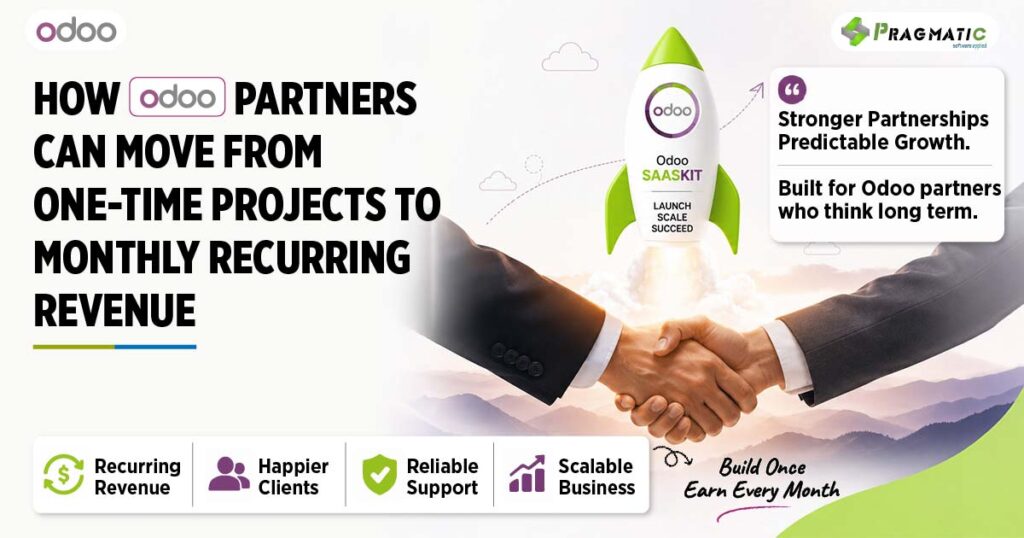
The entire software industry has moved to subscriptions and Odoo partners have a unique opportunity to make that shift for themselves.
The numbers make the case clearly.
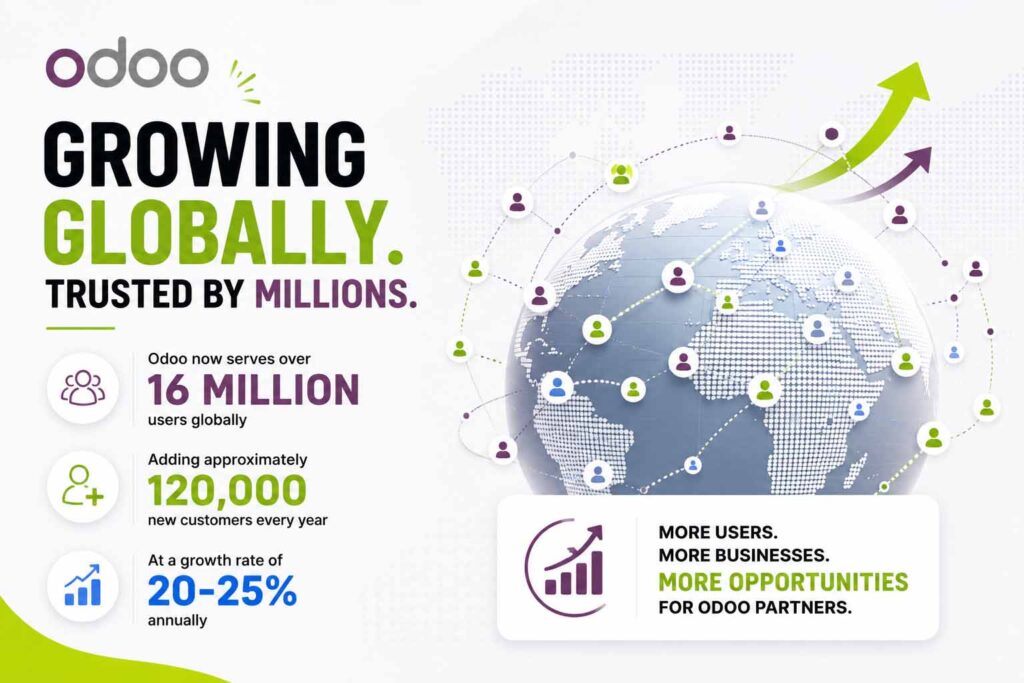
Businesses that were once reluctant to adopt cloud ERP are now actively seeking it. The demand for managed, hosted Odoo environments is growing faster than the supply of partners who know how to deliver it.
The partners who figure out the recurring revenue model first will not just survive. They will compound.
What monthly recurring revenue actually means for an Odoo partner
Monthly Recurring Revenue – commonly called MRR – is the income a business can count on every single month from subscriptions or retainers. Unlike project revenue, it does not require a new sale to exist. It simply continues.
For an Odoo partner, MRR can come from :
- Managed hosting fees – Charging clients a monthly fee to host and manage their Odoo environment on your platform
- Support retainers – A fixed monthly fee for ongoing support, updates and troubleshooting
- Module subscription access – Charging clients monthly access to specific Odoo modules included in their plan
- User-based pricing – Billing that scales automatically as a client adds more users to their system
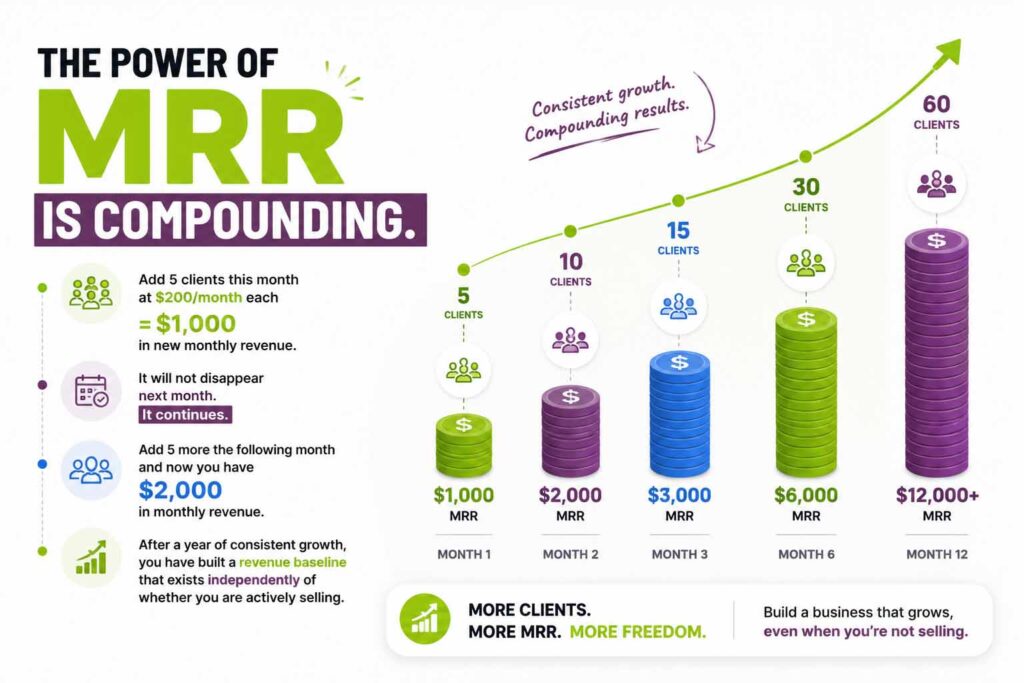
The project model has no such compounding. Every month restarts from zero.
The shift : From project delivery to managed hosting
The shift from project partner to managed service provider sounds significant. In practice, it is a change in how you structure the relationship with clients – not necessarily in the work you do.
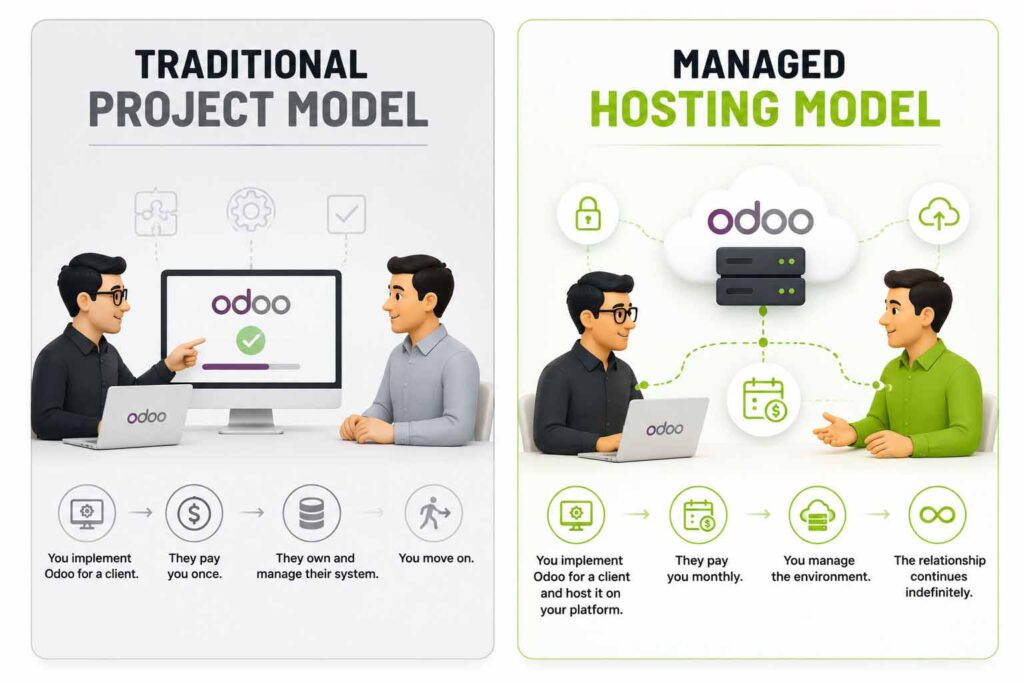
In the managed hosting model, you become the platform your clients run their business on.
You are not just the consultant who sets things up – you are the infrastructure they depend on. That changes the nature of the relationship, the stability of your revenue and the value you represent to your clients.
Clients actually prefer this model too.
It removes the burden of managing infrastructure, worrying about backups, handling upgrades and dealing with technical issues on their own. You handle all of that. They focus on running their business.
What you need to offer Odoo as a managed service
To make this transition, there are four core capabilities you need in place –
1. Multi-tenant infrastructure
Each client needs their own isolated Odoo environment – their own database, their own domain, their own module configuration. You manage all of these from a single central system.
2. Automated billing
Monthly invoices need to be generated automatically based on each client’s plan and usage. Chasing renewals manually is not a sustainable model at scale.
3. Domain and SSL management
Each client environment typically needs its own domain or subdomain, secured with an SSL certificate. This needs to be handled systematically, not manually per client.
4. A central management dashboard
You need one place to see all clients, manage their access, install or remove modules, handle billing, and run reports – without logging into individual environments one by one.
Building all of this from scratch is a significant engineering project.
Most Odoo partners do not have an in-house DevOps team to design, build and maintain this infrastructure. And they should not have to.
Multi-Tenancy explained – The architecture behind scalable hosting
Multi-tenancy is a term worth understanding because it is the technical foundation of the managed hosting model.
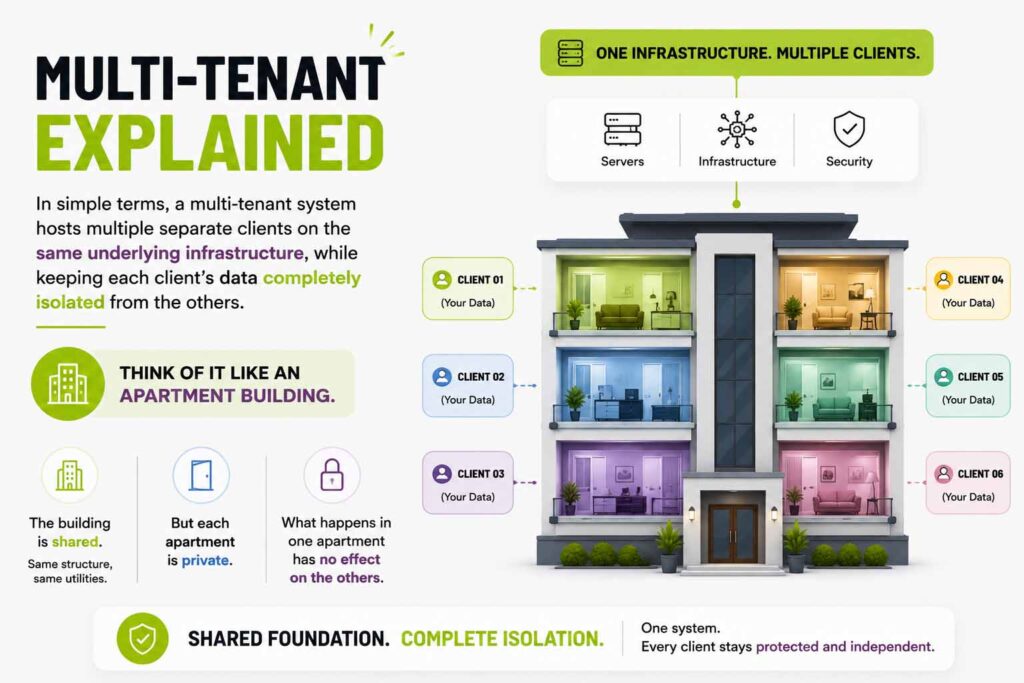
For Odoo hosting, this means :
- Each client (called a tenant) has their own Odoo database
- No client can see or access another client’s data
- Module configurations, user permissions, and custom setups are independent per tenant
- All tenants run on the same server infrastructure, making it cost-efficient to operate at scale
The alternative – giving each client a completely separate server – is expensive, difficult to manage and does not scale. Multi-tenancy solves all three problems.
When implemented correctly, you can manage 50 clients from the same dashboard you would use to manage 5.
The overhead per client decreases as you grow. That is what makes the recurring revenue model financially compelling.
How automated billing changes the business model
Manual billing is one of the hidden costs that makes scaling a managed service difficult. Sending individual invoices each month, tracking who has paid, chasing late renewals, handling plan upgrades – these tasks consume time that should be spent on growth.
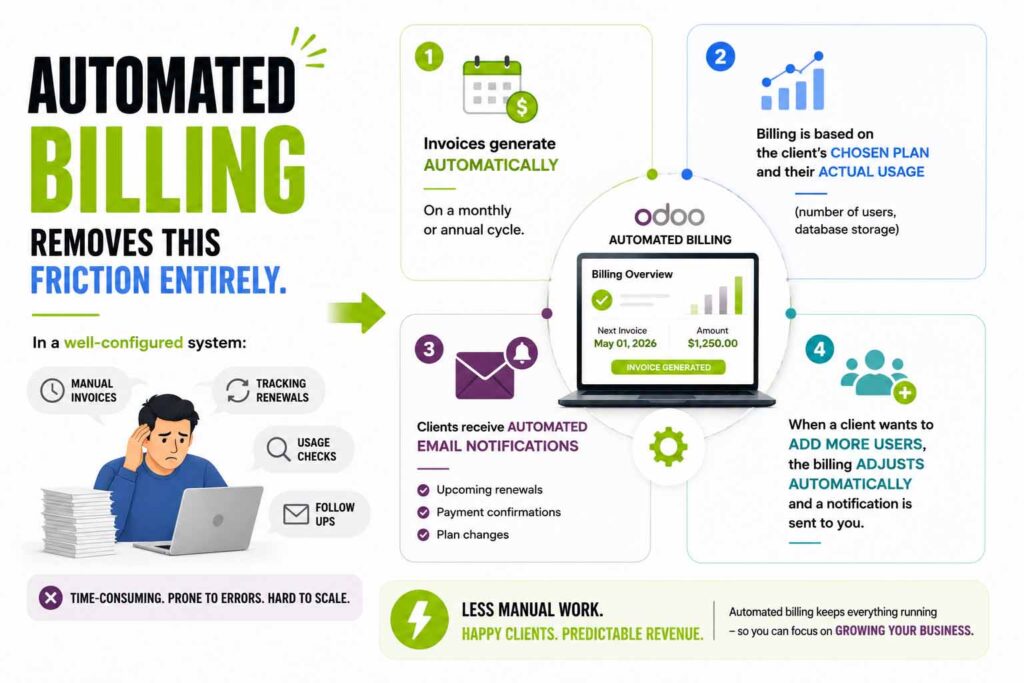
This is not just a time-saving feature. It is what makes the business model viable at scale.
A partner managing 5 clients can handle manual billing. A partner managing 50 clients cannot.
Automation is what bridges that gap.
From 10 clients to 50 without adding headcount
Let’s consider a real scenario that reflects what Odoo partners face when they try to scale –
An Odoo partner in the manufacturing sector has 10 active clients. All 10 are on self-managed on-premise deployments. The partner spends roughly 3 to 4 hours per client per month on maintenance, updates and troubleshooting – often reactively, when something breaks.
As the partner tries to grow to 20 or 30 clients, the math stops working. More clients means more maintenance hours. At some point, the team is fully occupied keeping existing clients running and has no capacity to onboard new ones. Growth stalls.
Now consider the same partner with a managed hosting platform in place :
- All 10 existing clients migrate to hosted environments on the partner’s SaaS platform
- Client environments are monitored centrally; most issues are caught before the client notices
- Backups run on a schedule automatically; the partner does not initiate them manually
- New clients are onboarded in under 5 minutes – a new database, domain and module set is provisioned automatically
- Monthly invoices go out automatically; the partner does not send them
The partner now has capacity to grow to 30, 40 or 50 clients with the same team size. The revenue compounds. The operational burden does not scale at the same rate as the client count.
This is the difference the managed hosting model makes – not in theory, but in practice.
The Odoo SaaS Rocket Kit – what it does and how it works
The Odoo SaaS Rocket Kit, built by Pragmatic Techsoft, is a ready-to-deploy framework that provides exactly the infrastructure described above – without requiring you to build it yourself.
Tenant management
Create, suspend or delete client environments directly from a central SaaS Master Panel. Each tenant gets their own isolated database and a unique domain or subdomain. You control user limits and module access per tenant from the same dashboard.
Subscription and billing automation
Monthly and annual subscription plans are built in. Invoices generate automatically based on each client’s plan. Billing adjusts based on actual user counts and storage usage. Email notifications go out automatically for renewals, plan changes, and user limit requests — all without manual intervention.
Domain masking and SSL
Each client can use their own domain or subdomain. SSL certificates are handled automatically through the system. Clients get a branded, professional URL – not a generic subdomain that exposes your backend infrastructure.
Module management without server access
Install, uninstall or update Odoo modules per client directly from the frontend dashboard. You do not need to log into a server console or use command-line tools. Custom modules can also be uploaded from the frontend and validated before deployment to ensure your master system stays stable.
Backups on schedule
Configure automated backup frequency for all tenant databases. Backups can be stored locally or at a remote location via SFTP. Set a retention period so old backups are cleaned up automatically. Clients can log into their own portal and download their own backups — removing that support burden from your team entirely.
Reporting and usage analytics
Track storage consumption, user counts and API call activity per tenant. Identify which clients are growing (potential upsell opportunities) and which are inactive (potential churn risks) from one place.
Compatibility and deployment flexibility
The app supports both Odoo Community and Enterprise editions and can be deployed on AWS, GCP, Azure, DigitalOcean, Hetzner, Contabo, or your own on-premise server. It works with PostgreSQL, Nginx, SSL and Cloudflare – the standard infrastructure stack.
A new client environment can be set up in under 5 minutes.
No server console. No manual configuration. No technical back-and-forth.
Why Pragmatic Techsoft built it and why that matters to you
Pragmatic Techsoft has been building Odoo solutions since Odoo was called TinyERP – before most existing partners in the market had heard of it. With over 16 years of Odoo implementation experience, a team of 100+ Odoo developers and a portfolio of 200+ apps on the Odoo Appstore, Pragmatic has seen every version of this problem.
The SaaS Rocket Kit was not built as a side project. It was built because Pragmatic ran into the same scaling limitations that every growing Odoo partner faces and invested seriously in solving them.
The result is a production-tested framework that has been deployed by Odoo partners and entrepreneurs across multiple countries and Odoo versions.
What that means for you is straightforward : you are not the beta tester. The framework has been through real-world deployments, real client environments and real edge cases. The billing automation, the domain handling, the backup scheduling – these are not prototype features. They work.
Your next step starts here – a smarter business awaits
The Odoo market is growing. Clients are actively looking for managed hosting. The partners building subscription businesses today are the ones who will be generating reliable, compounding revenue while their competitors are still chasing the next project.
The question is not whether the managed hosting model works. It does — and the infrastructure to deliver it is available right now.
If you are ready to stop starting from zero every month and start building a business that grows on its own momentum, the Odoo SaaS Rocket Kit is the most direct path there.
Talk to the Pragmatic Techsoft team to understand how the kit fits your current client base and what the transition looks like in practice.
WhatsApp us on : +91 97656 29686
Email us with your queries on su*****@*********co.in
Frequently Asked Questions
Q1. Do I need to be an official Odoo partner to offer hosted Odoo to clients?
No. You do not need to be a registered Odoo partner to host Odoo for clients using a SaaS Kit. The Odoo Community Edition is open-source (LGPL v3 licensed), which means you can run, modify and host it commercially without a partnership agreement. If you are using Odoo Enterprise modules as part of your offering, you will need to hold valid Enterprise licenses for your clients – but the hosting layer itself does not require partner status. That said, being an official Odoo partner does open up additional commercial benefits such as access to partner resources, certified training, and referral leads. Pragmatic Techsoft can advise on what makes sense depending on your business model.
Q2. How do I price my managed hosting plans for clients?
There is no single formula, but most Odoo managed service providers structure pricing across three variables: a base platform fee (access to the hosted environment), a per-user fee (charged monthly per active user on the client’s instance) and storage (charged if clients exceed a defined data allocation). A common starting point is a base monthly fee per tenant ranging from $50 to $200 depending on the modules included, plus $5 to $15 per user per month above a minimum threshold. The SaaS Rocket Kit supports both flat-rate and usage-based billing models, so your pricing structure can reflect whatever the market in your sector will support. Starting with a simple two-tier plan (basic and standard) is usually easier to sell than a complex matrix.
Q3. What happens to client data if a client cancels their subscription?
When a client ends their subscription, their tenant database still exists on your system until you explicitly delete or archive it. The Rocket Kit allows you to suspend a tenant (cutting off access) rather than immediately deleting it – which gives you a grace period to handle offboarding, data export, or reactivation if the client changes their mind. You can configure how long suspended databases are retained before permanent deletion. Best practice is to have a clear offboarding policy communicated to clients at sign-up – how long their data is kept after cancellation and how they can request a full data export before leaving.
Q4. Can I offer a free trial to new clients through the SaaS Kit?
Yes. The Odoo SaaS Rocket Kit has built-in trial period management. You can configure a trial duration from the SaaS Master Panel – clients who sign up get a working Odoo environment for the length of the trial without paying. The system tracks trial expiry and sends automated notifications as the end date approaches, prompting the client to convert to a paid plan. Trial databases that are not converted can be automatically cleaned up based on rules you set. This is one of the most effective ways to reduce friction in the sales process – letting a client experience the product before committing.
Q5. Can I migrate existing clients who are currently on self-hosted Odoo installations to the SaaS platform?
Yes, and this is actually one of the most common paths to getting started. Existing clients whose Odoo is currently running on their own servers or a basic VPS can be migrated to your managed platform. The process involves creating a new tenant on your SaaS platform, restoring the client’s existing Odoo database into that tenant and updating their domain settings to point to the new environment. Pragmatic Techsoft’s team has experience supporting this migration process and can guide you through it. From the client’s perspective, the transition is largely seamless – same Odoo, same data, new URL if needed and from that point forward they are on your managed subscription.