
The question that interrupts every fleet manager’s day
It happens somewhere between the third and fourth phone call of the day.
📦A customer wants to know where their delivery is.
🧰A manager needs to confirm a technician has reached a site.
🤙And the person responsible for the fleet has to stop whatever they’re doing, call a driver and wait for an answer that should have been available on a screen.
This isn’t a story about a single bad day. For most growing fleets – five vehicles or fifty – it’s the default operating mode.
And it’s a far more expensive habit than most owners realize, because it doesn’t show up as a line item anywhere. It shows up as lost time, missed windows and customers who quietly stop trusting your ETAs.
Why “Where are you?” is the most expensive question in Fleet Management
Every fleet-based business [logistics, last-mile delivery, field service, distribution] runs on the same basic promise : we’ll be there when we said we would. Everything else, from route planning to customer service, is built on top of that promise.
The problem is that most fleets still verify this promise the same way they did fifteen years ago : by calling the driver and asking. It works, technically.
But it’s reactive by design. You only find out something has gone wrong once you’ve already stopped to ask – and by then, the delay has usually already happened.
Industry data on last-mile delivery operations backs this up clearly 👇
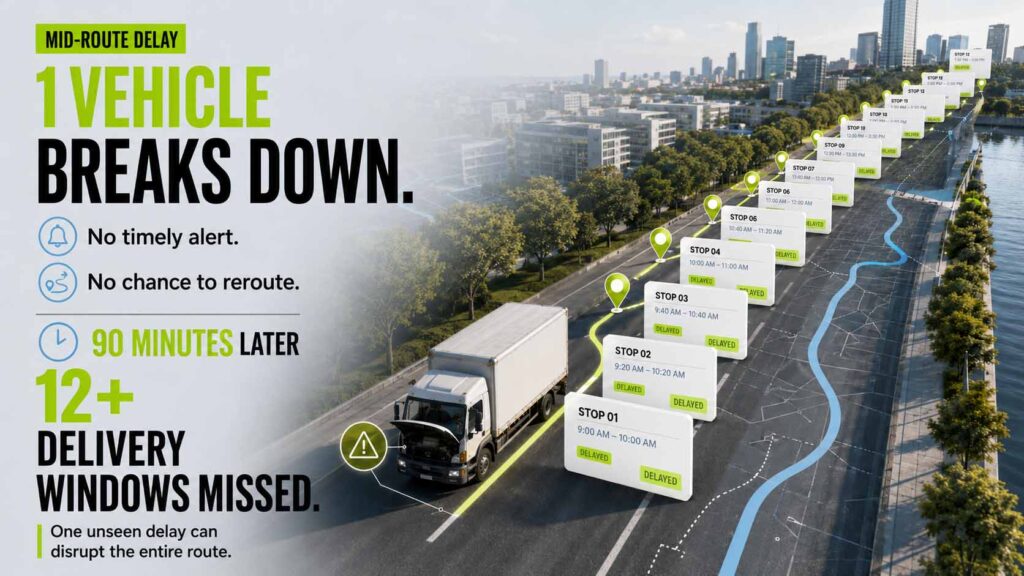
A single vehicle breakdown or unexpected delay in the middle of a route can cascade into more than a dozen missed delivery windows within the space of ninety minutes, simply because nobody knew about the problem until it was too late to reroute around it.
Dispatchers who rely on driver phone calls for updates typically respond to emerging problems several times slower than teams working off live location data – not because they’re less capable, but because they’re always working with information that’s already stale by the time it reaches them.
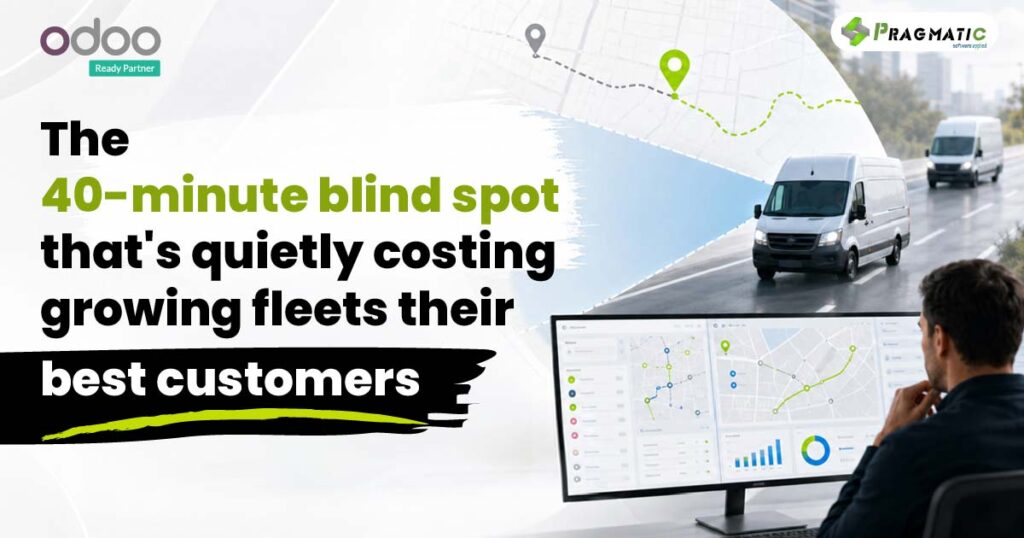
The 40-minute discovery problem
Here’s the pattern that repeats across almost every fleet that hasn’t solved visibility –
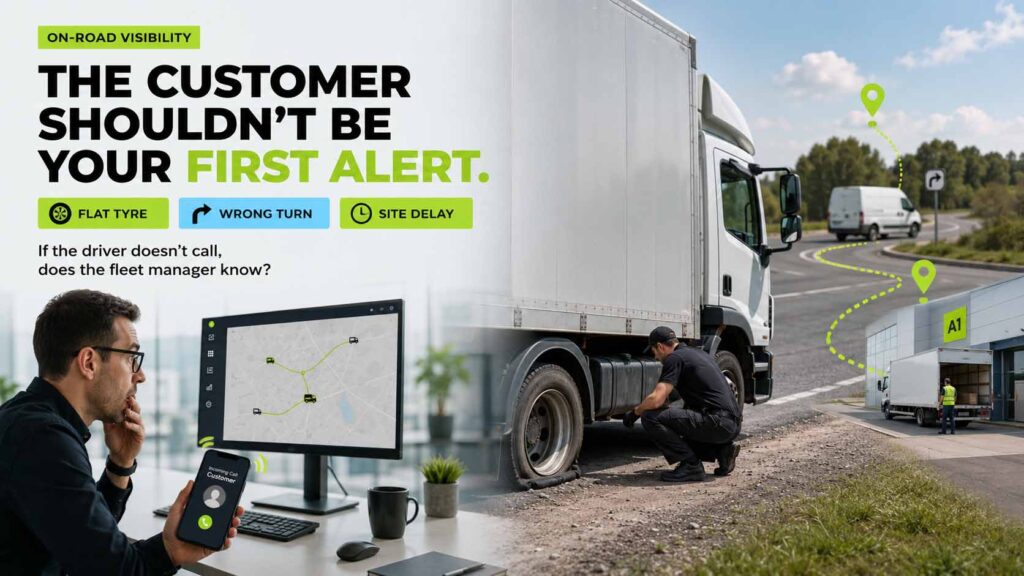
Something goes wrong on the road – a flat tyre, a wrong turn, a delay at a customer site – and the fleet manager doesn’t find out until the driver calls or worse, until the customer calls first.
That gap between when a problem happens and when someone actually finds out about it is where the real damage occurs.
A ten-minute delay that’s caught immediately can be absorbed quietly. The same delay, discovered forty minutes later through a customer complaint, has already turned into a missed window, an apology,and a slightly less loyal customer.
This is the part that doesn’t show up in a monthly report. Nobody logs “customer trust eroded” as a cost. But ask any fleet owner what actually keeps them up at night, and it’s rarely the big disasters – it’s the accumulation of small, invisible delays that they only ever hear about after the fact.
What actually changes when you can see your whole fleet at once
The fix here isn’t complicated and it doesn’t require ripping out your existing systems. It’s simply moving from asking where someone is to seeing where everyone is, at the same time, on one screen.
👉A live map showing every driver’s current location – updated continuously, not on request – removes the need for the check-in call entirely.
👉Drivers logged in and active show up clearly; drivers who’ve logged out show up just as clearly.
👉A dispatcher glancing at that map can spot a vehicle that’s been stationary too long, confirm a driver is close to a delivery point or simply reassure a customer with confidence instead of a guess.
This is a small operational shift with a disproportionately large effect, because it changes when you find out about a problem – from after it’s already cost you something, to while there’s still time to do something about it.
Visibility doesn’t have to mean enterprise complexity
Most of the fleet tracking conversation online is aimed at large logistics operations running hundreds of vehicles, AI-driven route optimization, and predictive maintenance models. That’s real, and it’s where the industry is heading at scale. But it’s also not where most growing fleets are today – and it’s not what most of them need first.
What a five-to-fifty vehicle business actually needs is far more foundational.
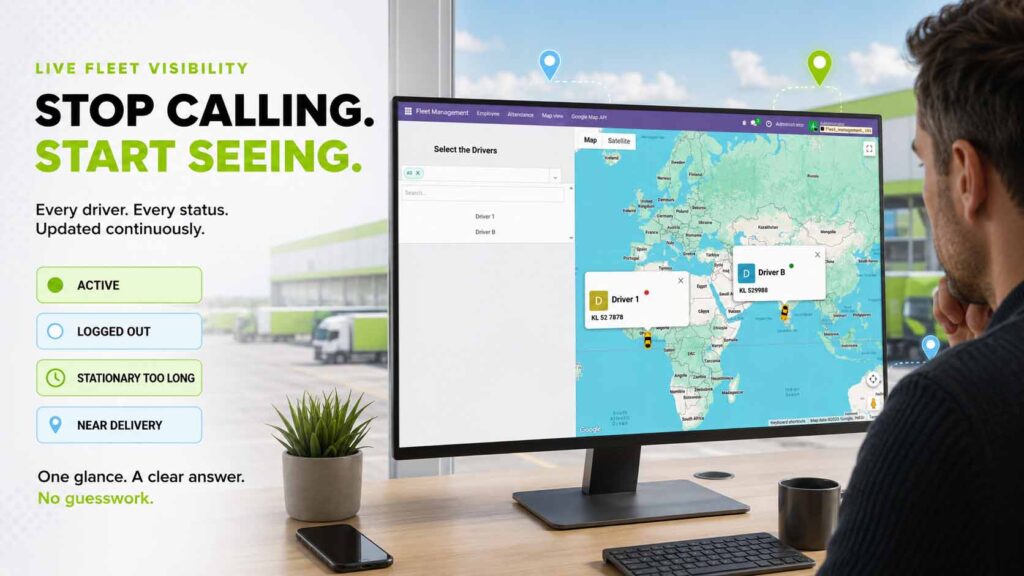
Know where your drivers are right now, know who’s logged in and working and have a clean digital record of which driver is assigned to which vehicle.
That’s not a small ask solved by an enterprise platform with a six-month rollout. It’s a specific, well-defined problem that a focused, right-sized tool can solve well – without the overhead of a system built for a fleet ten times your size.
Bringing fleet visibility into the system you already run
This is exactly the gap Pragmatic Techsoft built the Fleet Tracking Management app to close.
With over 17 years and 400+ Odoo implementations across 50+ countries, Pragmatic has seen this same blind spot repeat itself across industries and geographies – a fleet-based business that’s grown past the point where phone calls and memory can keep track of drivers and vehicles, but hasn’t yet adopted a system to close that gap.
The app brings live Google Maps-based driver tracking, dedicated driver profiles linked to specific vehicles and portal access for drivers – directly inside the Odoo system a business is likely already running for its operations, HR, or accounting.
No separate platform to log into, no duplicate data entry, no six-month enterprise rollout. Just visibility, built into the tools you already use daily.
It’s one of over 200 custom Odoo apps Pragmatic has built and listed on the Odoo App Store, each one designed the same way – around a specific, real operational gap rather than a generic feature checklist.
For a growing fleet still relying on phone calls to know where its own vehicles are, this is usually the first, highest-impact fix worth making.
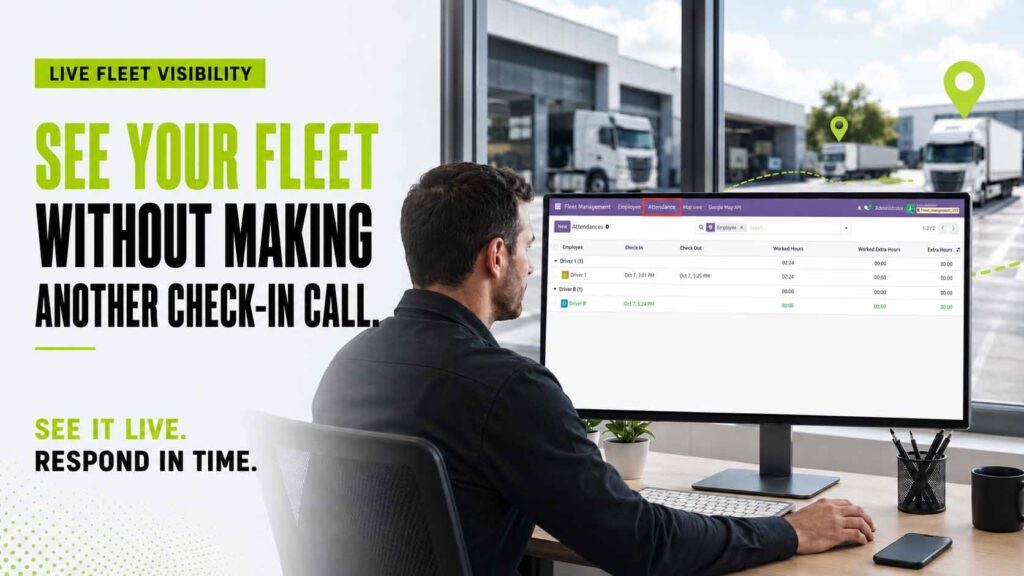
If your team still depends on phone calls to locate drivers, confirm arrivals or respond to customers, the problem isn’t coordination. It’s the lack of live visibility.
Our Fleet Tracking Management app for Odoo gives dispatchers and fleet managers one live view of drivers, vehicles and their current status. It helps your team identify delays earlier, provide more reliable customer updates and manage daily fleet activity without introducing another disconnected platform.
🚚Still calling drivers for location updates?
Let us show you how to bring live driver and vehicle visibility directly into Odoo.
Connect with our team to see how the app can work with your current fleet operations and Odoo setup.
FAQs
Q1. Does this replace the need for GPS hardware trackers in vehicles?
No – the Fleet Tracking Management app uses Google Maps integration for driver and vehicle location visibility within Odoo. It’s built for businesses that need clear operational visibility, not hardware-level telematics like fuel sensors or engine diagnostics.
Q2. Is this suitable for a fleet with under 10 vehicles?
Yes. The app is built to fit growing fleets that have outgrown phone-call-based coordination but don’t need – or want the overhead of an enterprise fleet platform.
Q3. Does it work with our existing Odoo setup?
Yes. It’s designed as a native Odoo module, compatible with versions 17 through 19, so it sits inside the system you’re already using rather than requiring a separate platform.
Q4. What happens when a driver logs out – do we lose visibility?
No. Logged-out drivers are still visible on the map, clearly marked as inactive, so managers always have a complete picture of the fleet’s status, not just who’s currently online.