

The question no fleet owner wants to ask out loud
Every fleet owner has, at some point, looked at a month-end attendance sheet and quietly wondered : did this actually happen the way it’s written down?
It’s an uncomfortable question, because asking it out loud feels like accusing someone. So most owners don’t ask about it.
They approve the sheet, run the payroll and file the discomfort away until next month – when the same feeling shows up again.
Why a register works fine for an office and fails for a fleet
A register at the door makes sense when everyone walks through the same door. It stops making sense the moment your workforce is drivers, delivery staff and field technicians who never see that door at all.

Their entire working day happens on the road – at a customer’s gate, a loading dock, a drop-off point three localities away. There’s no fixed entry point to check them against, so what fills the gap is trust –
👉A WhatsApp message saying “reached”
👉A phone call confirming someone’s on shift
👉A colleague signing the register on their behalf because they’re running ten minutes late and it feels like a small favour.
None of this is usually dishonest. It’s just what happens when a system built for a fixed workplace gets stretched to cover people who are never actually there.
Three familiar scenes from Fleet-based businesses
1) The courier company
A 12-driver delivery business runs attendance the same way it has for years – a register at the depot, signed each morning before drivers head out. One driver, running late most mornings, has a colleague sign him in so it doesn’t “count” against him. It’s a small kindness.

Six months later, the owner notices this driver’s attendance looks suspiciously perfect compared to everyone else’s – and has no way to prove or disprove it.
Let’s take an example – MetroRun Couriers
At MetroRun in Pune a senior driver lets a colleague sign his name daily so he avoids late penalties, leaving management with a spotless paper register but no way to verify actual times.
2) The service business
A company sending technicians to client sites for AMC visits and repairs has no fixed reporting point at all. Attendance is essentially self-reported – a technician texts when they start and finish.
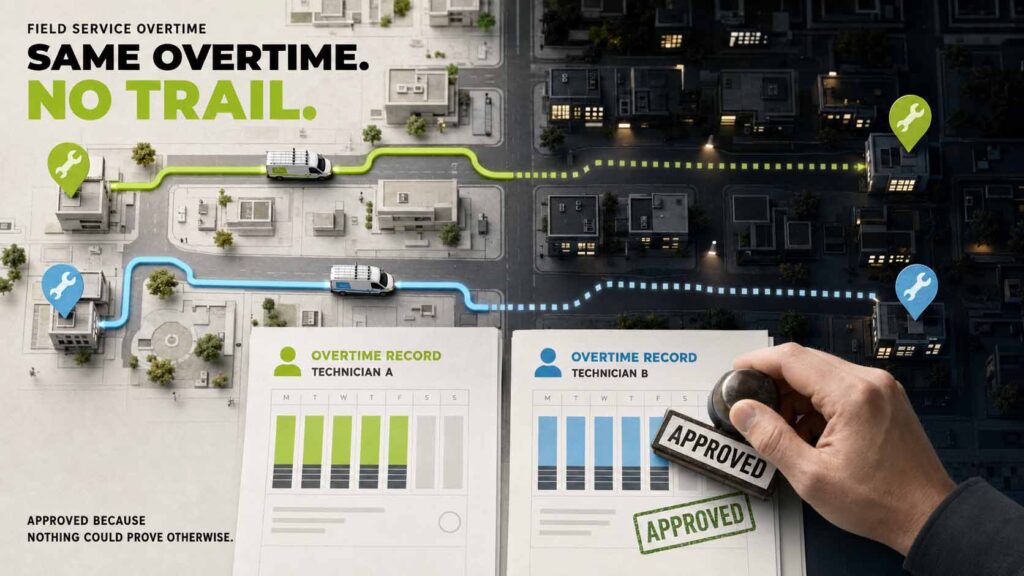
At month-end, two technicians claim nearly identical overtime hours for a week neither can fully account for. The manager approves it anyway, because there’s no record to argue with.
Consider this case : At SaffronTech two technicians logged identical extra hours via WhatsApp for a busy week and with no client sign-offs the manager approved the pay claims rather than risk conflict.
3) The distribution business
A growing distributor with 20 drivers across two cities relies on a regional supervisor to manually compile attendance from phone updates and forward it to HR.
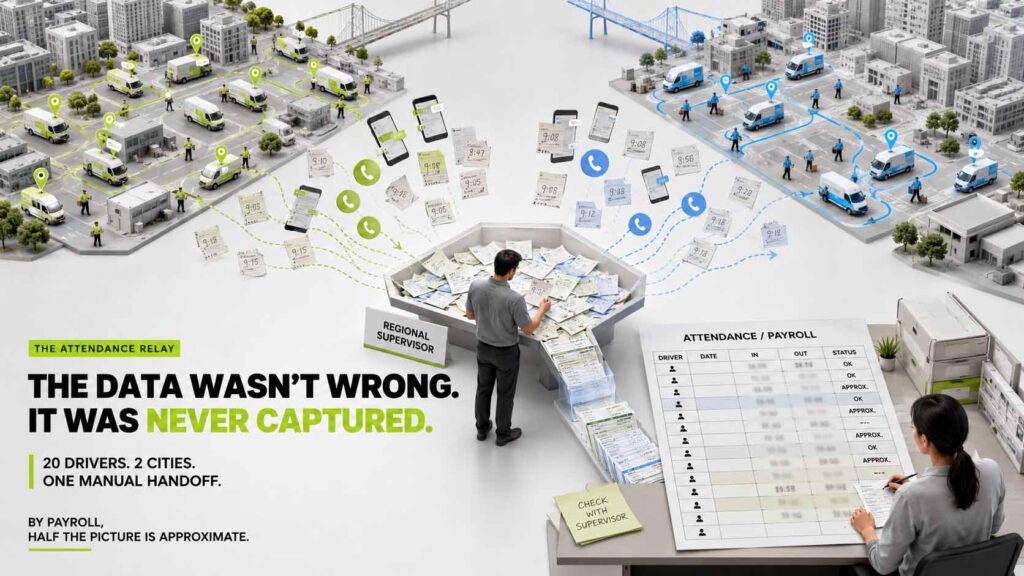
By the time it reaches payroll, half the entries are approximate. Nobody’s trying to cheat the system – the system simply was never built to capture accurate data in the first place.
At KisanMart Logistics drivers send “around 8 AM” updates to a supervisor who normalizes times before forwarding them to HR, producing rounded attendance that payroll must later reconcile.
Different industries, same underlying problem – attendance for a mobile workforce, tracked using tools designed for a stationary one.
The payroll leak nobody budgets for
None of the scenes above involve a single dramatic incident. That’s exactly why the cost is so easy to miss. It’s not one big theft – it’s a slow, steady drift between what’s recorded and what actually happened.
A few minutes rounded up here. A covered-for late arrival there. An “extra hours” claim nobody can confirm or reject with confidence.
Individually, each instance looks too small to worry about. Multiply it across ten, twenty, or fifty drivers over a full year, and it becomes a meaningful share of payroll spent on hours that were never properly verified – not necessarily stolen, just never accurately captured to begin with.
The quieter cost is the friction it creates. Every unverifiable overtime claim turns into a conversation nobody wants to have: the driver insists they worked late, the manager has no way to confirm it, and whichever way it’s resolved, something small gets chipped away – either the driver’s trust in being paid fairly or the manager’s confidence in what they’re signing off on.
What login-based driver attendance actually fixes
The fix isn’t a stricter policy memo or closer supervision. It’s removing the shared, editable record and replacing it with something tied to the individual.
When every driver has their own portal login, check-in and check-out happen against that specific account – not a register anyone else can sign on their behalf. The moment a driver logs in, it’s recorded. The moment they log out, working hours are calculated automatically, without anyone reconstructing a timeline from memory or a WhatsApp thread at month-end.
Check out how it looks in our Fleet Management module built on Odoo ⤵️


Let’s go back to the courier company example –
The driver who was “always on time” on paper simply can’t be signed in by a colleague anymore.
Not because anyone’s watching more closely – because the system no longer allows a workaround that was never really anyone’s decision to offer in the first place.
This doesn’t require new hardware or a change in how drivers already work day to day. It requires a login instead of a signature – a small shift that closes a surprisingly large gap.
Accountability without turning into surveillance
It’s worth being direct about what this is and isn’t. Automated attendance isn’t about watching drivers more closely or catching people out – framed that way, it becomes a trust problem instead of a solution to one.
The honest framing is fairness on both sides.
A driver who’s genuinely put in a long day gets that reflected accurately, without having to argue their case. A business paying for hours worked gets confidence those hours are real. Neither side has to rely on the other’s word, because the system settles it the same way, every time, for everyone.
That’s a different relationship than a punch clock installed to catch people cheating. It’s simply removing ambiguity from a part of the job that never needed to be ambiguous.
Bringing driver attendance into the same system that runs your fleet
This is precisely the problem Pragmatic Techsoft set out to solve with the attendance capability inside its Fleet Tracking Management app.
Expertise backed with 17+ years and 400+ Odoo implementations across 50+ countries, Pragmatic has watched the same pattern repeat across couriers, service businesses and distributors alike – growing fleets outgrowing paper registers and phone-based check-ins long before they adopt a proper system to replace them.
The app gives every driver a personalized Odoo portal login, automatically logs check-in and check-out times and calculates working hours without manual entry – all inside the same Odoo instance already running a business’s operations, HR or payroll.
There’s no separate attendance tool to reconcile against a separate payroll system. It’s one accurate record, in one place, that both sides can trust.
It’s one of more than 200 custom Odoo apps Pragmatic has built and published on the Odoo App Store, each designed around a specific operational gap seen repeatedly across real implementations – not a generic feature list built to look impressive on a spec sheet.
For a fleet still running attendance on trust and paper, this is usually one of the fastest, most measurable fixes available.
Stop reconciling trust – start recording truth
Every fleet-based business eventually hits the same wall : the point where phone calls, WhatsApp check-ins, and paper registers stop being “good enough” and start quietly costing money, time, and trust. If any of the scenes in this article felt familiar – the driver whose attendance looks a little too perfect, the overtime claim nobody can verify, the supervisor manually compiling attendance from scattered updates – that’s usually the sign this point has already arrived for your fleet.
The good news is that fixing it doesn’t mean overhauling how your drivers work or bolting on a separate system to manage.
It means putting one accurate, automatic record in place – inside the Odoo system you’re likely already running.
If you’d like to see how the Fleet Tracking Management app would actually look running against your own fleet {your drivers, your routes, your current setup} – get in touch with Pragmatic Techsoft.
📧Email us on su*****@*********co.in or drop a message on WhatsApp – +91 97656 29686.
FAQs
Q1. Does this use biometric verification like fingerprint or facial recognition?
No. Attendance is based on a personalized Odoo portal login unique to each driver – replacing a shared paper register with an individual digital record, without requiring biometric hardware.
Q2. Can drivers see their own attendance and working hours?
Yes. Portal access lets drivers log in and view their own recorded data, which reduces disputes because both sides work from the same record.
Q3. Does this integrate with existing payroll processes in Odoo?
Yes. Since it’s a native Odoo module, attendance data sits within the same system used for HR and payroll, rather than living in a disconnected tool requiring manual reconciliation.
Q4. Is this only useful for large fleets with dozens of drivers?
No. The payroll-accuracy and dispute-reduction benefits apply from a handful of drivers upward – the earlier a system replaces trust-based tracking, the less drift there is to untangle later.