
A deadline is not yet a plan
“Can we go live in three months?”
It is one of the first questions asked during an ERP conversation. Sometimes the deadline is connected to a financial year, an expiring legacy contract, a new facility or an upcoming audit. Sometimes it simply comes from management’s desire to move quickly.
The answer may be yes.
But a target date becomes credible only when it is connected to scope, people, data and decisions.
A ten-user service implementation and a multi-warehouse manufacturing rollout cannot follow the same timeline.
Nor can two manufacturers with similar revenue if one has clean BoMs and standard production, while the other has years of inconsistent product masters, undocumented workarounds and five external systems.
Implementation duration is not determined by software configuration alone. It is determined by how quickly the business and the partner can turn uncertainty into tested decisions.
The honest answer to how long Odoo takes
As a practical planning range, a focused standard implementation may take a few months.
A mid-sized manufacturing implementation often needs several months.
A multi-company, highly customized or heavily integrated programme may require a longer phased rollout.
These are planning ranges, not promises.
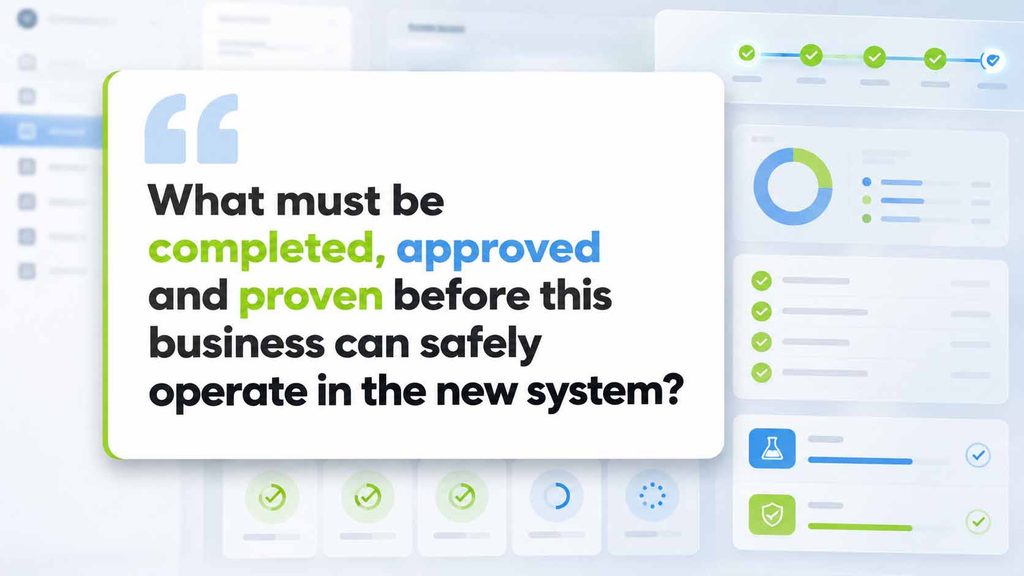
The more useful question is :
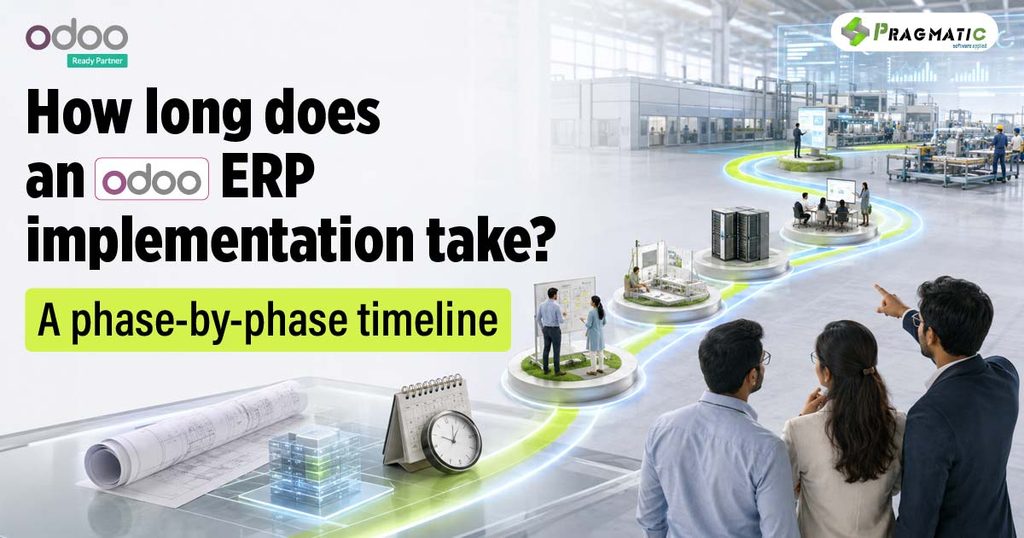
The timeline should be built around six phases. Some activities can overlap, but none should be skipped.
Phase 1 – Discovery and process alignment
Discovery establishes what is being implemented and why.
The partner should meet process owners, review current systems and follow complete business journeys. For a manufacturer, that might begin with a customer order and continue through planning, procurement, production, quality, dispatch, invoicing and margin review.
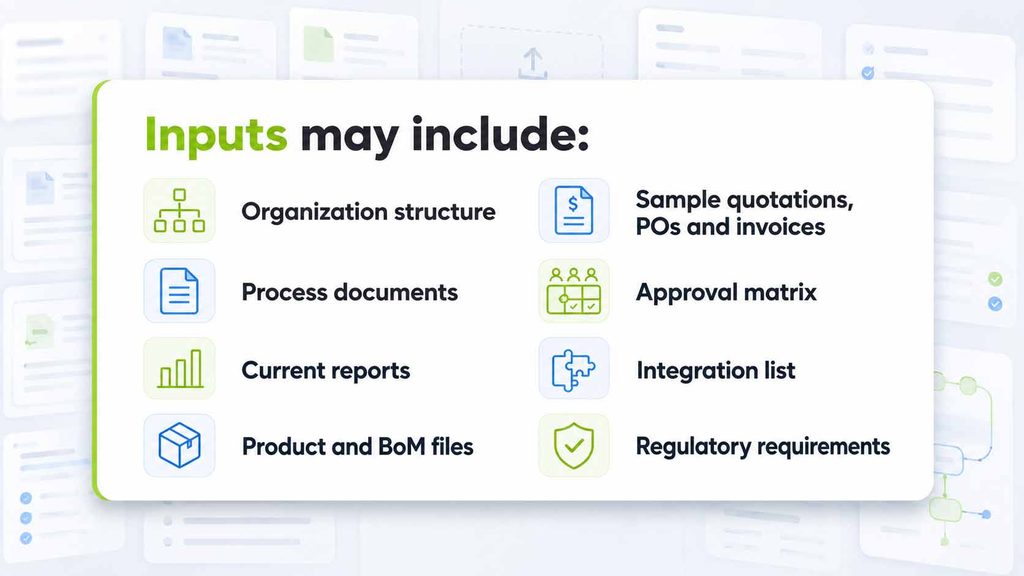
The output should include agreed processes, priorities, major gaps, decision owners and an initial risk view.
A rushed discovery can make the project look faster at the beginning while making every later phase slower.
Phase 2 : Solution design and scope confirmation
During solution design, the team translates business requirements into Odoo workflows.
Every requirement should fall into one of five categories
1. Standard Odoo capability
2. Standard configuration with process change
3. Third-party or Pragmatic application
4. Custom development or integration
5. Deferred or rejected requirement
This is where difficult questions should be answered.
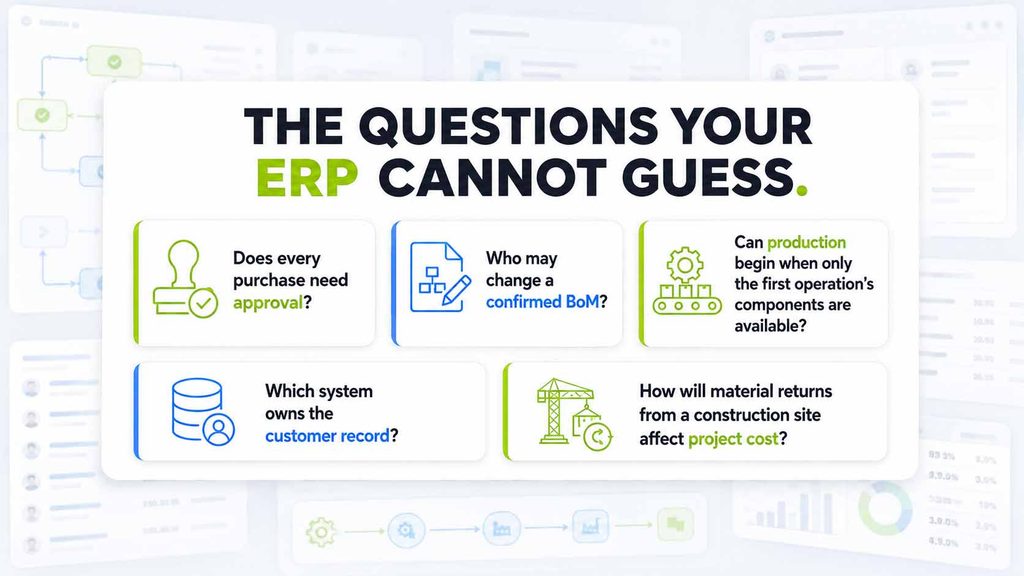
The design should be demonstrated with representative scenarios before extensive development begins.
Phase 3 : Configuration, development and integration
Configuration sets up companies, users, roles, products, taxes, warehouses, routes, work centres, accounting and process options.
Development extends the system where justified. Integrations connect external platforms and services.
This phase should be delivered incrementally. Regular demonstrations allow process owners to see working flows and clarify decisions while changes are still manageable.
For manufacturing, Odoo 19 can support BoMs, manufacturing orders, work centres, operation dependencies, Shop Floor time tracking, quality checks, maintenance and production costs. The implementation team still needs to configure these capabilities according to the operating model.
For integrations, a technically complete connection is not enough. The team must test failures, duplicate prevention, retries, mapping changes and monitoring.
Phase 4 : Data migration and validation
Data work should begin early, not after configuration is finished.
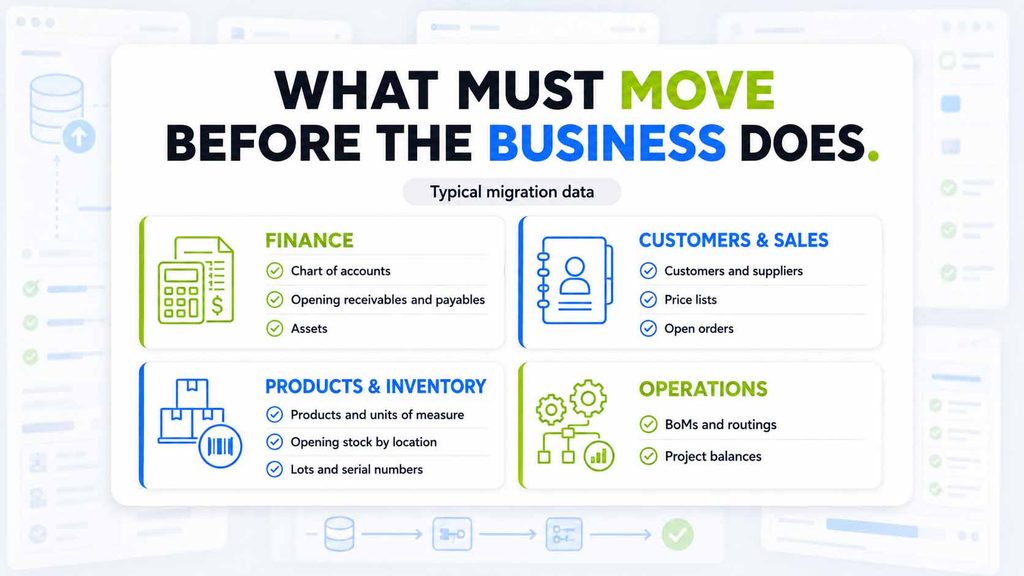
The migration cycle usually includes extraction, cleansing, mapping, test loading, user validation, correction and final loading.
Each data set needs a business owner. Consultants can provide templates and validation rules, but only the customer can confirm whether a duplicate supplier should be merged or which BoM is current.
Reconciliation is essential. A migration is not complete because the file uploaded successfully. Totals, quantities and balances must agree.
Phase 5 : Testing and training
Testing should cover end-to-end scenarios, exceptions, permissions and integrations.
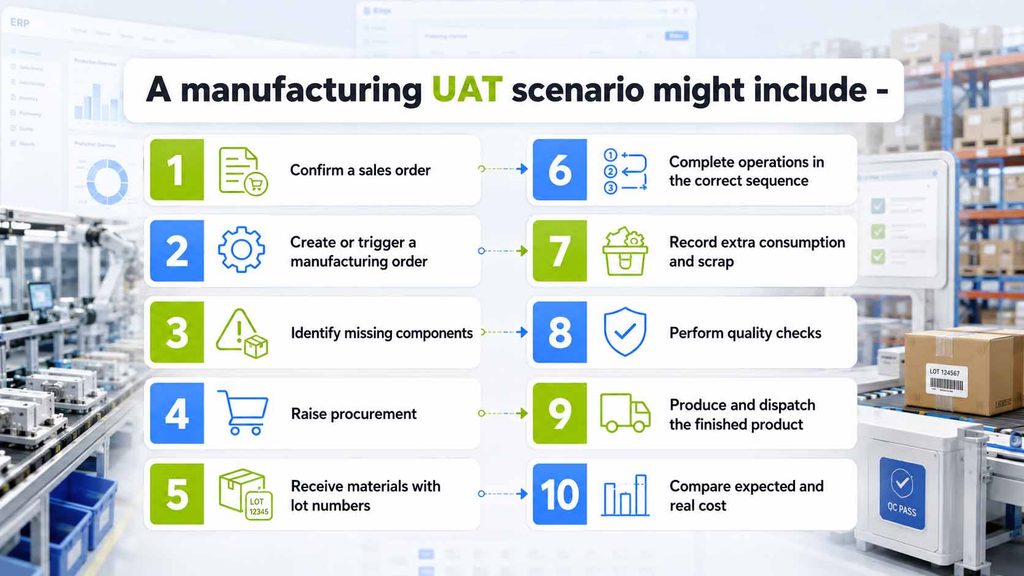
Training should follow these same journeys. Users understand systems better when learning is connected to the work they perform.
One demonstration to a crowded room is rarely enough. Use role-based sessions, guided practice and key-user ownership.
Phase 6 : Cutover, go-live and stabilization
Cutover moves the business from the old operating environment to Odoo.
The plan should define :
🎯 Final transaction date in the legacy system
🎯 Data freeze and extraction
🎯 Final migration
🎯 Stock and accounting reconciliation
🎯 Open order treatment
🎯 User access activation
🎯 Go-live communication
🎯 On-site or remote support coverage
🎯 Issue priorities and escalation
During stabilization, the team should separate four types of issues :
1. System defect
2. Incorrect configuration or data
3. User misunderstanding
4. New requirement
Treating every concern as a bug creates confusion and prevents the team from solving the right problem.
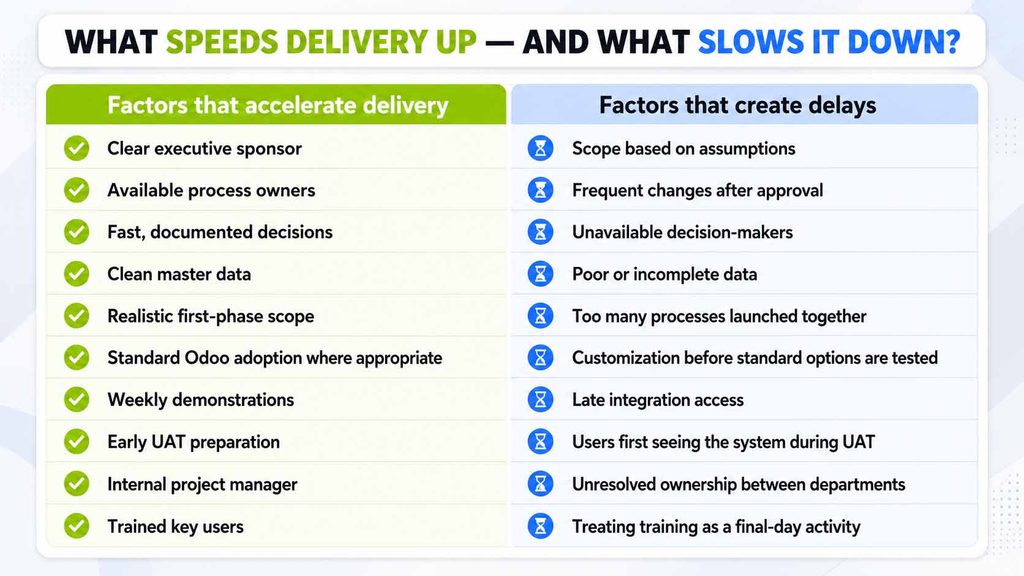
What makes implementation faster or slower
The software is often ready before the organization is.
Sample timelines for three types of business
These examples are indicative and should not be treated as fixed commitments.
- Standard distribution or service business
A focused rollout involving sales, purchase, inventory, accounting and clean data may be planned across approximately three to four months.
- Mid-sized manufacturing business
A rollout involving BoMs, work centres, quality, maintenance, batch tracking, costing and multiple departments may need approximately five to eight months, depending on data and customization.
- Multi-company or highly integrated business
A programme involving several entities, large migrations, external systems and industry-specific extensions may be planned in phases across eight to twelve months or more.
The calendar duration can shorten or expand. The essential point is to connect each date to deliverables and customer responsibilities.
Speed comes from readiness
A fast implementation is not one that skips discovery, compresses testing or carries unresolved decisions into go-live.
It is one where the business is ready to make decisions, provide clean data, test realistic scenarios and adopt a controlled first-phase scope.
At Pragmatic Techsoft, we do more than configure Odoo modules. We study how the business actually operates, design the right workflows, manage data migration, develop necessary customizations and integrations, train users and support the transition through go-live and stabilization.
With 17+ years of Odoo experience, 400+ implementations and customers across 50+ countries, we understand where ERP timelines commonly break down. For manufacturing businesses, that means paying close attention to BoMs, routings, procurement, batch traceability, shop-floor operations, quality, costing and finance as one connected process.
Odoo provides the flexibility to move quickly. Our role is to ensure that speed does not come at the cost of operational readiness.
If your organization has a target go-live date, Pragmatic Techsoft can work backwards from that date to assess scope, readiness, dependencies and delivery risk before the commitment is made.
Frequently asked questions
1. Can Odoo be implemented in three months?
Yes, for some focused projects with clear scope, standard workflows, available users and clean data. It is not a responsible default promise for every company.
2. Why do manufacturing implementations take longer?
Manufacturing connects product data, BoMs, routings, inventory, procurement, shop-floor execution, quality, costing and finance. Data and process accuracy are therefore more demanding.
3. Can phases overlap?
Yes. Data cleansing can begin during design and training preparation can begin during configuration. However, dependencies must be managed carefully.
4. Should accounting go live before operations?
It depends on the architecture and business priorities. The team should avoid creating a phase that requires heavy manual reconciliation between systems for an extended period.
5. What is the customer’s biggest responsibility?
Providing available process owners who can make decisions, prepare data, test complete scenarios and support user adoption.
6. What happens if the deadline cannot move?
Reduce or phase scope, increase decision availability and protect critical testing. Do not simply remove the activities that prove the system is ready.