
Why two Odoo quotations can be completely different
One Odoo partner submits a surprisingly lean proposal.
Another comes back at more than twice the amount.
A third refuses to confirm a final price until discovery is complete.
Which one is correct?
Possibly all three. They may not be pricing the same project.
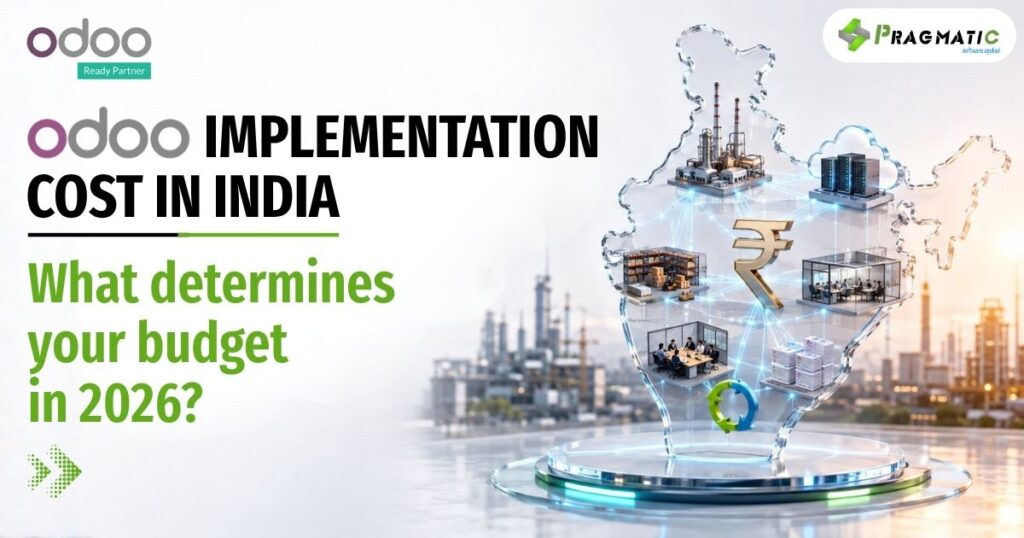
Odoo implementation cost in India varies because every quotation reflects different assumptions. One may include discovery, migration, training and go-live support. Another may cover basic configuration and leave data, testing and adoption with the customer.
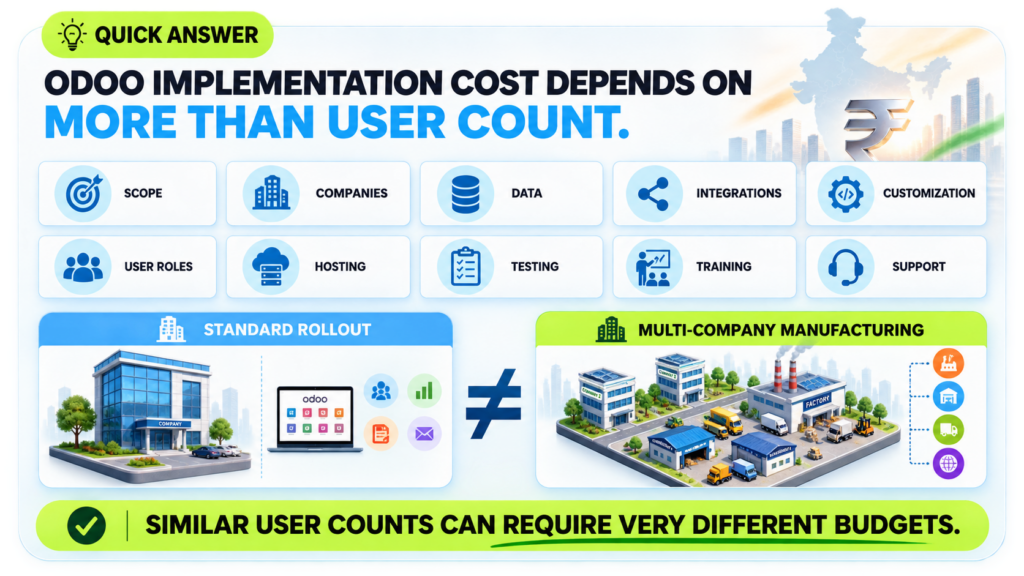
The most useful question is therefore not, “What does Odoo cost?”
💡It is “What will it take to make Odoo work reliably for our business?”
That question matters more in 2026 as businesses seek connected ecommerce, WhatsApp, AI assistance, bank integrations, manufacturing traceability, mobile operations and consolidated multi-company reporting.
Every new connection creates value and increases the need for careful design, reliable data and testing.
This guide explains the factors behind an Odoo implementation, helping growing Indian companies evaluate proposals without being misled by a low entry price or an unnecessarily heavy solution.
Software subscription is only one part of the investment
Odoo’s software subscription and the work required to implement it are separate cost categories.
The subscription depends on the applicable plan, number of users and commercial terms. Requirements involving custom applications, external APIs, multiple companies or specialized hosting can also influence the appropriate plan and architecture.
Because pricing can change by geography and contract period, buyers should verify terms on the official Odoo pricing page before budgeting.
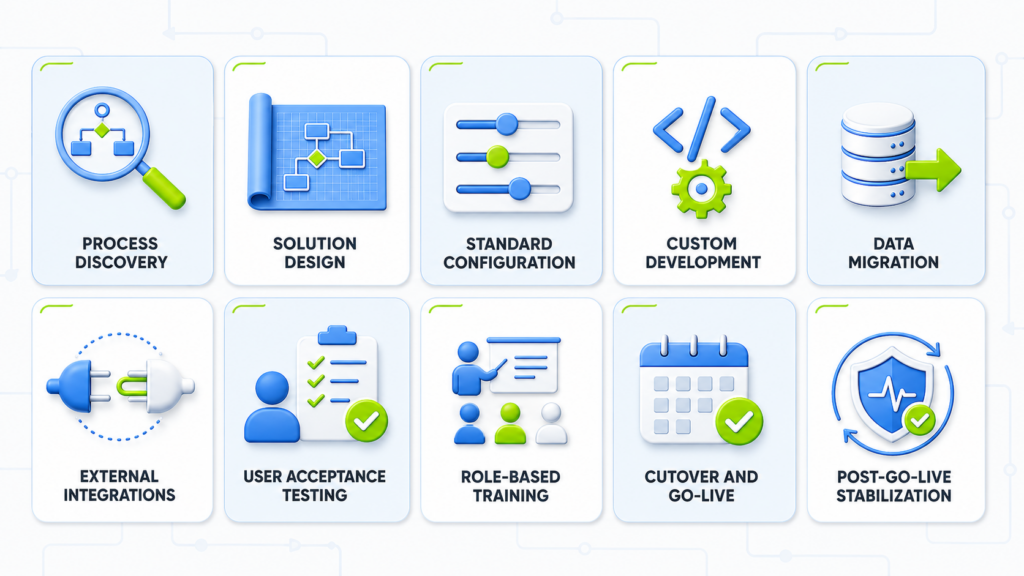
Implementation covers the work required to turn the platform into a usable operating system.
Depending on the project, this can include –
Then there are internal costs.
Employees must attend workshops, prepare data, validate workflows, test realistic scenarios and support adoption. These hours rarely appear in a vendor quotation, but they are still part of the investment.
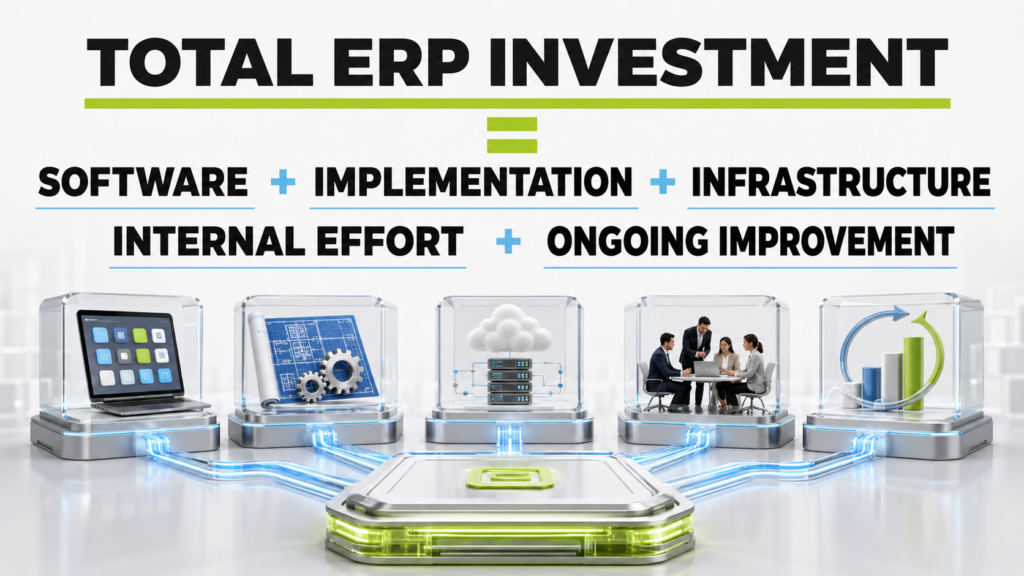
A proposal that covers only software and initial configuration may appear cheaper because several other responsibilities have been left with the customer or postponed until later.
Why Indian ERP buyers often compare the wrong number
Indian ERP buyers are not simply price-sensitive. They are strongly value-conscious and want every rupee to be justified. These behaviours are not unique to India, but negotiated procurement, layered approvals and pressure for early budget certainty can make them especially influential.
1) The first quotation becomes the benchmark
The first credible number often becomes the reference point for every proposal that follows. A more detailed quotation may feel expensive before anyone checks whether it includes more discovery, migration, testing, training or support.
2) Buyers want certainty before the scope is certain
A fixed price feels safer, but fixing it before clarifying the process does not remove uncertainty. It can move that uncertainty into exclusions, change requests or reduced delivery depth. A partner that requests discovery before confirming scope may be giving the more responsible answer.
3) Negotiation can reduce the price without reducing the expectation
Commercial negotiation is normal. The risk begins when the price falls but the expected outcome does not. Fewer workshops, limited migration, reduced testing, shorter training or less support may absorb the reduction. If that trade-off is not documented, the saving exists only on paper.
4) Customization can be mistaken for additional value
Additional development is not automatically an additional value. When standard Odoo supports the required outcome, using it well is usually safer than recreating every spreadsheet rule through code. Unnecessary customization adds testing, maintenance and future upgrade responsibility.
5) Internal business effort is treated as free
Management time, employee workshops, data preparation and delayed decisions are rarely assigned a cost. A cheaper implementation that creates repeated clarification, rework and parallel spreadsheets may consume more internal effort than a better-managed project.
6) The lower proposal is often easier to approve
A process owner may know that a detailed proposal is safer but struggle to justify it to management. That is why proposals should be presented as a breakdown of scope, assumptions and risk, not one total. The objective is not to choose the most expensive partner. It is to understand what each price includes and which responsibilities remain with the customer.
A low price is valuable only when the scope behind it is equally clear.
The nine factors that shape an Odoo implementation budget
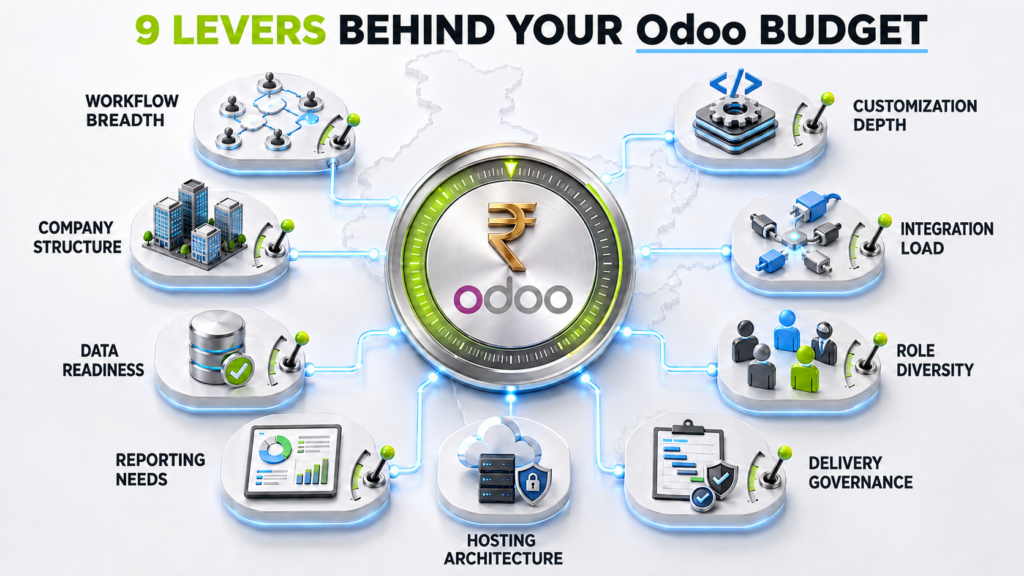
1. Business-process scope
Implementing CRM and sales is different from connecting sales, purchasing, inventory, manufacturing, quality, maintenance and accounting.
Count complete processes, not only applications. A manufacturing journey can cross sales, purchasing, production, quality, inventory, costing and finance. More exceptions, approvals and handovers require more discovery, configuration and testing.
2. Number and complexity of companies
A group may require separate taxes, warehouses, charts of accounts, currencies, approvals and access rights, plus consolidated visibility. Intercompany transactions, shared products, centralized purchasing and data security make multi-company design more than a simple switch.
3. Standard configuration versus customization
Configuration uses options already available in Odoo. Customization extends behaviour through code, Studio or third-party applications. Specialized workflows such as BOQ control, RA billing, quality documentation or complex commissions increase effort. The goal should be justified customization that remains supportable during upgrades.
4. Data migration
Migration effort depends on :
- Source systems and data quality
- Master records and transaction history
- Attachments and opening balances
- Lot, serial and stock information
- Cleansing, trial loads and reconciliation
Moving thousands of clean records may be simpler than moving a smaller database filled with duplicates and missing details. Migration needs data owners, trial loads, validation and reconciliation.
5. Integrations
Integrations may connect ecommerce, payments, banks, logistics, marketplaces, equipment, CRM, WhatsApp or custom portals. Each connection requires decisions about ownership, direction, frequency, mapping, security, errors and duplicates. Real-time, bidirectional synchronization normally needs more design and testing than scheduled one-way exchange.
External API requirements can also affect the applicable Odoo plan. Odoo’s current external API documentation states that API access is available on Custom plans rather than One App Free or Standard plans.
6. Reporting and analytics
Standard reports may cover much of the requirement. Specialized dashboards, statutory formats and consolidated reporting increase effort. Before requesting a report, define the decision it supports; some “must-have” reports are inherited spreadsheet habits.
7. User count and role diversity
User count affects subscription cost, but role diversity affects implementation effort. Fifty similar sales users may be simpler to support than twenty users across production, quality, warehouse, finance and management. Each role needs suitable access, scenarios and training.
8. Hosting and technical architecture
Odoo Online, Odoo.sh and on-premise deployment provide different levels of customization and control. Odoo’s version 19 hosting documentation states that Odoo Online is not compatible with non-standard apps. Infrastructure planning should also cover backups, environments, monitoring, security and maintenance.
9. Project governance and support
Project management, documented decisions, demonstrations, risk reviews and go-live planning add visible cost. Their absence creates invisible risk. Buyers should also define stabilization, bug handling, response expectations and the ongoing support model.
Three implementation scenarios that show why scope matters
These examples are not quotations or price benchmarks. They show why company size or user count alone cannot determine an implementation budget.
Scenario A – Distribution company with standard workflows
The company has one legal entity, two warehouses and around twenty users. It needs CRM, sales, purchasing, inventory, accounting and basic dashboards. Migration covers master data, opening stock and accounting balances, with no major external integration. Most requirements fit standard Odoo.
Scenario B – Mid-sized manufacturer
The manufacturer has one plant and four warehouses. It needs multi-level BoMs, work centres, quality, maintenance, batch traceability, shop-floor tracking, purchasing, costing and finance. It must also migrate production and inventory data. A similar user count does not make it comparable with Scenario A because its operational dependencies are much deeper.
Scenario C – Multi-company manufacturer with integrations
The group operates three companies, several warehouses and two production facilities. It needs ecommerce, intercompany workflows, consolidated reporting, approval matrices and logistics integration. More architecture decisions, test cycles and stakeholder coordination make it fundamentally different from a standard rollout.
Hidden costs buyers often miss
🔻Poor master data
Cleaning products, units of measure, vendors and BoMs can take longer than expected. Loading poor data simply transfers old confusion into the new ERP.
🔻Parallel systems
Running old and new systems together may be necessary briefly, but extended parallel operation increases effort and reconciliation problems.
🔻Unavailable decision-makers
Delayed approvals hold up configuration and testing while the implementation team remains allocated.
🔻Late requirements
A requirement discovered during final testing costs more because design, development and testing may need to be repeated.
🔻Underestimated adoption
Users involved too late may resist the process or rebuild old spreadsheets, creating retraining and rework.
🔻Upgrade impact
Poor customization increases future upgrade effort. Evaluate maintainability, not only immediate build cost.
How to compare Odoo proposals fairly
A proper proposal comparison should examine the assumptions behind each total.
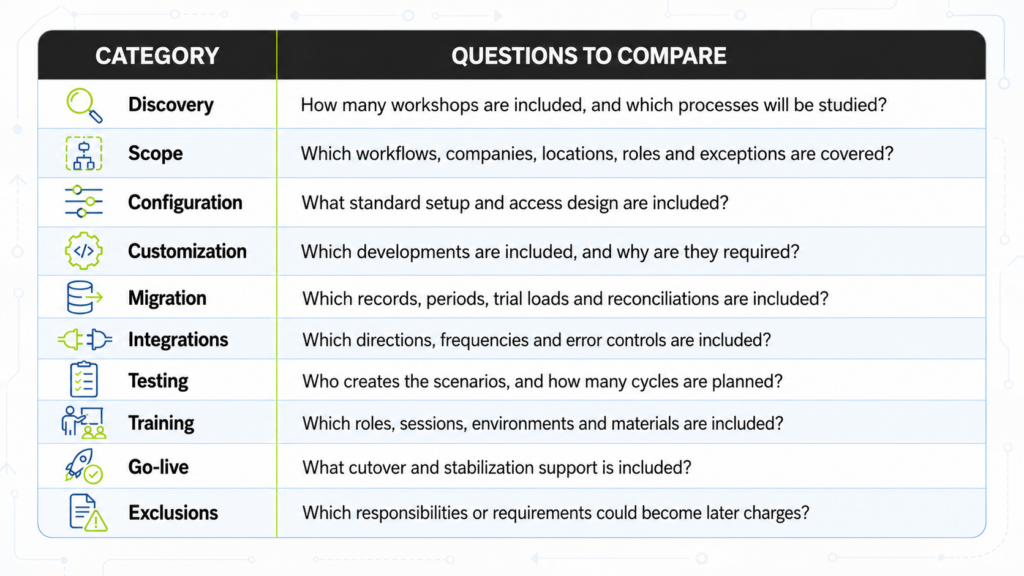
Do not compare a discovery-led implementation with a limited configuration package as though they are identical products.
Ask every shortlisted partner to respond to the same workflows, data volumes, integrations and decision criteria. This creates a fairer commercial comparison and exposes where a lower proposal is based on narrower assumptions.
How to control cost without damaging the implementation
1) Start with priority workflows
Implement the processes that protect revenue, cost, inventory, compliance or customer delivery before adding convenience features.
2) Adopt standard Odoo where it fits
Every inherited spreadsheet rule does not deserve custom development. Simplifying the process can reduce both implementation and long-term maintenance costs.
3) Prepare data early
Assign owners for customers, products, accounts, suppliers, bills of materials and opening balances. Do not wait until configuration is almost complete.
4) Use phased delivery when the scope is large
A controlled first phase is safer than trying to launch every company, integration and function simultaneously. Each phase should still deliver a complete, usable business process.
5) Freeze decisions at agreed milestones
Continuous changes prevent stable testing and make effort difficult to control. Document decisions, owners and acceptance criteria.
6) Train internal champions
Key users reduce dependence on the implementation partner and help colleagues adopt the system after go-live.
7) Invest in discovery
Time spent clarifying workflows, data and responsibilities before configuration is usually cheaper than correcting a misunderstood requirement after development.
Controlling cost does not mean removing governance, migration trials, testing or training. It means directing the available budget toward the processes that create the most operational value.
Buy clarity before buying configuration
There is no responsible universal answer to “What should an Odoo implementation cost?” without understanding the business processes, data, integrations, companies, controls and expected outcomes.
The lowest proposal may represent an efficient standard implementation. It may also represent missing scope. A higher proposal may reflect genuine complexity, or it may be unnecessarily heavy. Only a transparent breakdown allows the buyer to tell the difference.
A good implementation budget does not pay for more screens. It pays for fewer operational gaps, better decisions and a system the business can actually use.
Implementation is a project, not a purchase. The budget should reflect the complete path from today’s operation to an adopted, supportable system.
Pragmatic Techsoft has worked with Odoo since version 4 and supports implementations, customizations, integrations and industry-specific solutions across global markets.
If you are evaluating Odoo, request an Odoo Fit and Scope Assessment before committing to a final implementation scope.
Frequently asked questions
1. Does the Odoo subscription include implementation?
No. The software subscription and implementation services are separate. Confirm the latest plan, user pricing and applicable commercial terms directly with Odoo or your implementation partner.
2. Why might a partner avoid giving a fixed price immediately?
A responsible partner may need discovery before fixing the price because process complexity, data, integrations, custom requirements and company structure materially affect the effort.
3. Is customization always expensive?
Not necessarily. A small, clearly defined extension can create significant value. Cost and risk increase when customization is broad, poorly specified or changes core behaviour unnecessarily.
4. Can we implement one department first?
Yes, but dependencies must be considered. Manufacturing, for example, relies on accurate products, inventory, purchasing and accounting design. A phase should deliver a complete working process rather than an isolated application.
5. How should we budget for support?
Support needs depend on the number of users, custom applications, integrations, service expectations and release frequency. Ask for a defined stabilization period followed by a clearly separated ongoing support model.
6. Can Odoo Online be used with custom modules?
Odoo’s current version 19 documentation states that Odoo Online is not compatible with non-standard apps. Custom module or third-party application requirements should therefore be considered when selecting the hosting approach.