
The proposal is not the implementation
The presentation was polished.
The demonstration looked effortless.
Every question received a confident yes.
Then the implementation began.
Three months later, the customer discovered that the sales process had been demonstrated, but not properly mapped. Manufacturing required more customization than expected. Historic data was still sitting in spreadsheets. Department heads disagreed on approvals. Employees had been shown screens, but nobody had helped them understand the new way of working.
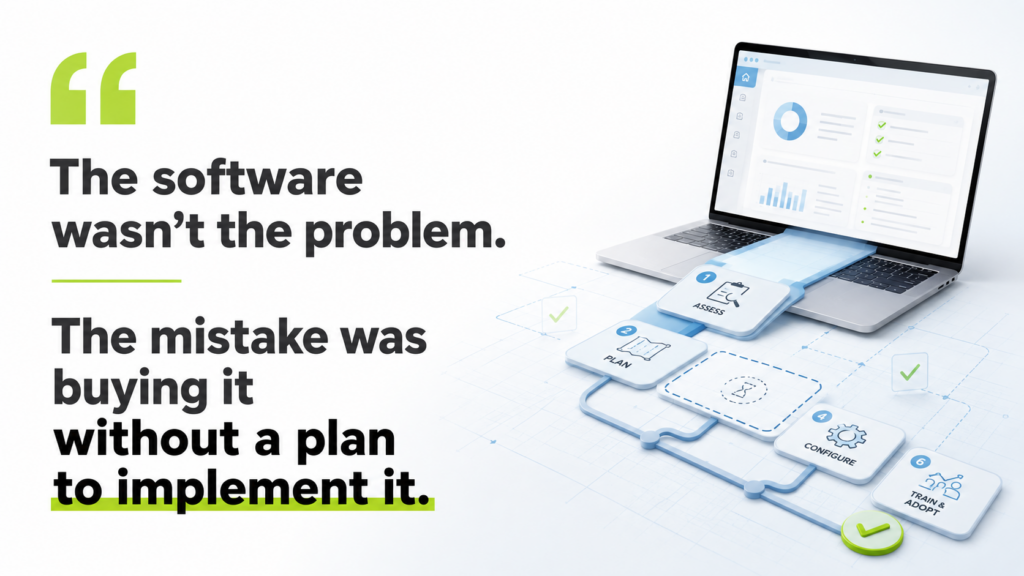
This distinction matters when choosing an Odoo implementation partner.
Odoo can connect sales, purchasing, inventory, manufacturing, projects, accounting, service and many other functions. But an integrated system only creates value when the business processes underneath it have been understood, challenged and designed correctly.
The right partner does not begin by asking which apps you want.
💡The right partner begins by understanding how an inquiry becomes an order, how an order creates operational demand, how costs are captured, where decisions are delayed and which controls cannot be compromised.
In 2026, this choice is becoming even more important. Businesses are adopting AI, automation, connected shop-floor tools and more complex integrations. That makes the ERP foundation more valuable, but it also makes poorly designed foundations more expensive to correct.
Why choosing an Odoo partner matters more in 2026
ERP buyers today are not simply replacing accounting software. They are trying to connect operations that have grown across spreadsheets, messaging apps, department-specific systems and individual employee knowledge.
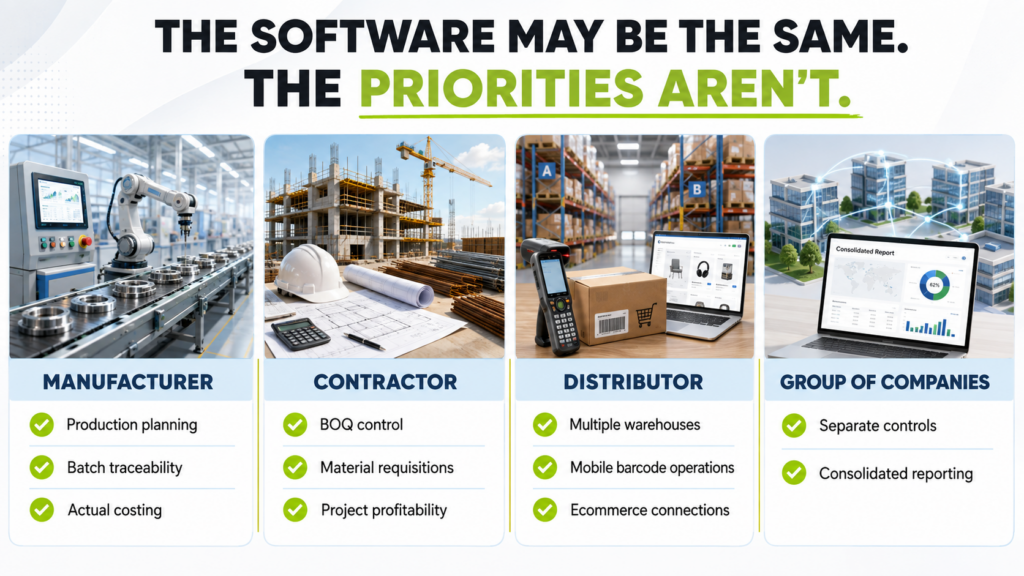
These requirements cannot be evaluated through a generic demonstration alone.
Odoo 19 provides a broad functional foundation, including manufacturing orders, bills of materials, work centres, shop-floor time tracking, projects, analytic accounting, inventory, quality, maintenance and integrations.
The implementation partner must determine how these capabilities fit the customer’s real process and where configuration, process change, third-party applications or custom development are justified.
That is why partner selection is not merely a technical procurement exercise. It is a decision about who will translate the business into a working operating model.
What an implementation partner should actually do
A capable implementation partner should perform five jobs.
1. It should understand the business🎯
This includes process discovery, stakeholder interviews, current-system analysis, pain-point validation and clarification of what success looks like.
2. It should design the solution🎯
That means mapping the future workflow, identifying standard Odoo capabilities, documenting gaps and deciding which requests should be configured, customized, integrated or rejected.
3. It should manage delivery🎯
A good partner controls scope, priorities, dependencies, testing, data migration, decisions and risks. It does not leave the customer to coordinate multiple functional and technical teams alone.
4. It should prepare users🎯
Training should be role-based and connected to daily work. A warehouse operator does not need the same training as a finance controller. A project manager does not need the same training as a procurement executive.
5. It should stay accountable after go-live🎯
Stabilization, issue triage, adoption reviews and controlled improvements are part of implementation success.
Fifteen questions to ask before signing
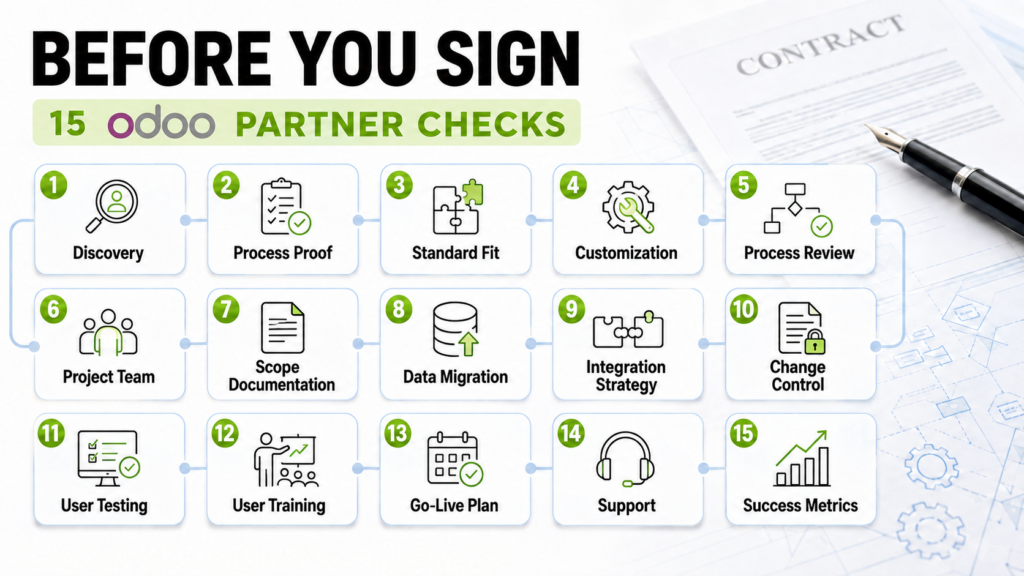
1. What happens before you prepare the final scope?
Listen carefully to the answer. A partner should discuss discovery workshops, process mapping, stakeholder interviews, sample documents and data review. If the final scope is based mainly on a demonstration call, important complexity is probably being postponed rather than resolved.
2. Have you implemented Odoo in our type of operation?
Do not ask only whether the partner has worked in your industry. Ask what it implemented. A logo does not prove process depth. Request examples of workflows, such as production scheduling, subcontracting, construction billing, landed cost, batch recall or multi-company approvals.
3. Which requirements can standard Odoo handle today?
The answer should be specific. The partner should explain what Odoo 19 provides natively and what depends on configuration. This helps prevent standard capability from being sold as custom development.
4. Where do you expect customization?
Customization is not automatically bad. Uncontrolled customization is. Ask why every proposed extension is required, what standard alternative was considered and how the change will affect future upgrades.
5. How will you challenge our existing process?
An ERP should not reproduce every spreadsheet habit. A strong consultant will identify duplicate approvals, unnecessary data entry and controls that exist only because the current systems are disconnected.
6. Who will be assigned to the project?
Ask for named roles, not only company credentials. You need to know who will lead discovery, configure the solution, develop extensions, manage data, coordinate testing and support go-live.
7. How will scope decisions be documented?
Requirements should connect to agreed workflows, acceptance criteria and owners. If scope is captured through scattered messages and meeting memory, disagreement is almost guaranteed later.
8. How will data migration be handled?
Ask which data will move, who cleans it, how it will be mapped, how many trial migrations will occur and how balances or stock will be reconciled. Migration is a business workstream, not a final-week technical upload.
9. What is your approach to integrations?
For every external system, ask who owns the API, how errors are logged, what happens during downtime, how duplicates are prevented and which system remains the source of truth.
10. How do you manage change requests?
There should be a clear process for documenting the request, assessing impact, estimating effort, approving the change and updating the plan. “We will handle it later” is not change control.
11. What does user acceptance testing look like?
Good UAT is scenario-based. Users should test complete journeys using realistic data, exceptions and approvals. Clicking through isolated screens is not enough.
12. How will users be trained?
Look for role-based training, process guides, practice environments, recordings and support for key users. Training should explain decisions and responsibilities, not only which button to press.
13. What happens during go-live?
Ask about cutover planning, final migration, opening balances, stock freeze, issue ownership, escalation and daily stabilization reviews. The partner should know who does what, and when.
14. What support is included after go-live?
Clarify duration, service hours, response expectations, bug definitions, enhancement handling and the transition from project support to ongoing support.
15. How will we know the implementation succeeded?
Success should be connected to business outcomes. Examples include reduced manual entries, faster order release, more reliable delivery commitments, improved inventory accuracy, earlier cost visibility or fewer approval follow-ups.
Warning signs hidden inside a convincing proposal
Be cautious when a partner :
🚩Quotes a complex implementation without sufficient discovery
🚩Say yes to every requirement without discussing trade-offs
🚩Talks mainly about screens and modules, not business scenarios
🚩Cannot explain standard Odoo versus custom functionality
🚩Treats data migration as the customer’s problem alone
🚩Has no clear UAT or cutover method
🚩Promises an aggressive timeline without stating dependencies
🚩Provides a low initial estimate with vague exclusions
🚩Cannot show relevant project experience or working applications
🚩Focuses on go-live but not adoption
These signs do not always mean the partner is incapable. They mean more evidence is required before the decision is safe.
A practical partner evaluation scorecard
Score each potential partner from one to five across the following areas –
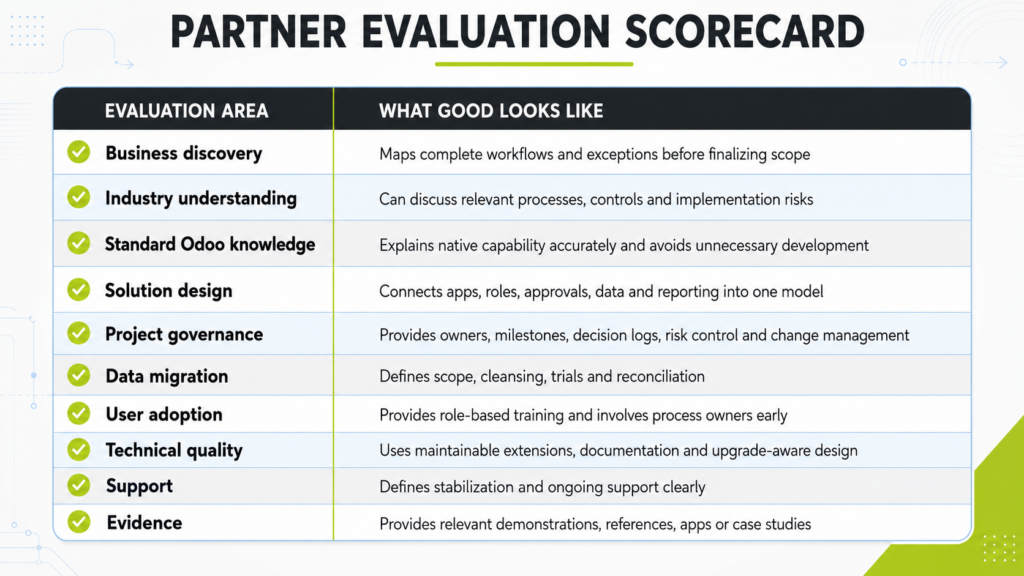
The score should not replace judgement.
It prevents an attractive demo or low price from becoming the only decision criterion.
Why the cheapest proposal can become the costliest decision
Imagine two proposals.
🔺Partner A quotes ₹18 lakh.
🔺Partner B quotes ₹25 lakh.
Partner A appears cheaper by ₹7 lakh.
During delivery, however, the first partner discovers missing integrations, underestimates migration and builds workarounds around unclear requirements. The project extends, users continue running parallel spreadsheets and additional changes cost another ₹12 lakh. Management time and delayed benefits add more invisible cost.
The second partner may not always be better.
But comparing proposals only by initial price ignores the cost of ambiguity.
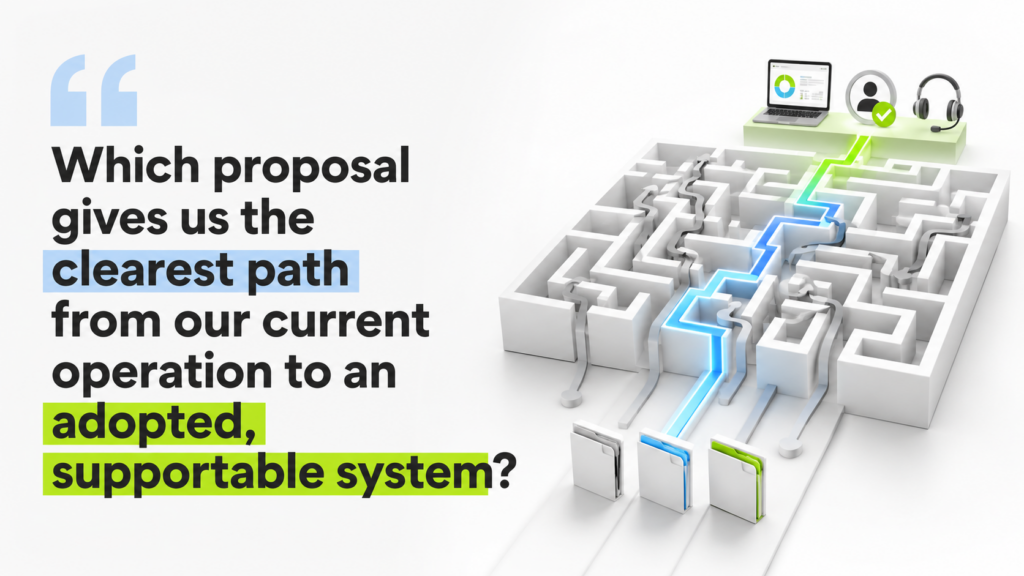
The better question is –
Choose for operational understanding
Odoo is flexible. That flexibility is valuable only when decisions are disciplined.
The best implementation partner is not necessarily the company with the longest feature list, the lowest rate or the most polished demonstration. It is the partner that understands how your business actually runs, explains trade-offs honestly and turns complex requirements into a controlled implementation.
Implementation is a project, not a purchase. Choose the people you trust to make the project correct the first time.
Pragmatic Techsoft has worked with Odoo since version 4 and supports implementations, customizations, integrations and industry-specific solutions across global markets.
If you are evaluating Odoo, request an Odoo Fit Assessment before committing to scope.
Frequently asked questions
1. Should I choose an official Odoo partner?
Partner status can be a useful signal, but it should not replace due diligence. Evaluate industry experience, assigned consultants, implementation method, references, technical capability and post-go-live support.
2. Is a local Odoo partner always better than an offshore partner?
Not necessarily. Location matters for workshops, language, time zones and regulatory understanding, but capability and governance matter more. Many successful projects use blended local and remote delivery.
3. How many partners should we evaluate?
Three serious proposals are usually more useful than ten superficial quotations. Give shortlisted partners the same scenarios, documents and decision criteria.
4. Should the partner customize Odoo to match our current process?
Only where the requirement creates genuine business value or meets an essential control. Existing processes should first be challenged, simplified and compared with standard Odoo.
5. What proof should we request?
Ask for a relevant workflow demonstration, a similar case study, customer references where available, sample project governance documents and an explanation of who will actually work on the project.
6. Who should participate in partner selection?
Include executive sponsorship, process owners, finance, operations, IT and representative end users. ERP decisions made by one department often create problems for everyone else.