

The margin inside the million-dirham bottle
Oud and perfume businesses in Dubai lose margin to three recurring problems – inconsistent unit-of-measure conversions between bulk raw material and finished bottles, unsecured formula data and disconnected sales channels.
Odoo ERP addresses all three with dual unit-of-measure tracking, permission-locked Bills of Materials and a single inventory system connected across wholesale, retail and e-commerce – while also giving businesses a path to UAE VAT, corporate tax and the incoming e-invoicing mandate. Let’s dive in and

A single bottle of well-aged, premium Oud oil can sell for a price that rivals a luxury watch. Behind that price sits a raw-material supply chain – agarwood sourced from regions like Assam or Cambodia, aged over years before it’s ever distilled – where a few milliliters can represent thousands of dirhams in value.
That kind of margin is easy to lose in the back office.
When ingredients are priced by the drop, an approximate
spreadsheet count or a manual unit conversion error isn’t a rounding issue – it’s a direct hit to profit.
As Dubai’s Oud and perfume brands scale from a single blending room to multi-channel, export-ready operations, many are moving off generic retail or accounting software and onto ERP systems built to handle this level of precision – most commonly Odoo.
Where fragrance houses lose money

1. The unit-of-measure problem
Raw agarwood and botanicals are typically purchased in bulk kilograms from suppliers in India, Cambodia, or Malaysia. The finished oil, however, is aged, blended and sold in Tola (11.66 grams), half-Tola or milliliter quantities.
When this conversion happens manually across departments – procurement in kilos, production in Tolas, retail in milliliters – small rounding differences compound into real inventory valuation errors.
2. Formula security
A fragrance house’s core asset is its blending formula. If that formula lives in a shared spreadsheet or an unsecured local file, it’s exposed to accidental edits, unauthorized copying or loss when an employee leaves.
3. Disconnected sales channels
A typical Dubai perfume business runs a wholesale warehouse (often in Al Quoz or Jebel Ali), boutique counters in the gold and perfume souks, a retail counter in a mall and an online store.
Without a shared inventory system, stock levels drift out of sync – leading to overselling or missed replenishment.
How Odoo handles perfume manufacturing
Odoo’s Inventory and Manufacturing modules are built to handle exactly this kind of precision, multi-unit, formula-sensitive production.
Here’s how the pieces map to the problems above.
1) Dual unit-of-measure tracking (Tola ↔ Kilo ↔ mL)
Odoo lets you configure a product with a purchase unit (kilogram) and a separate production or sales unit (Tola, half-Tola or milliliter).
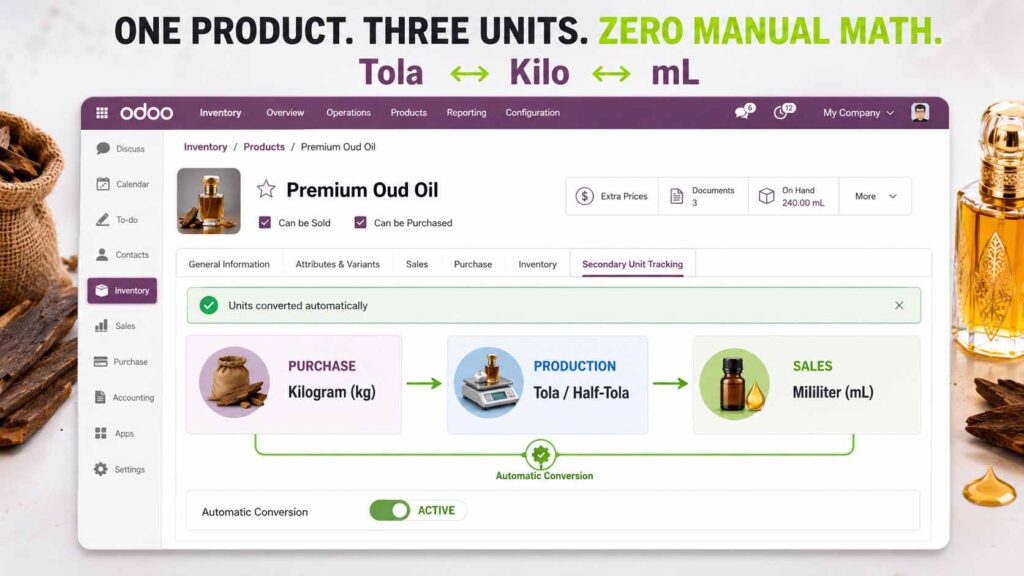
Raw material is logged in bulk on receipt; as it moves into production and finished goods, Odoo converts automatically between units, so nothing is left to manual math.
2) Formula protection through the Bill of Materials (BoM)
Odoo’s BoM stores the exact ratio of ingredients required for a batch and role-based access controls limit who can see it.
A production floor worker can be given visibility into the quantities needed for their specific work order without seeing the full master formula – that stays restricted to the roles you designate, such as a master perfumer or production manager. On top of this, Odoo calculates the landed cost per bottle by combining real-time raw material cost, packaging and labor.
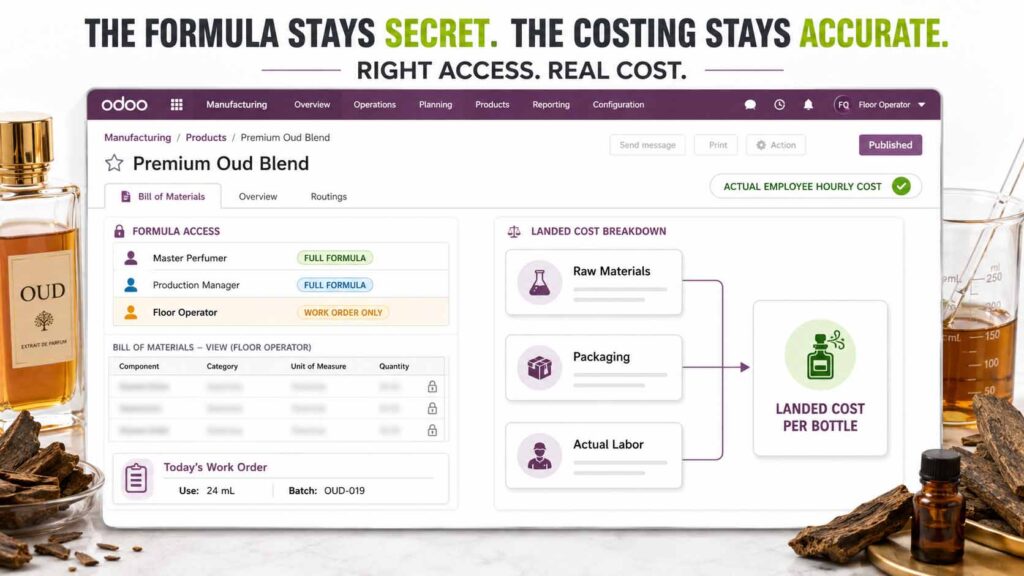
Odoo 19 specifically improved this further. Labor cost into a manufacturing order under FIFO or Average Cost (AVCO) valuation now pulls from the actual hourly cost of the employee logged against that operation, rather than a flat estimate – a meaningful improvement in cost accuracy for labor-intensive processes like hand-blending.
3) Batch, origin and maturation tracking
Aged Oud commands a premium the longer it matures and provenance (e.g., Assam vs. Koh Kong) affects both story and price.
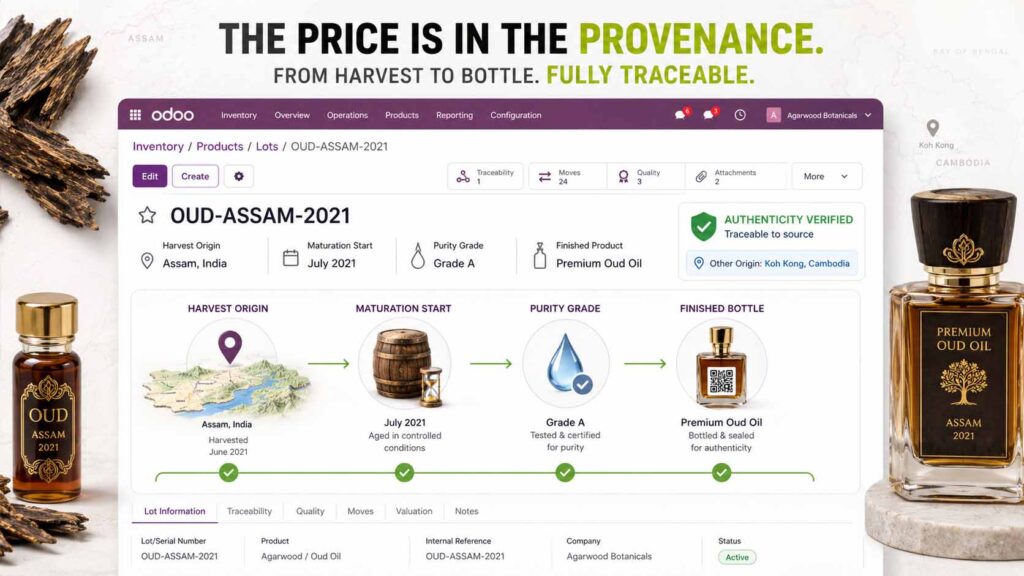
Odoo’s lot and serial number tracking lets you log a batch’s harvest origin, maturation start date, and purity grade, and trace it through to the finished bottle – useful for both internal costing and customer-facing authenticity claims.
4) One inventory system across all channels
Odoo’s Point of Sale, e-commerce and Sales modules read from the same stock records. A sale at a boutique counter, a wholesale order or an online checkout all decrement the same warehouse inventory in real time, and reordering rules can flag when raw materials are approaching a minimum threshold.
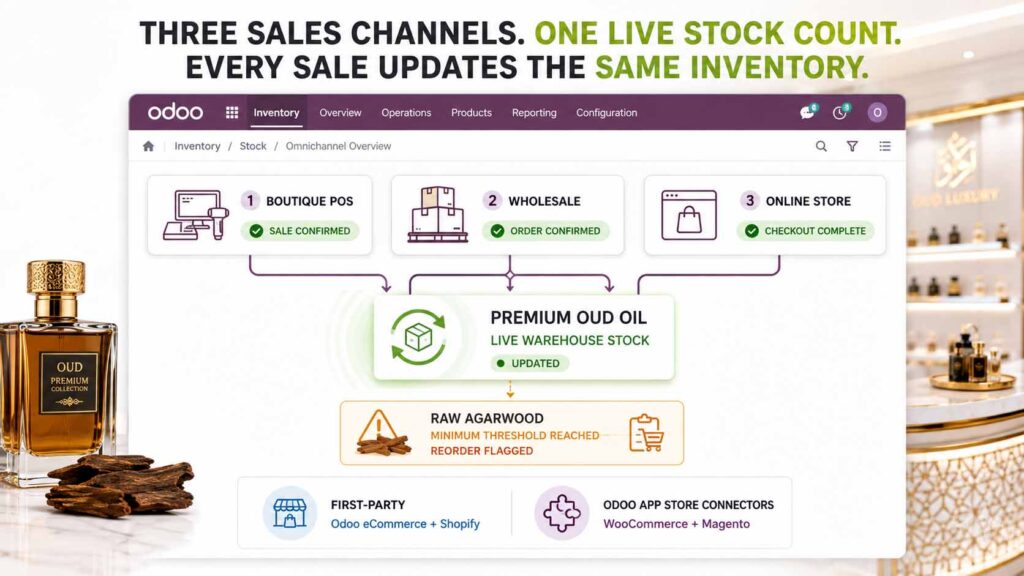
For online storefronts, Odoo has a first-party e-commerce app with a native Shopify integration; WooCommerce, Magento and other platforms connect through certified Odoo App Store modules rather than built-in core connectors – still a proven path, just worth knowing which is which when you’re evaluating implementation scope.
UAE tax and e-invoicing compliance for fragrance businesses
VAT and corporate tax, as they stand in 2026.
- Standard UAE VAT remains 5% on most goods and services.
- UAE corporate tax is 0% on taxable profit up to AED 375,000 and 9% above that threshold.
- Odoo’s Accounting module supports bilingual (Arabic/English) tax invoicing and can be configured to calculate VAT across wholesale, retail, and cross-border GCC sales and to generate the P&L and balance sheet data needed for corporate tax filing.
What’s new and time-sensitive : e-invoicing
This is the compliance shift most relevant to fragrance and perfume businesses right now and it isn’t optional for long :
- A voluntary e-invoicing pilot opened on July 1, 2026.
- Mandatory e-invoicing begins January 1, 2027 for businesses with annual revenue of AED 50 million or more (Accredited Service Provider appointment required by around October 30, 2026) and July 1, 2027 for smaller VAT-registered businesses.
- Under the mandate, a PDF, scanned copy or emailed invoice will not count as a valid e-invoice. Invoices must be issued in structured XML (the PINT AE / Peppol format), transmitted through an FTA-Accredited Service Provider and reported to the FTA in near real time.
- This applies to B2B and B2G transactions – relevant for any Oud or perfume house selling wholesale to retailers, distributors, or government-linked buyers, even if their consumer-facing retail sales aren’t yet in scope.
For a fragrance business already running Odoo for inventory and manufacturing, the same Accounting module is also where e-invoicing readiness gets built – which makes this a natural extension of the ERP conversation, not a separate project.
Working with Pragmatic Techsoft
Implementing this kind of system well requires an implementer who understands both the Odoo platform and the specific realities of perfume manufacturing – fractional units, formula sensitivity and regional compliance.
Pragmatic Techsoft is an Odoo implementation partner with 17 + years of Odoo expertise – based in India, with experience across manufacturing and multi-channel retail deployments and Odoo App Store development.
Working with an India-based team gives Dubai-based fragrance businesses access to certified Odoo implementation expertise, POS and e-commerce integration work, and UAE accounting localization, typically at a more competitive rate than a locally based consultancy – with project coordination handled through remote delivery and regular milestone syncs.
Where Pragmatic Techsoft can help –
- End-to-end Odoo implementation, from procurement through to point of sale
- Custom production workflows: dual UoM setup, BoM security, batch/maturation tracking
- POS and e-commerce integration across physical and online channels
- UAE accounting localization: VAT, corporate tax, and e-invoicing readiness
If your formulas, inventory, and margins are currently held together by spreadsheets and manual reconciliation, that’s a fixable problem – not a permanent cost of doing business. We’ve mapped out exactly how Tola-to-Kilo conversion, formula security and channel sync work inside Odoo because we’ve configured these workflows before.
A 30-minute conversation is usually enough to tell you where your current setup is leaking margin and what it would take to fix it.
👉 Book a free 30-minute Oud & Perfume ERP consultation.
Bring your current inventory process – we’ll show you specifically where Odoo tightens it.
FAQs
1) Can Odoo handle raw material price volatility for Oud? Yes. Odoo supports FIFO, Average Cost (AVCO), and Standard Price valuation methods, so when raw material costs shift, your finished-product costing updates to reflect the change rather than relying on a fixed estimate.
2) Are our formulas safe if Odoo is hosted in the cloud? Odoo supports encrypted communication (HTTPS) and role-based access permissions, and an implementation partner can configure access so only designated roles – such as a master perfumer – can view the full formula. Security ultimately depends on how access is configured during implementation, so this is worth specifying explicitly in your project scope.
3) We sell through wholesale, retail and an online store. Can Odoo unify all of this?
Yes. Odoo’s own e-commerce app connects natively and Shopify has a first-party Odoo connector; WooCommerce, Magento and similar platforms connect through certified Odoo App Store modules. All of them can share the same underlying inventory record, so stock stays consistent across channels.
4) Do we need to worry about e-invoicing yet?
If your annual revenue is under AED 50 million, mandatory e-invoicing applies from July 1, 2027 – but the voluntary pilot is already open and businesses selling B2B or to government entities should start preparing well before their mandatory date, since it requires structured XML invoicing through an Accredited Service Provider, not just a digital PDF.
5) How does working with an India-based implementer like Pragmatic Techsoft work for a Dubai-based business?
Delivery is remote, with milestone tracking and regular project syncs. The team works with UAE-specific compliance requirements (VAT, corporate tax, e-invoicing) as part of standard implementation scope.