
It usually starts as a pressure.
An ERP migration will rarely start as a plan.
Reports take longer to prepare.
Numbers need explanations before decisions can be made.
Teams depend on certain people because “they know how things work.” Founders step in more often than they’d like.
It’s not like there’s a panic scenario – everything is working fine. It’s just that everything takes a lot of additional effort.
And founders do what they’ve always done best.
They absorb that effort themselves. By constantly bridging the gaps and finding solutions, relaying things between departments and giving out orders with the added stress of “Was that implemented or not?”
Over time, they don’t just run the business. They become the system.
Across industries, regions and company sizes, the same conversations are surfacing.
Not because founders suddenly want new software – but because the gap between business reality and system capability is widening.
⚙️One major reason is tool fatigue.
Over the years, businesses added systems whenever new needs emerged: CRM, accounting, inventory, HR, project tools – all useful, all disconnected.
⚙️Another reason is the expectation shift.
Founders now expect real‑time visibility, not stitched‑together reports. They expect systems to support decisions, not slow them down.
⚙️And then there’s future readiness.
Whether it’s automation, analytics or AI, all modern capability depends on clean, connected data. Fragmented systems simply can’t support that.
ERP migration enters the discussion not because something failed – but because the business has moved faster than its systems.
There’s a belief many founders hold, often unconsciously –
“We’ll migrate once things stabilize.”
It sounds responsible. It sounds cautious.
But businesses don’t stabilize on their own.
Complexity compounds. Manual work becomes normal. Workarounds turn into dependencies.
The real danger is that the cost of waiting doesn’t show up as a single failure. It shows up as drag.
Migration gets delayed not because founders don’t see the problem – but because the cost of change feels visible, while the cost of delay stays hidden.
Founders delay migration to protect stability.
Ironically, delay creates instability in subtle ways –
By the time migration feels unavoidable, the business has already paid for waiting – just not in a single visible line item.
Migration done early feels strategic. Migration done late feels forced.
One of the biggest misconceptions about ERP migration is that it means starting over.
In reality, a well‑executed migration is about continuity.
It carries forward –
And it lets go of –
Migration is not about discarding the past.
It’s about making sure the foundation can support what comes next.
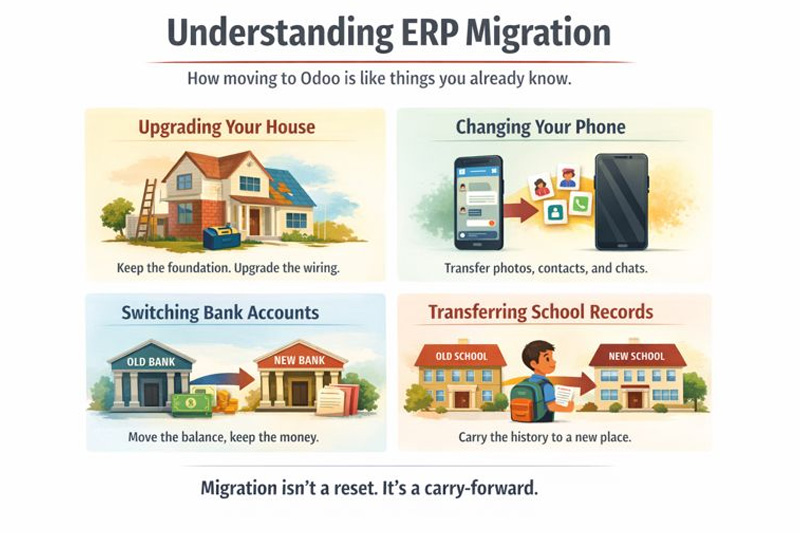
Founders don’t need technical explanations. They need familiarity.
Think of upgrading a house.
You don’t demolish it because the wiring is old. You upgrade the wiring so the house can handle modern needs.
Or changing a phone.
The device isn’t the value – your photos, contacts and conversations are.
Or switching banks.
Your money doesn’t disappear. Balances move. Statements remain.
ERP migration, when done right, should feel exactly like this – controlled, predictable and continuity‑driven.
Almost every ERP migration fits into one of these situations.
1. Legacy software to a modern ERP
Older ERPs or accounting tools become rigid, expensive to maintain and risky to upgrade. Migration here is about modernization without disruption.
2. No real system to a first ERP
Spreadsheets, emails, people’s memory, and aging accounting tools hold operations together. Migration here isn’t replacement – it’s professionalization.
3. Multiple tools to one integrated system
Nothing is broken, but nothing is connected. Migration here is about consolidation and control.
Different starting points. Same underlying tension.
Founders who handle migration well don’t start with software comparisons.
They start with questions :
ERP migration becomes a clarity exercise, not a tech upgrade.
The system follows the business intent – not the other way around.
At Pragmatic Techsoft, 17+ years of ERP work have reinforced one truth – migration succeeds when it reduces anxiety, not when it showcases technology.
Plan
Understand how the business actually runs. Audit data. Identify risk early.
Migrate
Execute in phases. Test before switching. Avoid big‑bang cutovers.
Validate
Ensure numbers match reality. Build trust before moving forward.
If confidence isn’t restored, migration isn’t complete.
Most businesses migrate :
What usually shouldn’t move :
Migration is also a chance to clean, not just copy.
Founders choose Odoo because it aligns with how businesses actually grow :
You don’t need everything on day one.
You build capability as the business matures.
That flexibility reduces migration anxiety significantly.
Healthy migrations prioritize –
Speed matters only after trust exists.
A calm migration beats a fast one.
Good migration feels boring. Bad migration feels dramatic.
ERP migration shapes how decisions are made, how accountability flows and how scalable the business becomes.
That makes it a leadership decision – even if execution is delegated.
Founders don’t migrate to get new software.
They migrate to –
Migration isn’t a reset.
It’s how founders move forward without losing control.
If this felt uncomfortably familiar, that’s not a coincidence.
You don’t need to decide on ERP migration today.
You don’t even need to decide on Odoo yet.
What you do need is clarity – without risk.
At Pragmatic Techsoft, we’ve spent 17+ years helping founders move from manual, fragmented or legacy systems to scalable, automated operations – without breaking what already works.
Our first step is a migration readiness discussion, where we help you understand :
This is especially useful if you’re :
If you’re at the stage where migration feels inevitable but risky – get in touch with our Odoo experts.
1) Is ERP migration risky?
It can be – if rushed or poorly planned. A structured, validated approach significantly reduces risk.
2) Do we need to migrate all historical data?
No. Only data that adds operational or decision value should move forward.
3) How long does ERP migration take?
It depends on scope and complexity. Confidence matters more than speed.
4) Is Odoo suitable for first‑time ERP users?
Yes. Its modular design works well for businesses moving from spreadsheets or multiple tools.
5) Can ERP migration be done in phases?
Absolutely. Phased migration is often the safest approach.





Leave a Reply
You must be logged in to post a comment.