
WooCommerce Scales Faster Than Operations
WooCommerce has become the default choice for modern ecommerce brands for a reason. It’s flexible, open-source, and powerful enough to support everything from boutique DTC brands to subscription-led businesses doing millions in annual revenue.
But there’s a pattern that repeats itself across almost every successful WooCommerce store:
The storefront scales faster than the operations behind it.
At first, this gap is invisible.
Orders come in. Plugins handle the basics. A few spreadsheets fill the gaps. The business grows.
Then, slowly, the cracks appear:
- Teams stop trusting stock numbers
- Refunds require manual checks
- Accounting reports need “adjustments”
- Promotions feel exciting – and risky
This article isn’t about replacing WooCommerce.
It’s about recognizing when your WooCommerce store needs operational support, and how mature brands handle that transition without breaking what already works.
WooCommerce in 2026 : A World-Class Storefront, Not a Backend System
WooCommerce’s direction through 2025–2026 is clear. The platform continues to invest heavily in :
- Faster checkout experiences
- Block-based customization
- Performance optimizations
- Better extensibility for developers
As a storefront, WooCommerce is stronger than ever.
But structurally, WooCommerce is still designed to do one primary job:
👉 Capture orders and facilitate online sales.
It was never intended to be :
- A full inventory planning engine
- A financial system of record
- A procurement or replenishment system
- A multi-company operational backbone
As ecommerce expectations rise especially around delivery accuracy, real-time stock visibility, and clean financial reporting – these limitations become visible.
Not because WooCommerce is weak.
But because businesses outgrow what it was designed to do.
The Hidden Cost of “Plugin-First” Scaling
Most WooCommerce stores scale the same way initially:
“We’ll just add another plugin.”
It’s logical. It works – until it doesn’t.
Typical plugin stack growth looks like this :
- Inventory sync plugin
- Coupon or promotion plugin
- Refund handling plugin
- Accounting export plugin
- Multi-channel sync plugin
Each plugin solves a feature-level problem.
None solve system integrity.
Over time, this creates :
- Fragmented data ownership
- Conflicting sources of truth
- Performance degradation
- Debugging complexity
- Manual reconciliation work
At low volume, this is manageable.
At scale, it creates a dangerous reality:
Operational effort grows linearly with sales.
That’s the opposite of how a scalable business should behave.
The Real Signals You’ve Outgrown WooCommerce-Only Operations
No founder wakes up one day and decides, “We need an ERP.”
Instead, they feel it.
Here are the most consistent, real-world signals:
Inventory Trust Starts Eroding
- Teams double-check stock before confirming orders
- Manual adjustments become frequent
- Overselling becomes a recurring issue
Product Variants Multiply Faster Than Systems Can Handle
- Same product, multiple attributes
- Bundles and kits introduce hidden complexity
- Errors increase during launches
Refunds Become Accounting Work
- Refunds exist in WooCommerce
- Finance still reconciles manually
- Reports don’t match reality
Promotions Create Confusion Instead of Clarity
- Coupons boost conversions
- Margins become unclear
- Finance questions revenue numbers
Sales Spikes Feel Risky
- Sync delays during peak traffic
- No visibility into failures
- Teams wait for problems to surface
CSV Exports Become Rituals
- Daily or weekly exports
- Manual cleanup
- Data moves, but not reliably
If two or more of these feel familiar, you’re no longer dealing with “startup problems.”
You’re dealing with systems maturity problems.
Why Inventory Is Almost Always the First Thing to Break
Inventory sits at the intersection of sales, fulfillment and finance.
WooCommerce updates stock when orders are placed.
But real-world ecommerce introduces complexity :
- Returns and cancellations
- Manual adjustments
- Bundles and kits
- Multiple warehouses
- Multiple sales channels
Without a centralized inventory authority:
- Stock becomes approximate
- Overselling increases
- Refunds don’t roll back cleanly
Modern ecommerce requires :
- Real-time updates
- Variant-level accuracy
- Central stock ownership
- Predictable rollbacks
Without an ERP-backed system, inventory becomes reactive instead of reliable.
Promotions, Refunds and the Accounting Blind Spot
Promotions are essential for growth.
They are also one of the most common sources of backend chaos.
Common WooCommerce pain points include:
- Coupons not mapping clearly to sales lines
- Discounts distorting revenue reports
- Refunds requiring manual corrections
- Inventory not rolling back accurately
This forces finance teams into :
- Spreadsheet reconciliation
- Manual journal entries
- Delayed financial visibility
At scale, poor accounting visibility doesn’t just create extra work – it leads to bad decisions.
Multi-channel Sales : Where Manual Sync Becomes a Business Risk
As WooCommerce brands mature, sales rarely stay in one place.
Expansion typically includes :
- DTC storefront
- Wholesale orders
- Marketplaces
- Offline or event sales
Without a centralized backend :
- Channels compete for stock
- Fulfillment coordination breaks
- Customer experience becomes inconsistent
This is often the point where businesses realize :
We don’t need more plugins.
We need a system of record.
ERP ≠ Platform replacement (What ERP actually Means in Ecommerce)
One of the biggest misconceptions around ERP adoption is fear of replacement.
In modern ecommerce :
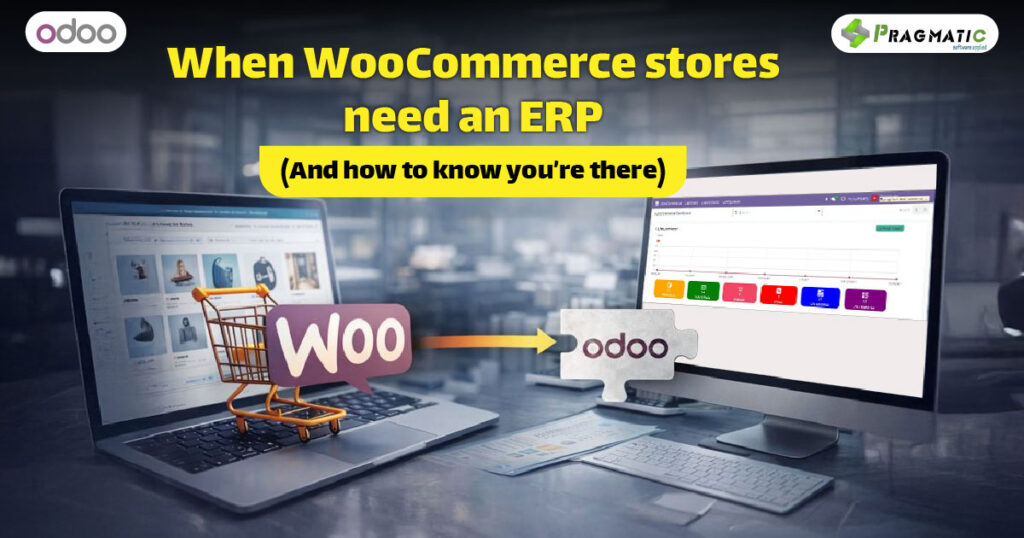
- WooCommerce remains the storefront
- ERP becomes the operational backbone
ERP handles :
- Inventory truth
- Order lifecycle
- Accounting logic
- Procurement and replenishment
- Multi-company operations
WooCommerce continues to do what it does best : sell.
Why Odoo Fits Growing WooCommerce Businesses
Odoo stands out because it is :
- Modular – adopt what you need
- Integrated – no data silos
- Flexible – fits different business models
- Scalable – grows with volume
With Odoo, WooCommerce brands can manage :
- Inventory & warehouses
- Sales & CRM
- Accounting & invoicing
- Purchasing & supplier management
- Multi-store, multi-company operations
All within a single system.
The Role of a Connector: Where Most Integrations Quietly Fail
ERP success depends less on the ERP itself – and more on the integration.
Weak connectors create :
- Delayed syncs
- Duplicate records
- Silent failures
- Manual cleanups
A production-grade connector must support :
- Real-time webhooks
- Queue-based processing
- Robust logs
- Clear ID mapping
- High-volume stability
Without this, even the best ERP fails to deliver value.
How Odoo WooCommerce Connector Advanced Solves Real Problems
The Odoo WooCommerce Connector Advanced is built specifically for stores that have outgrown basic sync.
Real-Time Webhook Sync
- Orders, customers, products and coupons sync instantly
- No cron delays
- No manual triggers
Inventory & Variant Integrity
- Mapping by WooCommerce IDs
- Variant-level accuracy
- Correct rollback on refunds
Clean Discounts & Refunds
- Coupons sync as proper sales order lines
- Refunds flow cleanly
- Accounting stays consistent
Queue & Logs for Stability
- High-volume order handling
- Full visibility into failures
- Predictable recovery
Multi-Store & Multi-Company Support
- Multiple WooCommerce instances
- Single Odoo backend
- No data overlap
Invoice & Return Handling
- Invoice status synced
- Returns handled correctly across systems
These features don’t just automate — they restore confidence.
A Realistic Use Case: From Firefighting to Predictable Growth
A growing ecommerce brand selling:
- Product variants
- Subscriptions
- Gift bundles
- Wholesale orders
Initially scaled well on WooCommerce.
As volume increased:
- Inventory mismatches appeared
- Refunds required manual cleanup
- Promotions distorted reporting
- Launch days felt unpredictable
After integrating Odoo with WooCommerce using the Advanced Connector:
- Inventory stayed accurate
- Accounting became reliable
- Promotions scaled cleanly
- Growth felt controlled
Most importantly:
The team stopped managing systems
and went back to building the brand.
Why Implementation Experience Matters
ERP integration is not just technical – it’s operational.
Pragmatic Techsoft brings :
- 17+ years of ERP expertise
- 400+ implementations
- Deep ecommerce process understanding
This ensures :
- Correct system architecture
- Clean data mapping
- Long-term scalability
Not just an integration – but a foundation.
The Operational Line WooCommerce Wasn’t Built to Cross
WooCommerce remains one of the strongest ecommerce platforms available.
But growth introduces complexity.
And complexity demands systems designed to manage it.
When inventory feels uncertain, accounting feels manual and growth feels risky – it’s not failure.
It’s a signal.
WooCommerce for selling.
Odoo for running the business.
A connector that keeps them in sync.
That’s how modern ecommerce scales – quietly and confidently.
Connect your WooCommerce store with our connector and boost your woocommerce business effectively!
FAQs
Q1. Do all WooCommerce stores need an ERP?
No. But growing stores with complex inventory, promotions or multi-channel sales eventually do.
Q2. Will adding Odoo slow down WooCommerce?
No. WooCommerce remains the storefront; Odoo handles backend operations.
Q3. Why is real-time sync important?
Delays cause overselling, refund issues and poor customer experience.
Q4. Can this handle high-volume sales days?
Yes. Queue-based processing and logs ensure stability during spikes.
Q5. Is this suitable for multi-store businesses?
Absolutely. The connector supports multi-store and multi-company setups.