
Manufacturers don’t lose customers because they make a bad product.
They lose them because they promise a date and then break it.
Every plant head knows the stress –
A sales order is confirmed
A customer promises the delivery to their customer
Suddenly a component is late
Production shifts scramble
Dispatch misses the slot
You’re firefighting instead of running a steady operation.
Most of this chaos isn’t caused by bad people or bad equipment.
It comes from bad date accuracy – the invisible glue that connects sales, procurement, production and delivery.
This is exactly where the shift from Odoo 18 → Odoo 19 becomes meaningful.
The core concepts p- lead times, scheduling, planning – remain the same, but Odoo 19 brings a level of clarity, alignment and real-time visibility that makes manufacture-to-deliver (MTD) flows noticeably more accurate.
When a manufacturer talks about manufacture-to-deliver, they mean :
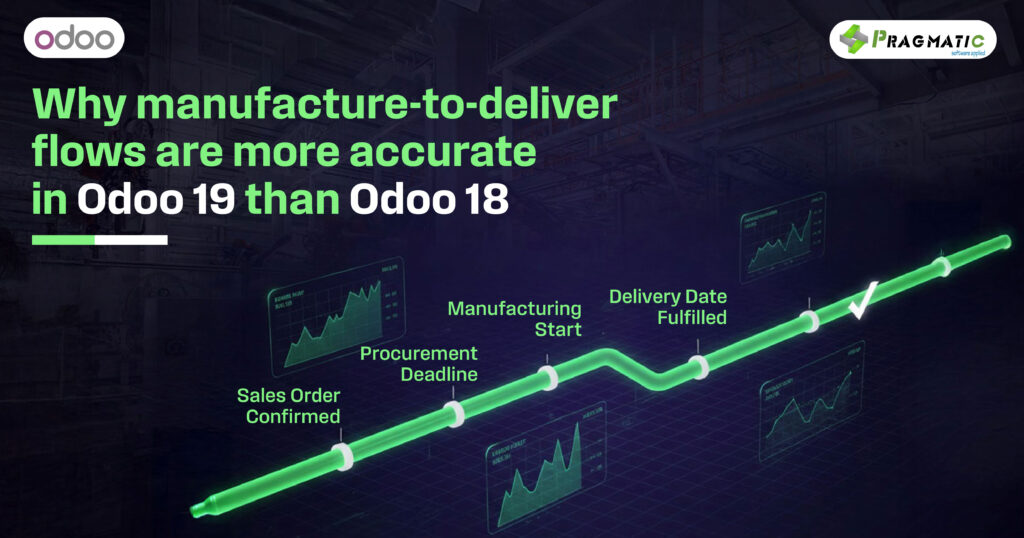
This involves a cascade of dates :
Delivery date promised to the customer
Manufacturing start date
Material availability date
Component purchase dates
Subcontracting dates
Pick/pack/ship dates
If even one date is off by a day or two, the entire chain collapses.
This is why an ERP must not only calculate dates correctly, but also show you where delays will happen before they actually happen.
Odoo 19 gets significantly better at this compared to Odoo 18.
Odoo 18 had a perfectly functional engine:
You set customer lead times
You configure vendor lead times
You add manufacturing lead times
You include safety buffers
Reordering rules generated POs
MOs were planned backwards from the delivery date
Deliveries were created and processed based on stock availability
On paper, this was enough.
In real operations, companies experienced two big issues :
Issue 1 : Lead-time setup was fragmented
Sales lead times lived in one area, vendor lead times in another, manufacturing lead times somewhere else.
Teams often misunderstood how these values interacted, which led to :Over-promising
Over-buffering
Under-buffering
Incorrect dates on delivery orders
Issue 2 : Planning was too “in the background”
Even when dates were calculated correctly :
The planners didn’t always see them clearly
Purchasing didn’t know which items needed earlier ordering
Subcontractors got last-minute RFQs
Production kept adjusting manually
Sales kept asking why a date changed
Odoo 18 worked fine only when the company’s master data discipline was perfect – which almost no real factory has.
Odoo 19 doesn’t reinvent planning.
Instead, it tightens every loose bolt in the MTD chain.
Here’s what actually makes the difference :
1. Unified lead-time logic (less confusion, fewer errors)
In Odoo 19, sales, purchase, and manufacturing lead times behave like one unified system. Everything connects cleanly :
When you confirm a sales order, Odoo calculates a realistic delivery date.
That date drives the manufacturing order scheduling.
Manufacturing start dates automatically drive component purchase deadlines.
Purchase deadlines naturally consider vendor lead times and buffers.
The entire flow feels like one continuous timeline, not three separate modules talking to each other.
This matters because manufacturers finally get :
✔ Clear, predictable delivery dates
✔ Mo start dates they can trust
✔ Purchase deadlines that are actually correct
✔ Fewer clashes between sales, purchase and production
2. Better planning with actionable buffers
In Odoo 18, safety buffers existed but were easy to misuse.
Teams often added manual buffers in spreadsheets to compensate.
Odoo 19 fixes this by giving cleaner, more controllable planning logic :
Security lead times are easier to interpret
Horizon days (a new buffer concept) help plan ahead without fully abandoning just-in-time behaviour
You can tune items individually
Long-lead items can plan further ahead
Fast-moving items can stay lean and JIT
This gives planners a clean dial instead of a complicated formula.
Result :
✔ Less surprise stockouts
✔ More stable production schedules
✔ Smarter PO timing
✔ Better-protected delivery commitments
3. Smarter subcontracting and dropship timelines
This is one of the biggest improvements for actual manufacturers.
In Odoo 18, subcontracting worked, but timelines weren’t surfaced clearly.
This caused classic headaches :
Components reached subcontractors late
Subcontracted assemblies came back after the MO start date
Dropship components arrived after production was ready
Purchasers missed “order by” dates
Odoo 19 tightens the entire chain.
When a manufactured product uses subcontracting :
Odoo automatically calculates when components must reach the subcontractor
You get clean “confirm by” dates on RFQs and POs
If components are dropshipped, Odoo accounts for that timing too
Subcontractor lead times directly impact MO planning
This closes the biggest real-world gap between planning and actual delivery performance.
4. Stronger scheduling and shop-floor visibility
Odoo 19 introduces a more predictable production engine :
Work centers schedule more realistically
Start/finish times adjust more sensibly
Production bottlenecks show up earlier
Planners can reshuffle work orders without breaking everything
Load distribution across machines is more efficient
This leads to :
✔ More accurate MO start dates
✔ Fewer last-minute shifts in schedule
✔ Less “overtime to catch up” behaviour
✔ More reliable delivery dates
When schedulers see problems ahead of time, the whole MTD flow gets smoother.
5. More reliable material planning
Material accuracy is at the heart of MTD reliability.
If one component is late, the whole order is delayed.
Odoo 19 improves this in three ways :
The replenishment engine looks further ahead if needed
a. Helps especially for imported or slow-moving items.
Forecasting reflects real constraints earlier
a. Shortages become visible before they impact an MO.
Allocation is more transparent
a. You can see which finished goods belong to which sales orders.
b. You know which deliveries will be late even before production completes.
Material planning consistency is one of the biggest contributors to improved MTD accuracy.
Let’s take a simple “Make-to-Order” scenario.
The setup
Customer lead time : 10 days
Manufacturing lead time : 4 days
Vendor lead time for a key component: 5 days
Safety buffers on sales / purchase / manufacturing
In Odoo 18
SO is confirmed
System calculates delivery date
MO is scheduled backward from that date
Odoo recommends a PO for components
The timeline exists, but critical dependencies are hidden
If the component PO is delayed by even one day, production slips- often unnoticed.
In Odoo 19
SO confirmation triggers the same base calculations
But now purchasing sees a clear “order by” deadline
Subcontracting timelines propagate automatically if applicable
The replenishment page shows both shortages and the dates that matter
Production dashboards show whether the MO is likely to slip
Delivery planning updates visibly if something is late
You’re not guessing anymore. You’re not discovering delays when it’s too late.
Your MTD chain becomes proactive instead of reactive.
If you’re moving from Odoo 18, follow these steps to get the real benefit :
1. Audit all lead times
Compare what’s configured vs. what actually happens in your plant.
2. Introduce Horizon Days only where needed
Use them for long-lead or high-risk items, not everything.
3. Clean subcontracting setups
Map every component’s routing to ensure timelines are correct.
4. Activate and train planners on dashboards
Forecast reports, replenishment pages and MO load charts must be used daily – not monthly.
5. Tighten stock accuracy
Bad on-hand data ruins any MTD plan, no matter how good the ERP is.
When done right, companies often see on-time delivery improve within 2–4 weeks.
Manufacturing is about flow. Flow breaks when dates are wrong.
Odoo 19 improves MTD accuracy because it :
Shows dates more clearly
Calculates dependencies more intelligently
Exposes risk earlier
Gives planners visibility instead of guesswork
Aligns sales, purchase and production around one timeline
For manufacturers, this translates into :
Better customer commitments
Fewer escalations
Less overtime and firefighting
Higher throughput
Lower working capital
A calmer, more predictable plant
Where Pragmatic Techsoft fits in
At Pragmatic Techsoft, MTD optimization is not a theoretical exercise – it’s something we do on the shop floor with real factories
We help manufacturers :
Fix lead times, buffers and routing logic
Set up clean subcontracting and multi-stage manufacturing
Build planning dashboards that actually get used
Remove bottlenecks in MPS, MRP and procurement flows
Migrate from Odoo 18 to 19 without breaking production
Align sales, purchase and operations under one realistic schedule
With 17+ years of Odoo experience and deep industrial expertise, we specialise in making Odoo behave like a plant really behaves – not like a theoretical flowchart.
If your delivery dates feel unpredictable, or if you’re planning a migration to Odoo 19, a short discussion with our manufacturing experts can show you exactly where your MTD flow is leaking and how to correct it.
Manufacture-to-deliver accuracy is the heartbeat of any factory.
Odoo 18 provided the foundation, but Odoo 19 strengthens everything around it—lead times, planning buffers, subcontracting logic, material forecasting, scheduling, and visibility.
The result is simple
What you promise is far closer to what you deliver.
For manufacturers who depend on reliable dates, Odoo 19 is a meaningful step forward.And with Pragmatic Techsoft guiding the setup, tuning and migration, you get a manufacturing system that behaves predictably – even under pressure.
1) Does Odoo 19 change the basic lead-time logic from Odoo 18?
No – it keeps the same logic but makes it clearer and more reliable.
2) Is just-in-time behaviour new in Odoo 19?
No – it’s simply more transparent and better controlled.
3) How does Odoo 19 improve delivery-date accuracy?
By tightening lead times, planning buffers, subcontracting dates and shop-floor visibility.
4) Do I need to change routes or BoMs to benefit?
Usually not – most improvements come from cleaner planning and configuration.





Leave a Reply
You must be logged in to post a comment.