
Retail growth is often celebrated as a clear sign that things are working.
More orders start coming in. New customers discover the brand. Sales channels expand – from physical stores to online platforms and marketplaces. On the surface, everything seems to be moving in the right direction.
But growth, especially in retail, has a way of exposing what isn’t working beneath it.
Processes that once felt efficient begin to slow down. Teams that handled operations comfortably now find themselves stretched. Systems that supported the business at a smaller scale start showing limitations.
At first, it doesn’t raise alarms.
A slight mismatch in stock. A delayed order that needs manual intervention. Someone from the team fixing numbers at the end of the day.
These feel like small, isolated issues.
But they rarely stay that way.
Over time, these small inefficiencies compound. They start consuming more time, more attention, and more effort than expected. And eventually, the business reaches a point where growth itself is no longer the challenge.
The real challenge becomes managing that growth without losing control.
At the same time, the expectations of customers have evolved faster than most retail systems.
Today’s customer doesn’t think in terms of channels. They move between online and offline experiences without even noticing it.
They might discover a product online, check its availability, visit a store to experience it physically, and then complete the purchase later from their phone. If the product doesn’t meet expectations, they expect a return process that is just as seamless.
From their perspective, it’s one continuous experience.
But for many retailers, the reality behind the scenes is very different.
Different systems handle different parts of the business. One platform manages eCommerce. Another runs the point of sale. Inventory sits somewhere else, while accounting operates independently.
This creates a disconnect.
While the customer interacts with one unified brand, the business is operating through multiple disconnected systems. That gap is where operational pressure begins to build.
Retail operations don’t break overnight. They gradually lose efficiency until the impact becomes unavoidable.
The first signs usually appear in inventory.
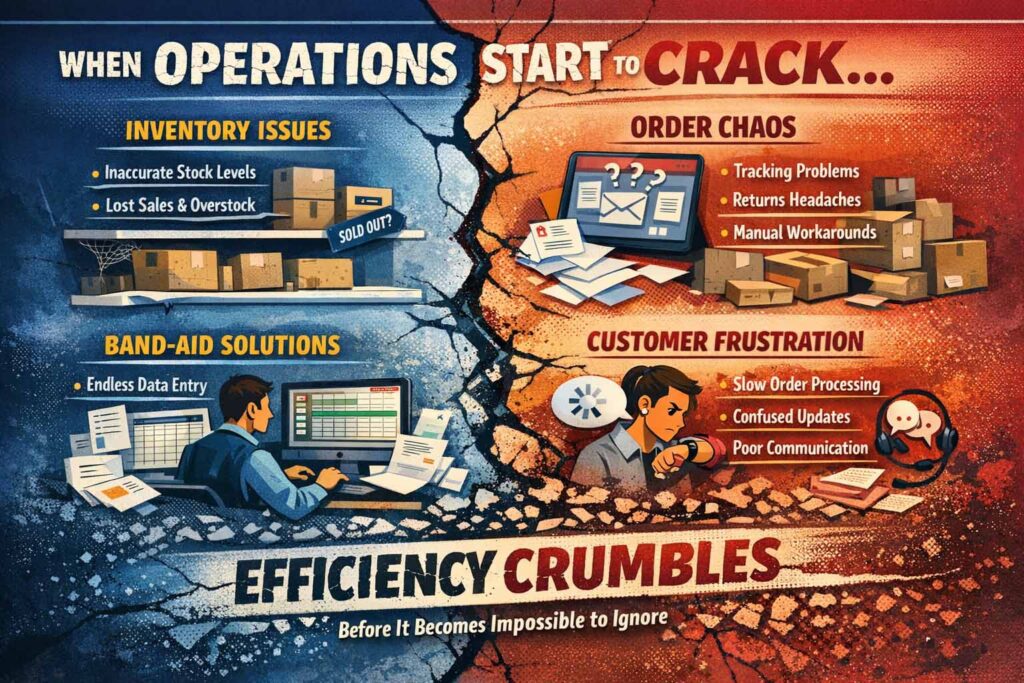
Stock numbers stop being completely reliable. Products may appear available when they are not, while excess stock sits unnoticed in other locations. This imbalance creates both lost sales and unnecessary holding costs.
As the business expands across channels, order management becomes more difficult to control. Tracking orders across platforms, managing returns, and processing refunds begin to require more manual effort than expected.
To keep operations running, teams start relying on workarounds.
Data is entered multiple times across systems. Employees switch between tools constantly. Spreadsheets become an essential part of daily operations rather than a temporary fix.
What starts as an internal inefficiency eventually reaches the customer.
Orders take longer to process. Information becomes inconsistent. Communication breaks down.
That is usually when the problem becomes visible enough to demand attention.
When these issues arise, the natural instinct is to fix each problem individually.
If inventory is unreliable, a new inventory system is introduced. If the point of sale is limited, it gets replaced or upgraded. If online and offline data are not syncing well, another integration is added.
Each decision makes sense in isolation.
But over time, this approach creates a much bigger problem.
Instead of simplifying operations, it adds layers of complexity. Each tool brings its own workflows, its own data structure, and its own dependencies. Keeping everything aligned becomes a task in itself.
Rather than running a retail business, teams find themselves managing systems.
Even more importantly, adding technology to an unclear or inefficient process does not solve the problem. It simply accelerates it.
This is why many retail transformations fail to deliver the expected results—not because the tools are ineffective, but because the system as a whole remains fragmented.
When retail operations are structured well, the business feels fundamentally different.
A sale made in-store reflects immediately in inventory. That same inventory is visible across all channels without delay. Orders are managed from a single place instead of being tracked across systems. Returns follow a defined workflow instead of becoming exceptions that require manual handling.
Teams no longer need to verify data repeatedly. Managers can trust the numbers they see. Customers experience consistency regardless of how they interact with the brand.
The goal is not to eliminate effort entirely.
It is to eliminate unnecessary friction.
For many business owners, the idea of an ERP system can feel overly technical.
But at its core, the concept is straightforward.
Instead of using separate tools for different parts of the business – sales, inventory, accounting, and customer management – an ERP brings everything into one connected system.
Odoo is designed around this idea.
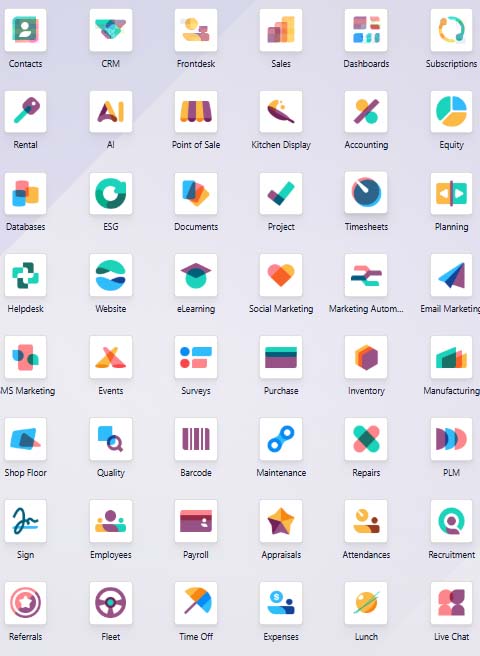
It combines key retail functions such as point of sale, eCommerce, inventory management and accounting into a single platform where all data flows together. Rather than relying on multiple integrations, it creates a unified environment where information is shared in real time.
This shift – from disconnected tools to a connected system is what allows businesses to move from reactive operations to structured, predictable processes.
The impact of a unified system becomes clearer when you look at everyday retail scenarios.
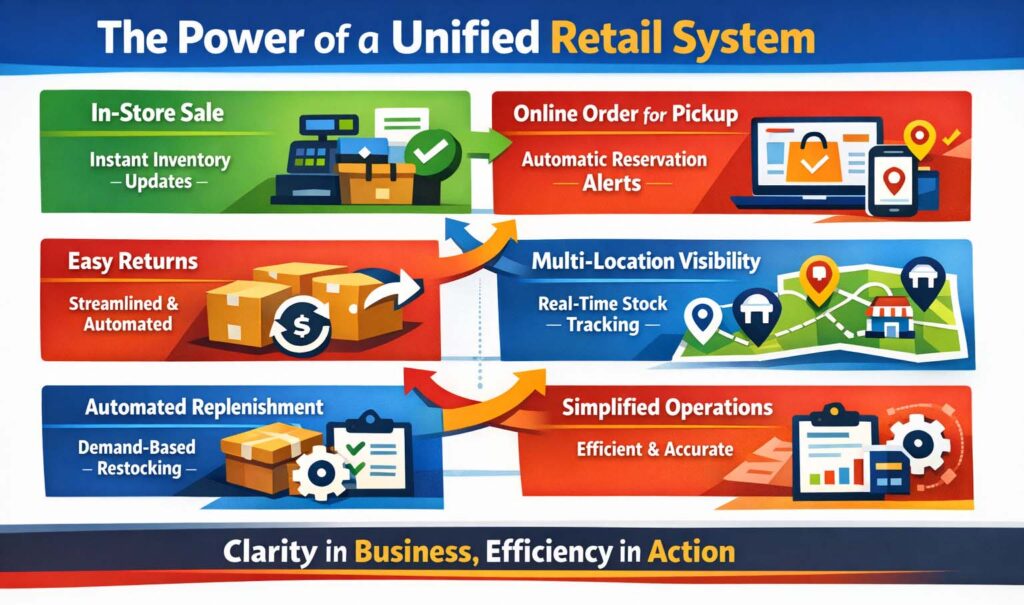
When a product is sold in a physical store, the system updates inventory instantly. That same stock level is reflected across online channels without delay, reducing the risk of overselling or mismatched availability.
When a customer places an order online for store pickup, the system automatically reserves the inventory and notifies the store. There is no need for manual coordination or cross-checking between systems.
Returns, which are often one of the most operationally complex areas in retail, follow structured workflows. Inventory adjusts automatically, and financial records are updated without requiring additional steps.
For businesses operating across multiple locations, inventory visibility becomes significantly clearer. Stock can be tracked across warehouses and stores in real time, and replenishment can be automated based on demand patterns rather than manual monitoring.
Even daily operations become simpler. Tasks such as reordering, invoicing, and reporting can be automated or streamlined, allowing teams to focus on higher-value work instead of repetitive processes.
The result is not just automation.
It is clarity in how the business operates.
Many systems claim to offer integration, but the way they approach it often differs.
Traditional ERP systems frequently rely on connecting separate tools through integrations. While this can work, it also introduces dependencies and complexity, especially as the business grows.
Odoo takes a different approach.
Its applications are designed to work together within the same ecosystem. This means that adding new functionality does not introduce the same level of complexity as adding a new external system.
Because data flows in real time across modules, there is no reliance on delayed synchronization. This reduces inconsistencies and improves decision-making.
Additionally, Odoo’s modular structure allows businesses to start with essential features and expand over time. It provides flexibility without forcing a complete overhaul at the start.
For growing retail businesses, this balance between simplicity and scalability becomes a significant advantage.
While the system itself is important, the way it is implemented often determines whether it succeeds or fails.
Retail businesses are not identical. Each has its own processes, workflows, and operational nuances. If a system is implemented without understanding these realities, it can create more friction than it removes.
This is one of the most common reasons ERP projects fail.
Not because the software is ineffective, but because it does not align with how the business actually operates.
Proper implementation requires more than just setting up modules. It involves mapping processes, structuring data correctly, and ensuring that teams understand how to use the system effectively.
Without this, even the most capable platform will struggle to deliver value.
This is where the role of the implementation partner becomes critical.
Pragmatic Techsoft approaches Odoo implementation with a focus on real-world operations rather than just technical setup. Instead of starting with the software, the process begins with understanding how the business functions – how inventory moves, how orders are processed, and how teams work on a daily basis.
Based on this understanding, the system is configured to support those workflows rather than forcing the business into predefined structures.
This approach reduces resistance within teams and improves adoption, which is often one of the biggest challenges in ERP implementations.
With experience across industries and complex operational environments, the focus remains consistent: simplify operations, reduce manual effort and build systems that can scale as the business grows.
Because in retail, the goal is not simply to implement a system.
It is to create an environment where the business becomes easier to manage.
Retail in 2026 is not just about growth.
It is about managing complexity effectively.
As customer expectations continue to rise and operations become more demanding, businesses need systems that support clarity rather than add confusion.
Relying on disconnected tools may work in the early stages, but it becomes increasingly difficult to sustain as the business expands.
Moving towards a unified system is not just a technological decision.
It is an operational one.
Platforms like Odoo make this transition possible. With the right implementation approach, they enable businesses to operate with greater control, consistency and confidence.
At Pragmatic Techsoft, we’ve spent the last 17+ years helping retailers navigate these shifts, turning fragmented processes into streamlined, scalable engines. If you’re ready to move from managing systems to growing your brand, let’s build your unified commerce future together.
Schedule a free consultation with our Retail experts
1) What is Odoo and how is it different from other retail software?
Odoo is an all-in-one business management system that connects sales, inventory, accounting, and customer data in a single platform, reducing the need for multiple tools.
2) Is Odoo suitable for small or growing retail businesses?
Yes, Odoo is modular and scalable, allowing businesses to start with essential features and expand as needed.
3) Can Odoo handle both online and offline retail operations?
Yes, it supports eCommerce and physical store operations within the same system, enabling seamless omnichannel management.
4) Why is implementation important in ERP systems?
Because ERP systems directly impact core operations. Without proper implementation, they may not align with business processes, leading to inefficiencies.
5) Why choose Pragmatic Techsoft for Odoo implementation?
Because the focus is on aligning the system with real operational workflows, ensuring that the solution works effectively in practice, not just in theory.





Leave a Reply
You must be logged in to post a comment.