

Most EPC project delays don’t begin on site. They begin much earlier – quietly, almost invisibly.
👉A drawing package is delayed by a few days.
👉A procurement decision is made based on an earlier version of the plan.
👉A site team mobilizes assuming everything is ready.
Nothing looks wrong immediately.
The schedule still shows progress. The reports still say things are “on track.”
But in reality, the project has already started drifting.
By the time work slows down or stops, the delay is no longer preventable – it is simply visible.
This pattern is not isolated.
It is increasingly common across EPC projects in 2026 and it is being discussed widely.
The issue is no longer just poor planning or lack of resources. It is the growing disconnect between how projects are planned and how they are actually executed.
The EPC landscape today is significantly more demanding than it was even a few years ago.
Globally, projects are becoming larger, more complex and more interconnected. Industrial plants, renewable energy installations and data center developments are being executed under tighter deadlines and higher expectations. At the same time, external pressures continue to add uncertainty.
Supply chain disruptions remain a major concern.
Even in 2026, long-lead items such as transformers, specialized equipment and imported components are subject to delays caused by geopolitical instability and logistics constraints.
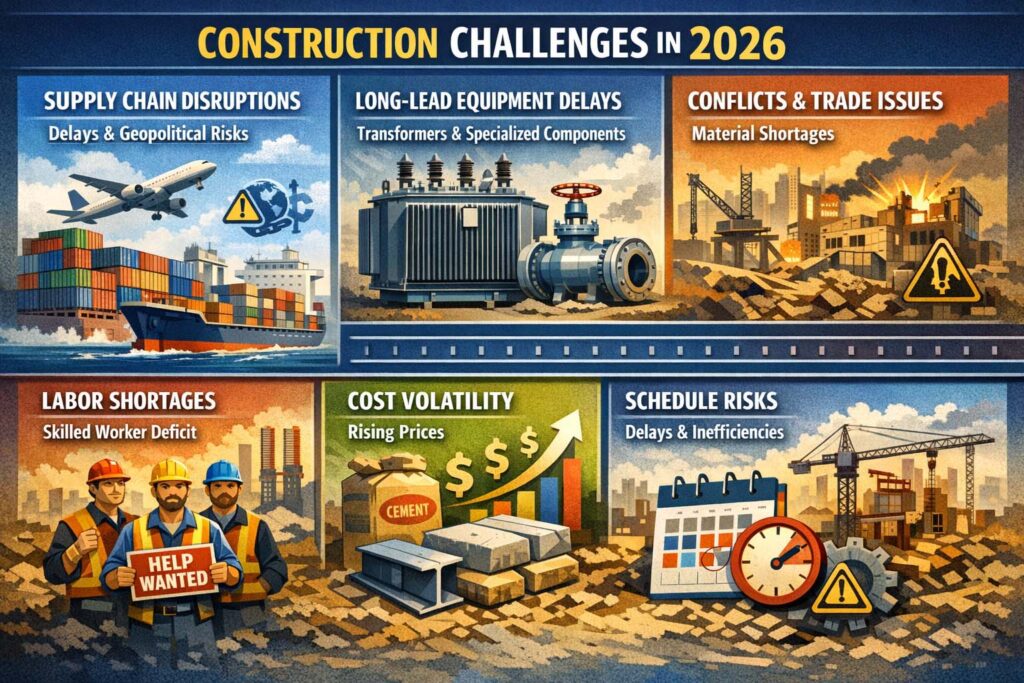
Reports from infrastructure and construction sectors continue to highlight how conflicts and trade disruptions are affecting material availability and delivery timelines.
Labor shortages are another persistent issue. A significant percentage of construction and EPC firms report difficulty in finding skilled workers, which directly impacts productivity and schedule reliability. When manpower is limited, even small inefficiencies in planning or coordination can lead to disproportionate delays.
Material cost volatility adds another layer of complexity. Fluctuations in steel, cement and energy prices are forcing procurement teams to make faster decisions, sometimes before engineering is fully stabilized.
All of this creates an environment where there is very little room for error. Projects cannot afford misalignment between teams – but that is exactly what is happening.
Engineering has always been the starting point of EPC projects, but its role has become more critical in today’s environment.
In many projects, engineering is no longer a clearly defined phase that concludes before procurement and execution begin. Instead, it continues to evolve as the project progresses. Design changes, client inputs and specification updates are introduced even after downstream activities have been scheduled.
This creates a chain reaction.
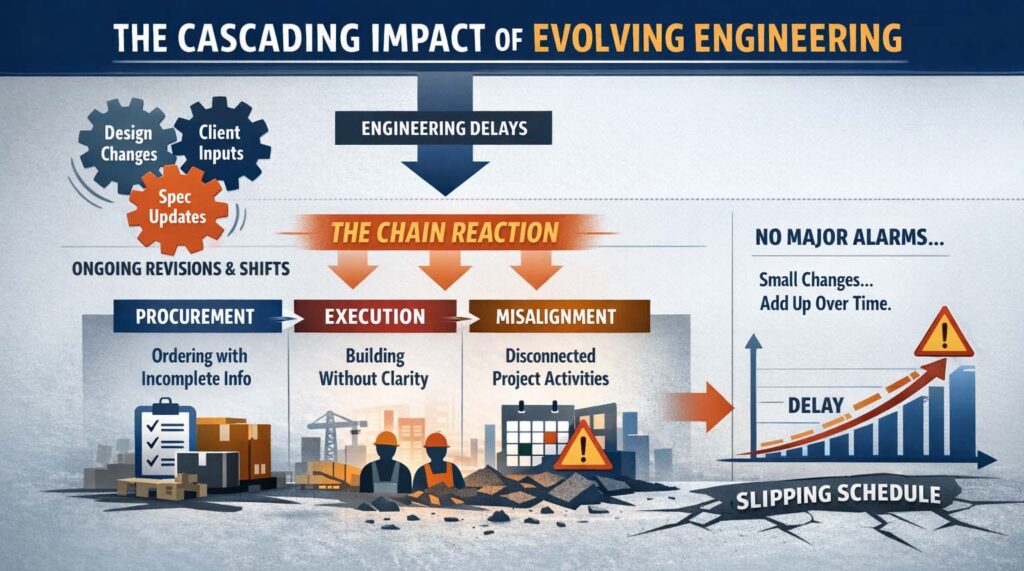
A delay in engineering deliverables does not just affect engineering – it affects everything that depends on it.
Procurement teams may proceed based on earlier versions of drawings or specifications. Execution teams may begin work without complete clarity on requirements. The project remains active, but it is no longer aligned.
What makes this particularly challenging is that these shifts are often small and incremental. They do not immediately trigger alarms. However, over time, they accumulate and begin to impact the overall project timeline.
Procurement teams in EPC projects are under increasing pressure to act quickly.
They are expected to secure materials early, manage supplier risks and optimize costs in an environment where delays can be expensive. In many cases, this leads to procurement decisions being made based on the initial project plan, rather than continuously updated information.
This is where the gap begins.
If engineering changes are not reflected in procurement timelines, materials may be ordered too early or too late. Early deliveries result in inventory and storage challenges, while late deliveries directly delay execution.
Industry observations consistently highlight material-related issues as a major contributor to project delays. These include incorrect orders, delayed deliveries and misalignment between material availability and execution schedules.
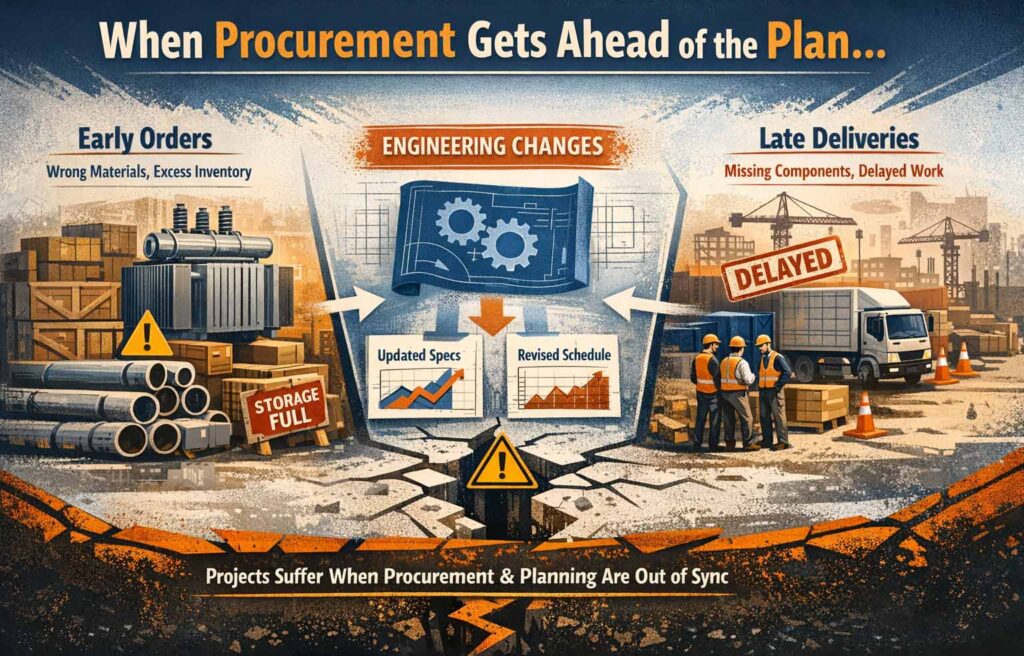
The challenge is not inefficiency within procurement itself. It is the lack of synchronization between procurement and the evolving project plan.
Site execution is where all upstream issues eventually surface.
By the time work reaches the site, any misalignment between engineering and procurement becomes immediately apparent.
Teams may arrive prepared to execute a task, only to find that prerequisites are incomplete. Materials may not be available in the required sequence. Drawings may have changed without clear communication.
This leads to familiar consequences!
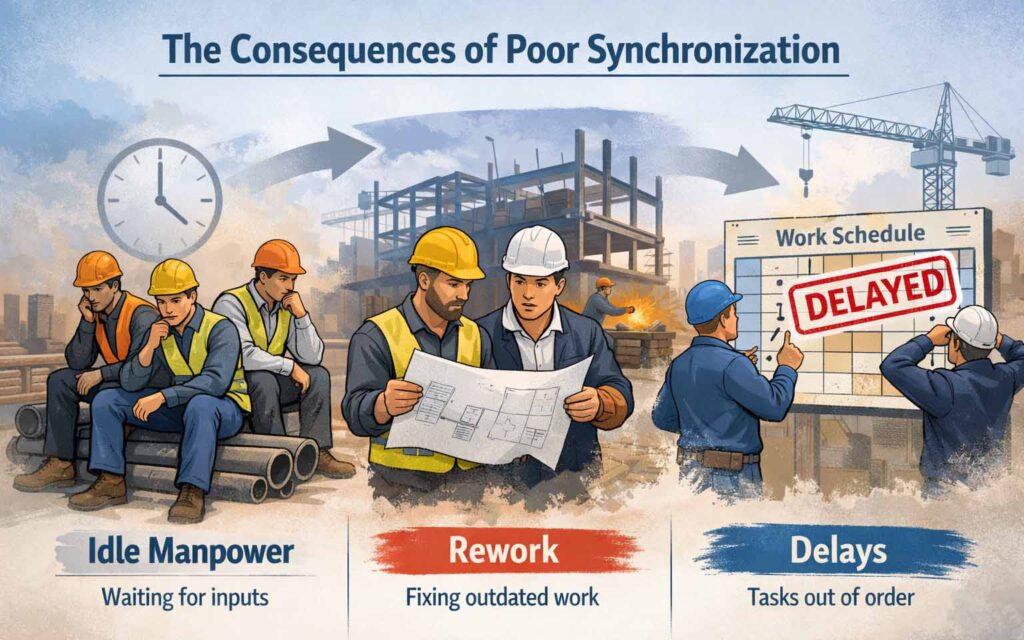
Perhaps more importantly, it leads to a loss of confidence in the project plan.
When site teams begin to see the plan as unreliable, they rely more on informal communication and reactive decision-making.
At that point, coordination becomes increasingly difficult.
At the heart of these issues is a single problem : lack of synchronization.
Engineering, procurement, and execution are all functioning, but they are not functioning together.
Each team operates with its own understanding of the project timeline. Updates take time to propagate. Dependencies are defined, but not actively enforced.
This creates what many professionals describe as “project drift.” The project does not fail abruptly – it gradually moves away from its intended path.
The schedule continues to exist, but it no longer represents reality.
Most EPC organizations already use planning tools and methodologies. Gantt charts, scheduling software and reporting systems are widely adopted.
However, these tools are often used in a static manner. Plans are created at the beginning of the project and updated periodically, rather than continuously.

In a dynamic environment, this approach is no longer sufficient.
Dependencies need to be actively managed, not just defined. Changes in one part of the project need to be reflected across the entire timeline in real time. Without this, the plan quickly becomes outdated.
This is why many projects appear well-planned but still experience delays.
Organizations that are managing projects more effectively in 2026 are not necessarily using more sophisticated tools – they are using them differently.
They focus on maintaining a live connection between planning and execution. Project structures are clearly defined, with work broken down into manageable components. Dependencies are tracked and updated as the project evolves.
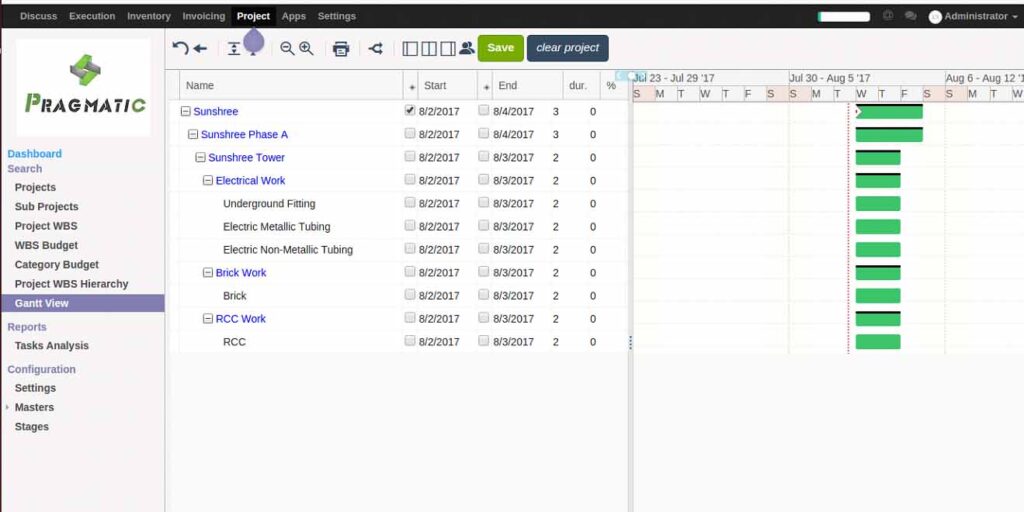
When changes occur, they are reflected across the project, ensuring that all teams are working with the same information.
This approach reduces reliance on manual coordination and improves alignment across teams.
This is where Odoo Project Planning & Gantt Chart becomes particularly relevant.
Instead of treating planning as a one-time activity, it enables teams to structure projects in a way that remains usable throughout execution.
With a clear hierarchy of project, sub-project, WBS, task groups and tasks, teams can define their work in a structured manner. Dependencies between tasks can be managed directly, ensuring that sequencing is maintained.
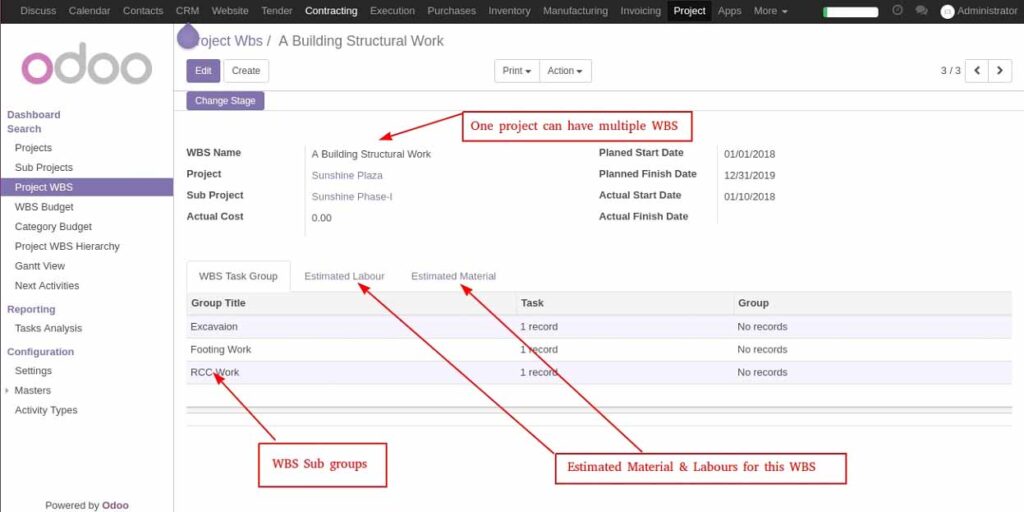
The Gantt chart provides a visual representation of the project timeline, allowing teams to adjust schedules and understand the impact of changes.
Because it is integrated within Odoo, it connects with other business functions such as inventory and communication, helping ensure that all teams are aligned.
This creates a system where the plan is not just documented- it is actively used to drive execution.
Implementing a system is one thing. Making it work in real-world conditions is another.
Pragmatic Techsoft, with over 17 years of experience in Odoo implementation, focuses on bridging that gap.
The approach is centered on understanding operational challenges and designing solutions that align with how businesses actually function.
For EPC companies, this means creating systems that reflect real project workflows, rather than forcing teams to adapt to generic tools.
This experience plays a critical role in ensuring that solutions like Odoo Project Planning & Gantt Chart deliver practical value, not just theoretical benefits.
EPC projects in 2026 are not failing because teams lack capability.
They are facing delays because planning and execution are no longer connected in a meaningful way.
The shift that is needed is clear.
From static plans to dynamic systems.
From isolated teams to integrated workflows.
From reactive execution to proactive coordination.
Projects that make this shift are better positioned to handle the complexity and uncertainty of today’s environment.
If your project plans are not reflecting what’s actually happening on site, it may be time to rethink how execution is being managed.
Because external pressures like supply chain disruptions and labor shortages are combined with internal coordination gaps between engineering, procurement, and execution.
The biggest cause is the disconnect between planning and execution, especially when dependencies and updates are not managed in real time.
By adopting systems that ensure continuous alignment between teams and allow project plans to evolve with execution.
It helps structure projects, manage dependencies and maintain alignment across teams within a unified system.
With over 17 years of experience, Pragmatic Techsoft provides practical implementation expertise that ensures systems deliver real business value.





Leave a Reply
You must be logged in to post a comment.