
It’s not just about salary
In 2026, businesses are expected to run faster, make decisions earlier and stay fully in control of their numbers. That is why accounting is no longer just about recording transactions – it is about keeping finance reliable, real-time and ready for action.
On paper, in-house accounting may seem simple and affordable. In reality, once Odoo enters the picture, the cost is no longer just the salary of an accountant. The real cost comes from setup gaps, manual corrections, delayed reporting and numbers that cannot be trusted when business decisions depend on them.
Why in-house feels like the safer choice
Most businesses start with an in-house accountant because it feels familiar. You get direct access, immediate responses, and the comfort of having someone internal handle the books.
That works in the early stages.
But as the business grows, finance becomes more connected to systems, automation, inventory, purchasing, sales and reporting. At that point, accounting is no longer just a task. It becomes a system-dependent function that needs both financial understanding and Odoo expertise.
And that is where many teams begin to feel the gap.
Where the real cost starts showing
The real cost rarely appears all at once. It builds slowly through small inefficiencies that are easy to ignore at first.
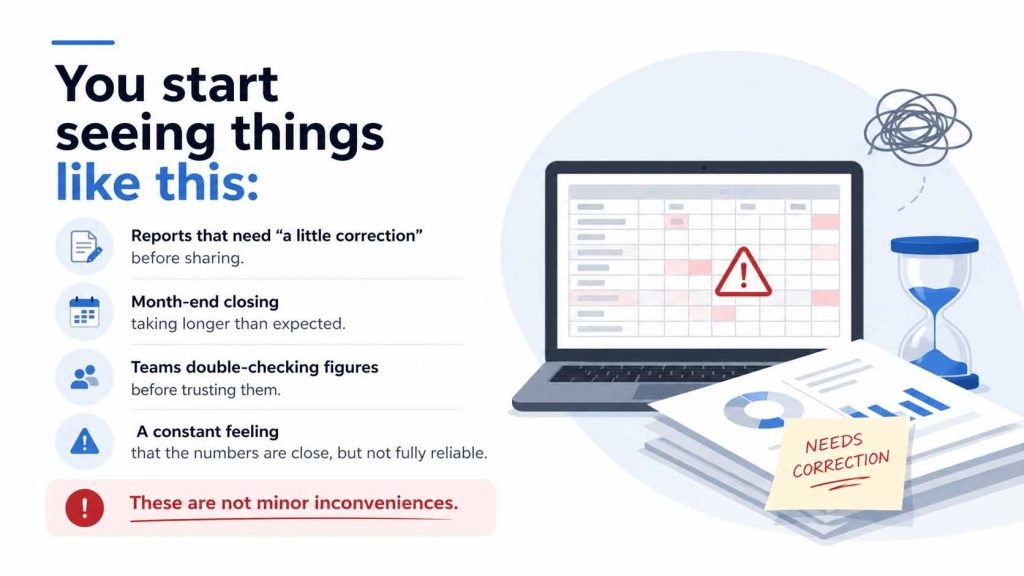
They are signs that the accounting system is not fully aligned with how your business actually operates.
And every manual fix adds more hidden cost.
How Odoo accounting really works
Odoo Accounting does not operate in isolation.
It is directly connected to :
- Sales
- Purchases
- Inventory
- Payroll
- Taxes
- Reporting
That means every action in your business creates an accounting impact.
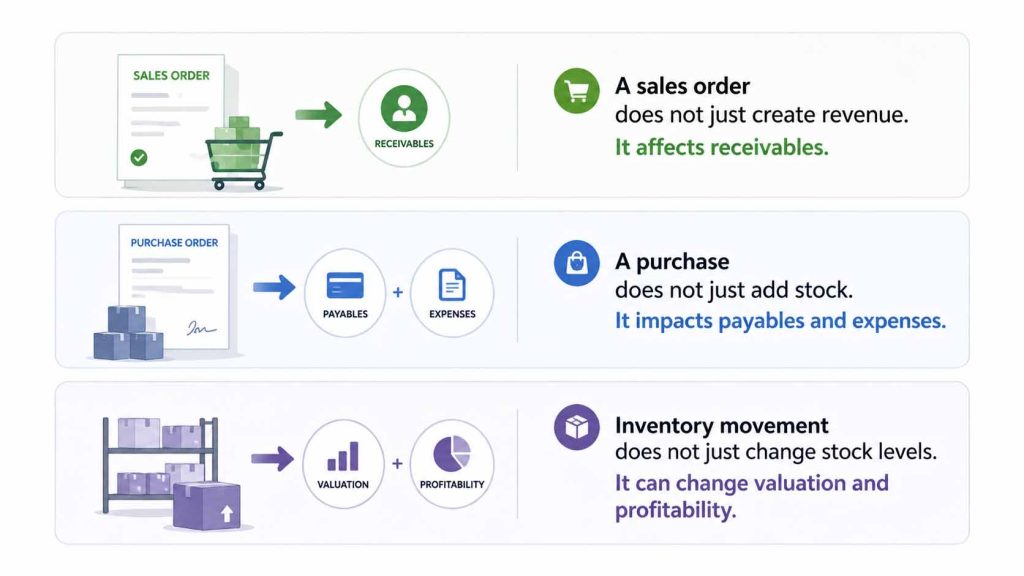
So if your Odoo setup is incomplete or misconfigured, your reports may look normal on the surface while still telling the wrong story underneath.
Small setup gaps create bigger problems
Most accounting issues do not begin with major mistakes. They begin with small setup gaps that compound over time.
Common problems include :
- Incorrect opening balances
- Poorly structured chart of accounts
- Inventory not mapped properly to financial accounts
- Misconfigured tax rules
- Weak reconciliation processes
At first, these issues look manageable.
But once transactions start building, every entry depends on the previous one. One small error can spread across reports, reconciliations and closing activity.
That is how a small setup issue becomes a business-wide accounting problem.
Why reports start feeling unreliable
This is usually when the frustration becomes obvious.
The system is working. Reports are being generated. But the numbers still do not feel right.
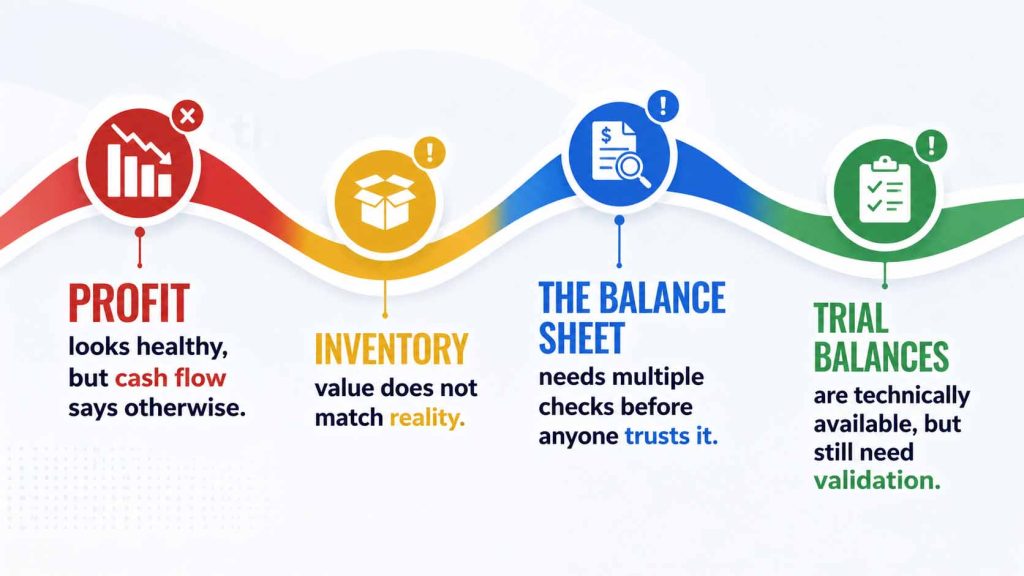
That happens when data is being captured, but not translated properly into meaningful financial insight.
In 2026, businesses cannot afford “almost correct” reporting. They need finance data that is fast, clean and dependable.
The operational cost most teams ignore
Accounting problems do not stay inside finance. They spread into the rest of the business.
When reports are not trusted :
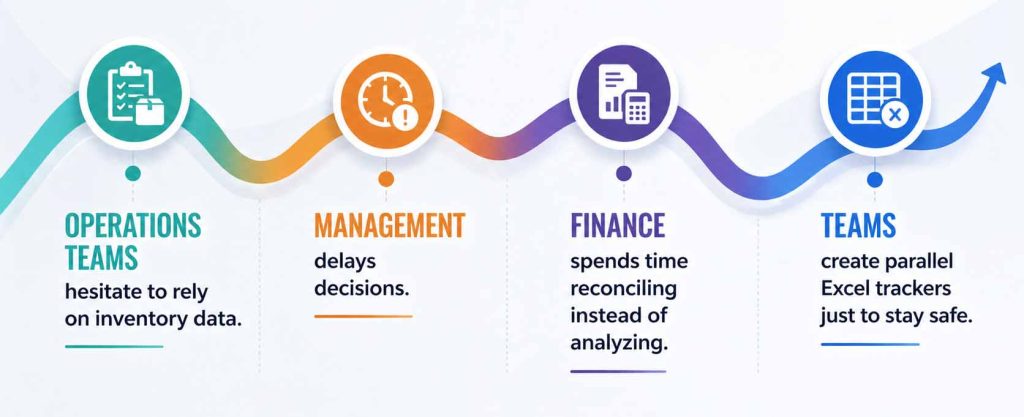
That is where real inefficiency begins.
Instead of a single source of truth, the company starts depending on manual checks and individual knowledge. In an ERP environment, that defeats the purpose of using the system in the first place.
Why hiring alone does not solve it
A common reaction to accounting issues is to hire someone more experienced. But experience in accounting alone is not always enough.
Odoo requires a combination of –
- Accounting knowledge
- System understanding
- Process alignment
- Reporting discipline
A strong accountant may know finance well, but if they do not understand how Odoo behaves across sales, inventory, purchases and reconciliation, the system can still produce inconsistent results.
That is why the issue is not just who you hire. It is whether the person understands how your business is structured inside Odoo.
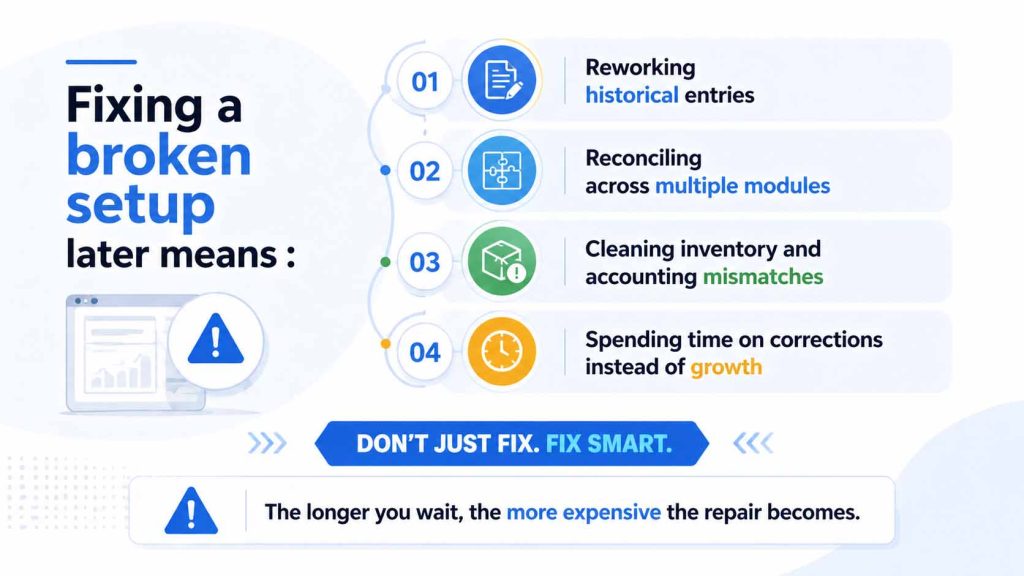
The cost of delaying proper setup
One of the most expensive decisions businesses make is delaying the cleanup.
They say :
- “We’ll fix it later.”
- “Let’s use it as-is for now.”
- “We can correct it after the month-end.”
The problem is that every new transaction adds more history, more dependencies and more correction work.
What proper Odoo bookkeeping should look like
When Odoo bookkeeping is done properly, the difference is immediate.
You stop questioning the reports.
You start relying on them.
A properly set up system should include :
- Accurate opening balances
- A logical chart of accounts
- Proper inventory-account alignment
- Reliable bank and ledger reconciliation
- Clean receivable and payable tracking
- Reports that reflect actual business performance
At that point, accounting becomes what it should be:
a decision-making tool, not a source of doubt.
How outsourcing solves the right problem
Outsourcing bookkeeping is not just about reducing cost. In the Odoo world, it is about bringing in the right expertise to solve the right problem.
A specialized partner helps you with :
- Odoo-specific accounting setup
- Ongoing reconciliation and maintenance
- Better reporting accuracy
- Less dependency on trial-and-error internal handling
- More flexibility without full-time overhead
Instead of building accounting knowledge through repeated mistakes, you get a team that already understands how to make the system work properly from the start.
Why businesses choose Pragmatic Techsoft
At Pragmatic Techsoft, we do more than maintain books. We help businesses build a finance system that actually works inside Odoo.
Businesses choose us because we bring :
- Deep expertise in Odoo Accounting, Financial Management, Assets and Budgeting.
- Experience across the US, UK, Canada, Australia, India, UAE, Europe and more.
- Live bookkeeping support for active businesses.
- A virtual back-office model that reduces pressure on internal teams.
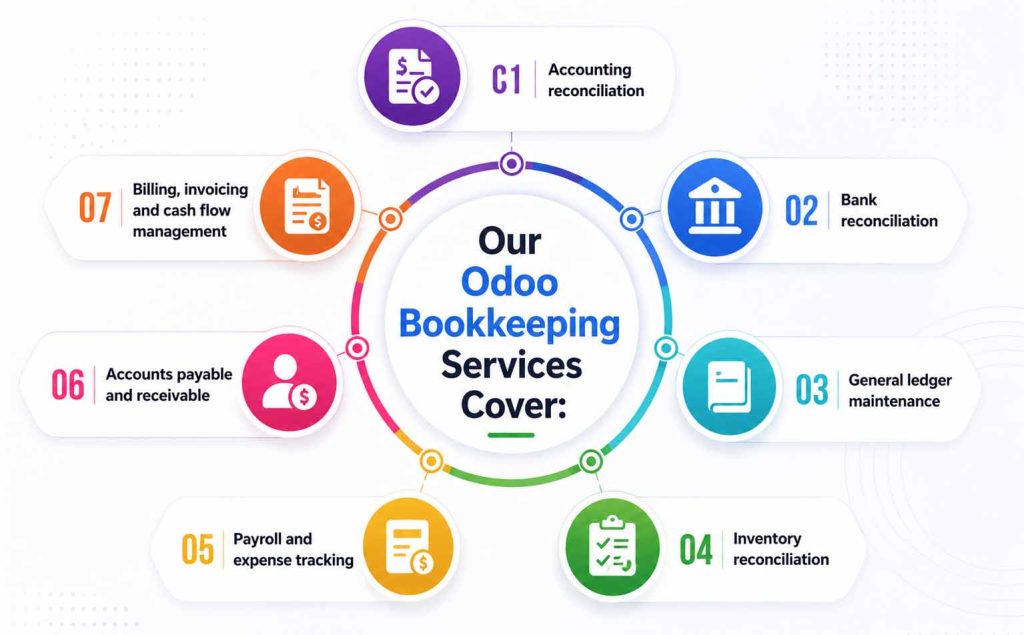
We help businesses move from manual corrections to structured, dependable finance operations.
The cost is in the system, not the salary
In-house accounting is not the problem by itself. The problem begins when the system is not structured properly, the expertise does not match the platform, and corrections are delayed until the damage grows.
At that point, you are not just paying for accounting.
You are paying for :
- Rework
- Delays
- Confusion
- Lost confidence in the numbers
In today’s business environment, that is far more expensive than a salary.
Final thought
If your numbers do not fully reflect your business, the issue is probably bigger than accounting.
It is a system issue. And when the system is fixed properly, accounting stops being a burden and starts becoming a business advantage.
Turn accounting from a cost center into a dependable business system. Partner with Pragmatic Techsoft for expert Odoo bookkeeping and back-office support.
FAQs
1. How do I know if my Odoo accounting setup needs fixing?
If you rely on manual checks, adjust reports before sharing them, or keep Excel backups “just to be safe,” your setup likely needs attention. A healthy system should reduce doubt, not create it.
2. Can I outsource only part of my accounting?
Yes. Many businesses start with specific areas like reconciliation, reporting validation, or inventory-account alignment. This gives flexibility without changing everything at once.
3. Will outsourcing reduce my control over financial data?
No. It usually improves control by giving you cleaner processes, clearer reporting, and more consistent reconciliation. You gain visibility instead of depending on ad hoc follow-ups.
4. What is the biggest risk of a partially correct setup?
The biggest risk is accumulation. As transactions grow, small inconsistencies multiply and become much harder and more expensive to fix later.
5. Why choose Pragmatic Techsoft for Odoo bookkeeping?
Because we combine accounting expertise with Odoo system knowledge. That means we do not just manage books — we help ensure the entire financial setup works correctly.