
Why dispatch is not the end of the process
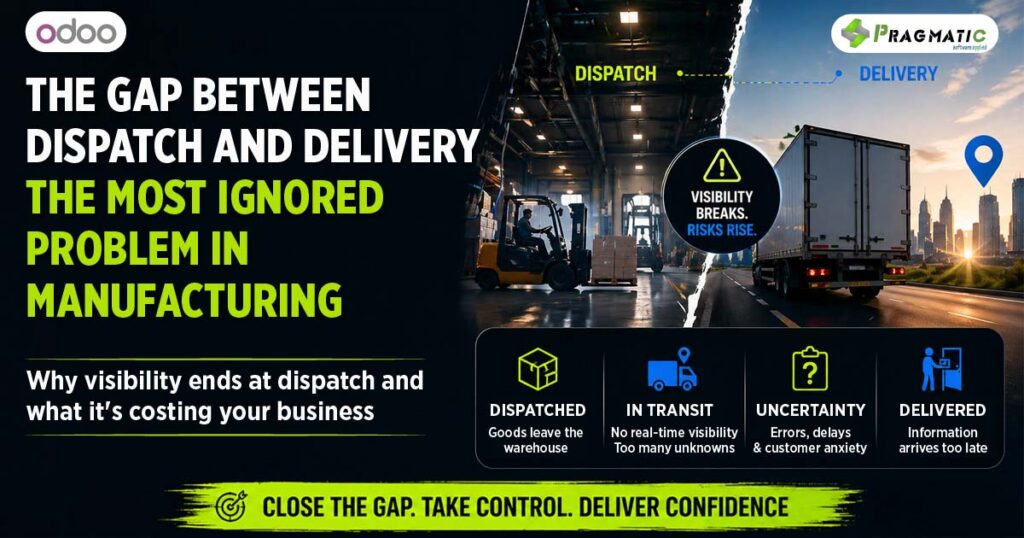
The biggest problem in manufacturing isn’t always production or demand – it’s the invisible gap between dispatch and delivery.
This is where visibility vanishes. Manual follow-ups kick in, and teams rely on calls, messages and memory instead of controlled workflows. For growing businesses, ignoring this gap is one of the costliest mistakes.
Once goods leave the warehouse – picked, packed, loaded and sent – the team assumes victory. On paper, the process looks complete.
But dispatch isn’t the end; it’s where control slips away.
The real challenge starts when the truck rolls out :
❓Were the right goods loaded?
❓The correct route followed?
❓Delivery confirmed with proof?
Lean too hard on manual checks and your entire operation turns fragile.
That’s why so many manufacturing teams feel perpetually busy – yet totally out of control.
The invisible gap between dispatch and delivery
There is a gap in almost every manufacturing operation that does not get enough attention.
It is the space between what the system says and what actually happens in the field.
- A sales order is confirmed
- A delivery is created
- The warehouse prepares the goods
- The driver leaves
But after that, visibility drops.
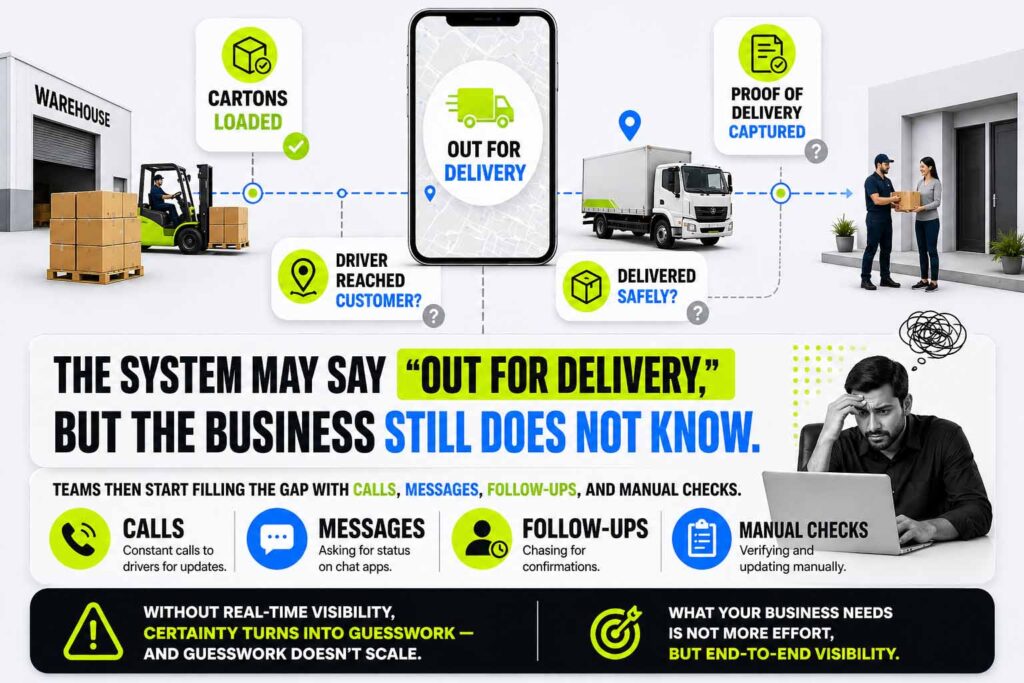
This is not a sign of poor effort. It is a sign that the process itself is not designed to carry execution all the way through.
That is the real issue.
Why this problem still persists and remains relevant in 2026
In 2026, manufacturing businesses are expected to work faster, communicate better and operate with less waste.
Customers now expect delivery clarity, faster updates and fewer excuses. At the same time, internal teams are under pressure to do more with leaner resources.
That makes this gap even more painful.
The problem is especially common in businesses that serve both B2B and B2C channels. These companies have to manage bulk deliveries, scheduled dispatches, frequent smaller orders and different customer expectations at the same time. That kind of complexity is manageable only when the system supports execution properly.
But many businesses still rely on a mix of ERP records, spreadsheets, WhatsApp messages and verbal updates.
That may work for a while. It does not scale well.
In 2026, the businesses that are gaining an edge are the ones that are reducing manual coordination and building more visible, connected workflows across warehouse, delivery and customer communication.
What this gap looks like in real operations
The gap between dispatch and delivery does not usually appear as one dramatic failure.
It shows up in repeated small issues.
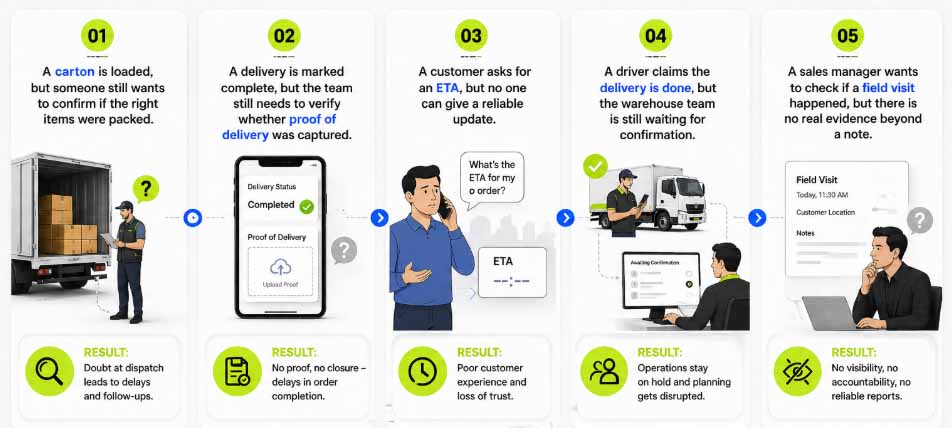
Each issue seems minor but they create a constant sense of uncertainty.
This is where many manufacturing businesses lose momentum. Teams do not just spend time doing work. They spend time verifying work that should already have been validated by the system.
The operational cost no one tracks properly
The hidden cost of this problem is often larger than the obvious one.
Of course, there are direct costs such as :
- Wrong deliveries
- Re-dispatches
- Delayed handovers
- Customer complaints
But the deeper cost sits in how the business functions every day.
👉People spend time making follow-up calls
👉Managers get pulled into exceptions
👉Operations teams keep checking status instead of moving work forward
👉Sales teams lose confidence in the delivery process
👉Customers lose patience because updates are slow or unclear
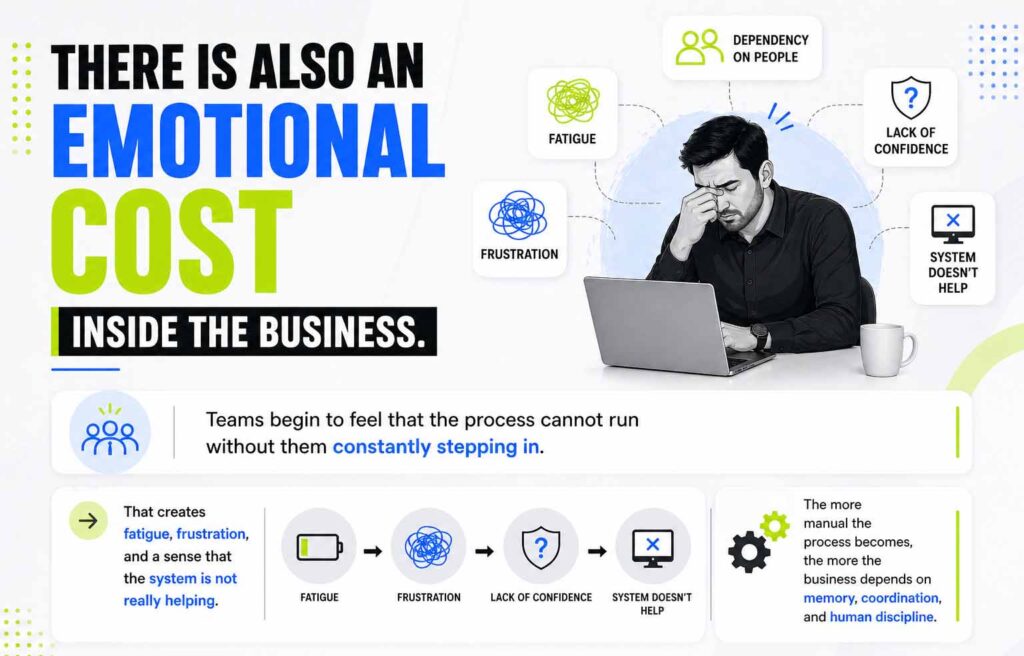
That may be acceptable at a smaller scale. It becomes expensive and stressful as the business grows.
Why manual fixes keep failing
When businesses notice this problem, the first response is often to tighten communication.
They add more calls. They add more follow-ups. Ask for more confirmation messages and ask drivers to update more often.
This can improve awareness for a short time, but it does not solve the root issue.
Manual fixes rely on people remembering to do the right thing at the right time. That is fragile. It also creates more room for inconsistency when the volume of orders increases.
In other words, manual control does not scale well.
The problem is not that teams are careless. The problem is that the process depends too heavily on human effort instead of system-led validation. A better model needs to reduce exceptions, not create more checking.
What a better delivery workflow actually needs
A better workflow does not begin with more reports.
It begins with better execution design.
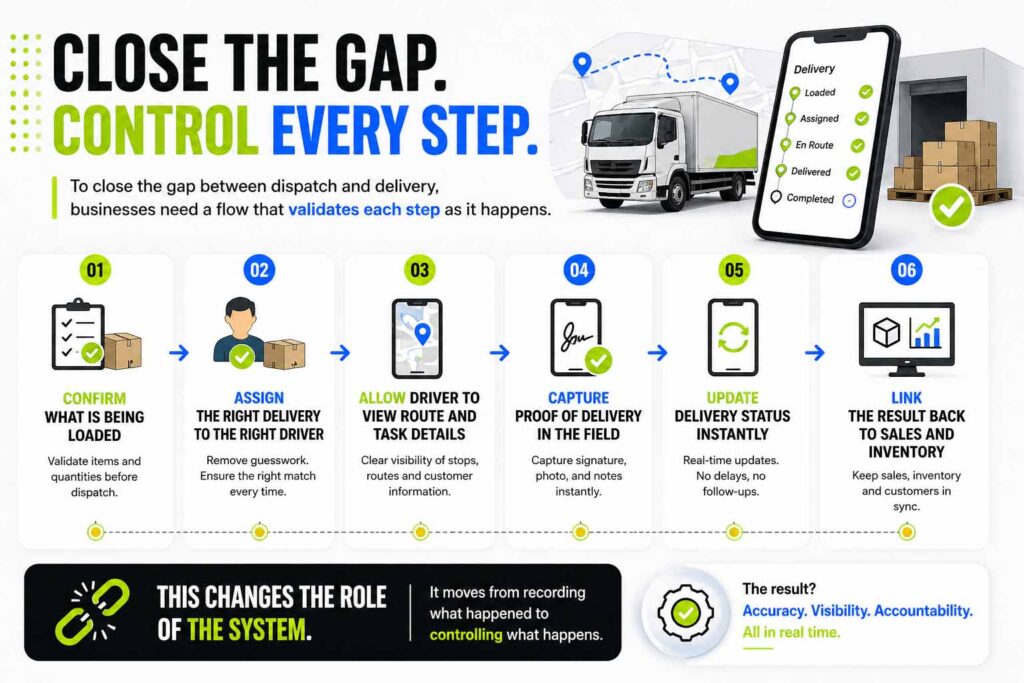
The system is no longer only a record-keeper. It becomes part of the control mechanism.
That is the real shift many manufacturing businesses need.
How Odoo supports the full dispatch-to-delivery flow
Implementing an open source scalable ERP like Odoo becomes highly relevant in such a scenario.
Odoo is a connected operational system that can help manufacturing businesses manage sales, warehouse operations, delivery workflows and customer-facing updates in one place.
With the right implementation, Odoo can support the full journey from order to delivery.
It can :
- Connect sales orders directly to dispatch operations
- Support barcode-based loading validation
- Assign deliveries to specific drivers
- Show delivery tasks in a structured workflow
- Capture proof of delivery through signature or photo
- Sync delivery completion with sales and inventory records
- Keep customer communication more consistent
For businesses that want more visibility and less manual chasing, this matters a lot.
In a modern manufacturing setup, the value is not just in recording what happened. The value is in making sure each step is controlled, validated and traceable.
That is where Odoo can create real operational impact.
How Pragmatic Techsoft approaches this problem
At Pragmatic Techsoft, the approach is to understand the business process first.
That matters because every manufacturing business has its own way of working. Whether you have multiple companies, a custom inventory logic, require a specialized and customized mobile app or want to track your sales, the first step is always to map the exact operational flow.
A deep understanding where we know –
- How does an order move from sales to dispatch?
- Where do errors or rechecks start creeping in?
- How are drivers assigned and informed?
- What really happens at the time of delivery?
- How is proof of delivery captured—or missed?
- How reliable is the visibility of sales activity in the field?
Once that’s clear, the solution starts taking shape.
Not as a generic implementation – but as something built around how the business already operates.
That’s the difference.
We’re not trying to introduce complexity. We’re trying to remove the need for constant checking.
👉 The focus is always on building a system that is easier to use, clearer to understand and reliable during actual execution – not just in reports.
That’s why we begin with a blueprint.
So the business can :
- Validate what’s being proposed
- Confirm what’s actually feasible
- Avoid building something that looks good on paper but fails on the ground
Because in the end, the goal isn’t just to implement a system.
It’s to make sure the system actually works for the business – day to day.
What changes when the gap is closed
When the gap between dispatch and delivery is properly addressed, the business feels different.
👉Dispatch becomes more reliable
👉Delivery becomes easier to verify
👉The warehouse spends less time double-checking
👉Sales teams stop chasing status manually
👉Managers spend less time on exceptions
👉Customers receive clearer communication
The biggest change is not just in efficiency. It is in trust.
When the business trusts the process, teams can focus on moving work forward instead of constantly checking whether work has been done correctly. That creates a calmer, more scalable operation.
This is especially important in manufacturing, where small operational errors can quickly affect customer satisfaction, inventory accuracy and team productivity.
A final thought
Most manufacturing businesses do not struggle because they lack tools.
They struggle because their tools do not carry the process far enough into execution.
That is why the dispatch-to-delivery gap keeps showing up. It is not always visible in reports, but it shows up in daily pressure, repeated follow-ups and the constant feeling that someone has to stay on top of everything.
Closing that gap is not about adding more work.
It is about creating a system that helps the business run with more clarity, less friction and better control.
For manufacturing teams that are growing, this is not a small improvement. It is a foundational one.
Schedule a quick session with us to fix this at the root.
DM us 📲𝗪𝗵𝗮𝘁𝘀𝗔𝗽𝗽 : +91 97656 29686
FAQs
1. Why do dispatch errors still happen even when an ERP is already in place?
Because many ERP systems handle records well, but they do not fully validate the execution stage. If loading, delivery and proof of delivery are still manual, errors can still happen.
2. What is the biggest business risk of poor delivery visibility?
The biggest risk is uncertainty. When the team cannot trust the delivery status, they lose time, create more follow-up work and increase customer frustration.
3. How can manufacturing businesses reduce delivery mistakes?
By combining barcode validation, driver workflows, proof of delivery and live status updates into one connected process instead of relying on manual checks.
4. Is this issue more common in B2B or B2C manufacturing?
It is especially common in businesses that handle both. Mixed delivery patterns and different customer expectations make visibility much harder to maintain without a connected system.
5. When should a business seriously fix this gap?
When manual follow-ups become normal, delivery proof is inconsistent and the process depends too much on people remembering what to do at each step.