

The week 6 wall
Every January, gyms are full.
People walk in wearing brand-new shoes, carrying fresh water bottles and genuinely believing this time will be different. They buy meal plans, block time on their calendars and promise themselves they’ll stay consistent.
Then life happens. Work gets busy. Meetings run late.
One missed workout becomes two. The app notifications stop getting opened. Before long, those expensive gym shoes are sitting exactly where they were six weeks earlier. Unused.
Most of us have lived that story in one form or another.
Now replace the gym membership with an ERP implementation.
The pattern remains surprisingly familiar irrespective of the ERP one chooses to implement.
👉The kickoff meeting is exciting
👉The implementation partner walks everyone through the roadmap
👉Training sessions are scheduled
👉The go-live date is circled on the calendar
For a while, everything feels like progress.
Fast forward six months.
🚩Someone in finance has quietly recreated the monthly reporting spreadsheet.
🚩Sales is maintaining customer information outside the ERP because “it’s easier.”
🚩Operations has its own tracker “just as a backup.”
The consultant has completed the project. The software is technically live.
Yet the business is slowly drifting back to the same processes it wanted to leave behind.
The investment doesn’t just sit inside the ERP license.
It sits inside every hour spent training employees, redesigning workflows, migrating data and trying to convince people that this new system will make work easier.
When that effort goes unused, businesses don’t just lose money. They lose confidence.
Over the years, we’ve had conversations with businesses across manufacturing, trading, hospitality, retail, distribution and service industries that all sounded remarkably similar.
“We bought the software.”🗯️
“We completed the implementation.”🗯️
“But somehow… everyone went back to Excel.”🗯️
After conducting several ERP assessments and helping businesses recover from stalled implementations, one pattern continues to appear.
The software rarely failed. Ownership did.
That’s an important distinction because software problems can be configured, customized or fixed.
Ownership is something entirely different.
Until someone inside the business truly owns the change, almost every new initiative eventually faces the same fate as an abandoned gym membership.
The tools remain. THE HABITS RETURN.
Why month 6 is where everything breaks
If you search for why habits don’t stick, you’ll find decades of behavioural research pointing toward the same conclusion.
Motivation is temporary.
New routines survive only when they become part of someone’s identity and daily behaviour.
The excitement of buying the gym membership isn’t what creates results.
Showing up every week does.
ERP implementations follow an almost identical psychological pattern.
The first few weeks after go-live are rarely the problem.
Everyone expects questions.

That’s when the real test begins.
🔺An invoice doesn’t map correctly.
🔺Someone struggles to generate a familiar report.
🔺A warehouse employee forgets to update inventory before dispatch.
🔺A purchase approval takes longer than expected.
None of these are major problems on their own.
They’re simply moments of friction.
But businesses under pressure don’t usually optimise for long-term improvement.
They optimize for today’s deadline.
And when people need to finish today’s work as quickly as possible, they naturally return to whatever feels familiar.

The transition doesn’t happen in one meeting where everyone decides to abandon the ERP.
It’s much quieter than that.
- One department exports reports instead of opening dashboards.
- Another starts maintaining an Excel file “just in case.”
- A manager asks someone to send numbers over WhatsApp because it’s faster than logging into the system.
Small exceptions slowly become standard practice.
Eventually, the ERP contains incomplete information.
Employees stop trusting the data because not everyone is updating it.
Leadership loses confidence because reports don’t match.
And once trust disappears, adoption follows.
Many experts describe this as an ERP adoption gap.
From our experience, it’s more accurate to call it an ownership gap.
The software was implemented successfully.
The change simply wasn’t owned long enough for new habits to replace old ones.
The same HABIT. A different business problem.
One of the reasons this pattern is so common is because ERP implementation isn’t really a technology story.
It’s a human behaviour story.
Think about how most people approach a gym membership.
They believe buying the membership is the difficult part.
Once they’ve paid, they feel committed.
💪But real fitness doesn’t begin when you swipe your card at the reception desk.
It begins in the mornings when motivation disappears and discipline takes over.
Businesses often approach ERP in exactly the same way.
🎉The purchase feels like a milestone.
🎉The implementation feels like the finish line.
🎉Go-live feels like success.
In reality, those moments simply mark the beginning of organizational change.
The similarities become difficult to ignore.

Nobody blames the treadmill because they stopped exercising.
Likewise, businesses shouldn’t immediately blame the ERP because adoption slowed down.
The software doesn’t create discipline. It creates opportunity.
The results still depend on consistent behaviour.
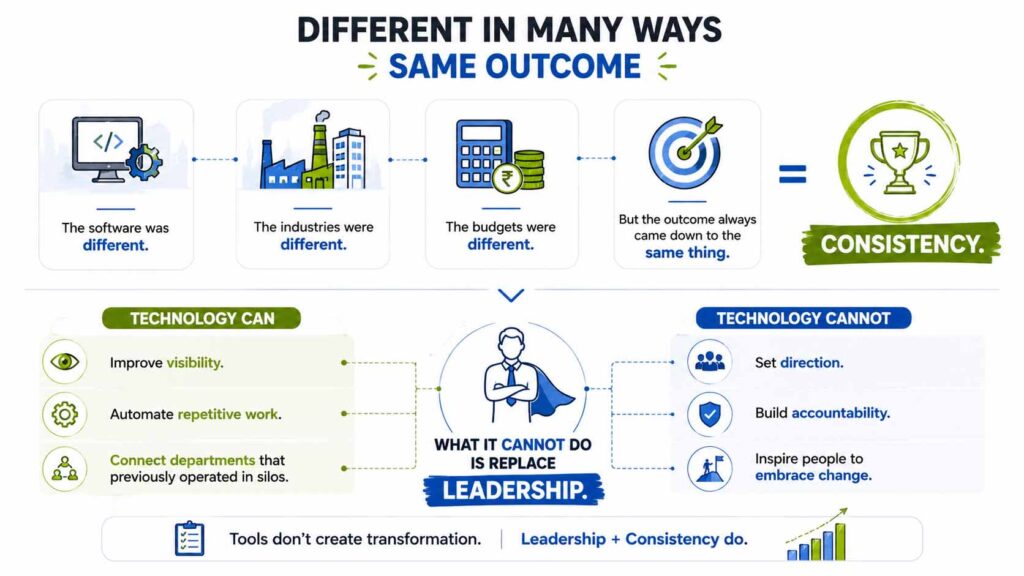
That’s why successful ERP projects have very little to do with technology and almost everything to do with leadership.
Business owners rarely fail because they choose the wrong software.
In fact, most of the companies we speak with made sensible decisions. They selected platforms that suited their business, invested in implementation and committed resources to the rollout.
Where things usually begin to unravel is after go-live.
👉The project gradually becomes “IT’s responsibility.“
👉Department heads return to their previous priorities.
👉Employees stop seeing the ERP as the way the business operates and start seeing it as another tool they should use when they have time.
That’s the moment change begins slipping away.
And by the time leadership notices, the business has quietly rebuilt the very spreadsheets it wanted to eliminate.
Steps to break the month 6 curse
The encouraging part is that this pattern isn’t inevitable.
Over the years, we’ve worked with businesses that had almost given up on ERP because of previous experiences. Many believed the software had failed them, when in reality, the implementation approach was what needed to change.
Successful ERP projects aren’t built on bigger budgets or more complex customizations.
They’re built on clarity, accountability, leadership involvement and gradual adoption.
Regardless of which ERP platform you choose, these principles remain remarkably consistent.
STEP 1
ASSIGN A BUSINESS OWNER, NOT JUST AN IT OWNER
One of the biggest mistakes businesses make is handing complete ownership of the ERP project to the IT department.
IT teams play an important role in implementation, but they shouldn’t be responsible for changing how an entire business operates.
Before a single workflow is configured, someone from the leadership team needs to own the outcome of the project. In many organizations, that’s the COO, Finance Head, Operations Director or even the Managing Director.
When leadership owns the outcome, decisions happen faster, departments stay aligned, and adoption becomes part of business performance rather than another technology initiative.
Technology supports the business.
Leadership drives the change.
STEP 2
REPLACE EXCEL WITH BETTER BUSINESS DECISIONS
Trying to ban Excel rarely works.
People don’t continue using spreadsheets because they enjoy them.
They use them because they trust them.
That trust has to be replaced, not removed overnight.
One of the simplest ways to do that is by changing where important business decisions are made.
If weekly review meetings, inventory discussions, monthly MIS reports, and financial planning all happen inside the ERP, employees naturally begin maintaining better data because they know leadership is relying on it.
The objective isn’t to eliminate Excel.
It’s to make the ERP the place where the business runs.
When that happens, Excel slowly returns to what it was always meant to be—a tool for analysis, not the operating system of the company.
STEP 3
SOLVE ONE BUSINESS PROBLEM BEFORE SOLVING TWENTY
Many ERP implementations struggle because they try to transform every department simultaneously.
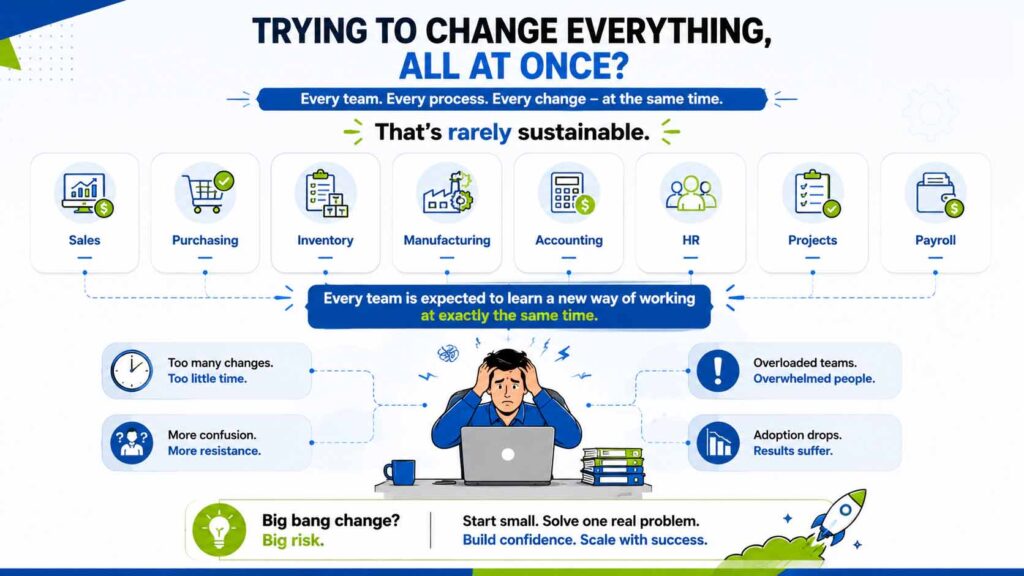
Think about how a good personal trainer works. They don’t introduce every machine in the gym on the first day.
💪They focus on one movement, build confidence, create consistency and only then increase complexity.
ERP implementations work best in exactly the same way.
📦For one business, inventory visibility might be the biggest challenge.
🧾For another, delayed invoicing.
For someone else, production planning.
Solve one meaningful business problem first.
Build confidence.
Let people experience success.
Then expand.
Small wins create trust. Trust creates adoption.
STEP 4
BUILD YOUR MONTH 6 PLAN ON DAY ONE
Most implementation plans focus heavily on one milestone.
Go-live.
Ironically, that’s often where the most important work begins.
The first three months after implementation are when employees begin asking questions they never encountered during training.
“Why is this report different?”
“Can we simplify this approval?”
“Is there a better workflow?”
“Can this be automated?”
Those questions aren’t signs that the implementation is failing.
They’re signs that people are beginning to use the system in real business situations.
Responding quickly during this period builds confidence.
Ignoring those questions creates frustration.
That’s why we always encourage businesses to think beyond implementation itself.
✔️Training before go-live is important.
✔️Supporting users after go-live is essential.
Because ERP adoption isn’t measured on launch day.
It’s measured six months later.
Why Odoo fits this approach so well
By now, one thing has become clear. The problem isn’t simply choosing an ERP.
The real challenge is choosing an ERP that allows your business to adopt change at a pace your teams can realistically sustain.
This is one of the reasons we specialize in Odoo.
Unlike many traditional ERP platforms that encourage large, all-at-once implementations, Odoo is built around a modular architecture.
Businesses can start with the areas creating the biggest operational bottlenecks – whether that’s Sales, Inventory, Accounting, Manufacturing, CRM or Purchasing – and expand only when teams are ready.

That flexibility matters.
It allows businesses to build confidence before increasing complexity.
Instead of forcing every department to change overnight, Odoo supports gradual transformation, making adoption far more achievable.
But it gives businesses the flexibility to implement change in a way that’s practical, measurable and sustainable.
The software was never the problem
The easiest thing to blame after a disappointing ERP project is the software.
Sometimes that criticism is justified.
Most of the time, it isn’t.
We’ve seen businesses invest heavily in ERP systems that eventually became little more than expensive databases because nobody owned the change after implementation.
We’ve also seen businesses achieve remarkable results with relatively modest ERP investments because leadership made one simple decision.
“This is how we run the business now.”
That’s why, at Pragmatic Techsoft, we don’t measure success by whether an ERP goes live on time.
We measure success by whether people are still confidently using it six months – and even six years – later.
For more than 17 years, we’ve helped businesses implement, customize, optimize and support Odoo across manufacturing, distribution, hospitality, retail, healthcare, logistics and service industries.
What we’ve learned is simple.
Successful ERP projects aren’t remembered because they had the most features.
They’re remembered because they became the way the business actually worked.
If you’ve been disappointed by a previous ERP implementation or you’re planning your first one don’t start by asking, “Which ERP should we buy?”
Start by asking the question we ask every client –
“What did you try before and why did it stop working?”
The answer rarely points to the software.
It almost always points to the opportunity to build something better.
If you’re considering Odoo, recovering from a previous ERP implementation or simply trying to understand why your team keeps drifting back to spreadsheets, let’s start with a conversation.
💬/📱Email us at su*****@*********co.in or WhatsApp us on : +91 97656 29686
We’ll help you identify where adoption is breaking down, where processes need attention, and what it would take to build an ERP your team genuinely uses.
A practical discussion focused on your business.
Frequently Asked Questions
1. Why do ERP implementations often fail even after successful go-live?
Go-live marks the beginning of adoption, not the end of implementation. Most failures happen because users gradually return to familiar ways of working when ownership, ongoing support, and leadership involvement begin to fade.
2. Can Odoo completely replace Excel?
For day-to-day business operations, yes. Odoo can centralize sales, inventory, accounting, purchasing, manufacturing, CRM and reporting. Excel still has value for ad hoc analysis, but it shouldn’t become the primary system your business depends on.
3. How long does it take for employees to fully adopt an ERP?
While every organization is different, meaningful adoption usually takes several months after go-live. Businesses that invest in post-implementation support, regular reviews, and leadership involvement generally see much stronger long-term adoption.
4. Is Odoo suitable for growing SMEs?
Yes. One of Odoo’s biggest advantages is its modular approach. Businesses can begin with the applications they need today and expand over time, making it a practical ERP for growing SMEs that want flexibility without replacing their entire system again.
5. How can businesses avoid repeating the mistakes of a previous ERP implementation?
Before evaluating new software, understand why the previous project struggled. In many cases, the root cause isn’t technology but unclear ownership, poor change management, lack of executive sponsorship, or attempting to change too much too quickly. Fixing those issues often has a bigger impact than changing the ERP itself.