
The number on the job ad isn’t the number you’ll pay
You see the job posting. £28,000 to £35,000 per year.
You think : right, that’s the budget.
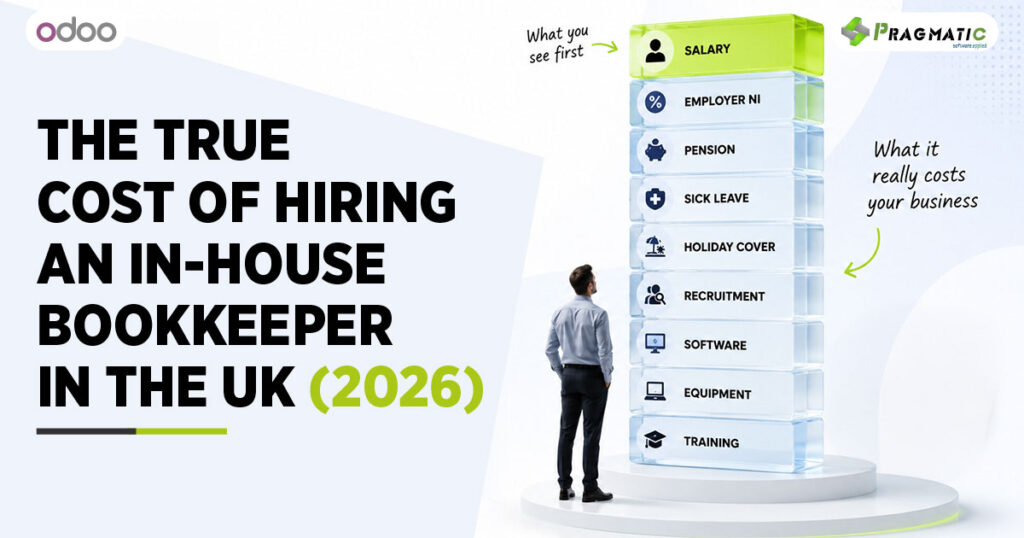
But by the time you add employer National Insurance contributions (now at 15% from April 2025, applied on earnings above £5,000), pension, sick pay, holiday cover, software licences, equipment and the hours spent recruiting – you’re looking at a figure closer to £43,000 to £58,000 per year.
For one person. Doing one job.
This guide lays out what a UK bookkeeper actually costs in 2026 – and what outsourcing the same work looks like by comparison.
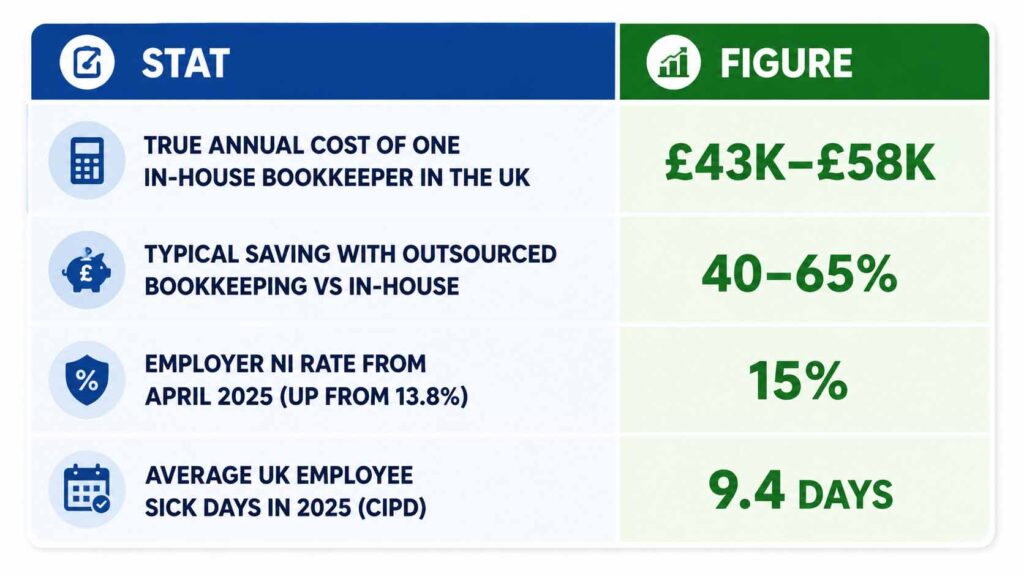
The true cost of an In-House bookkeeper in the UK
Let’s build the real number from the ground up. The current average bookkeeper salary in England is around £28,900 (Indeed, June 2026), with London/South roles typically ranging from £30,000 to £36,000. We’ll use £32,500 as a realistic mid-range baseline for a London or South-East hire.
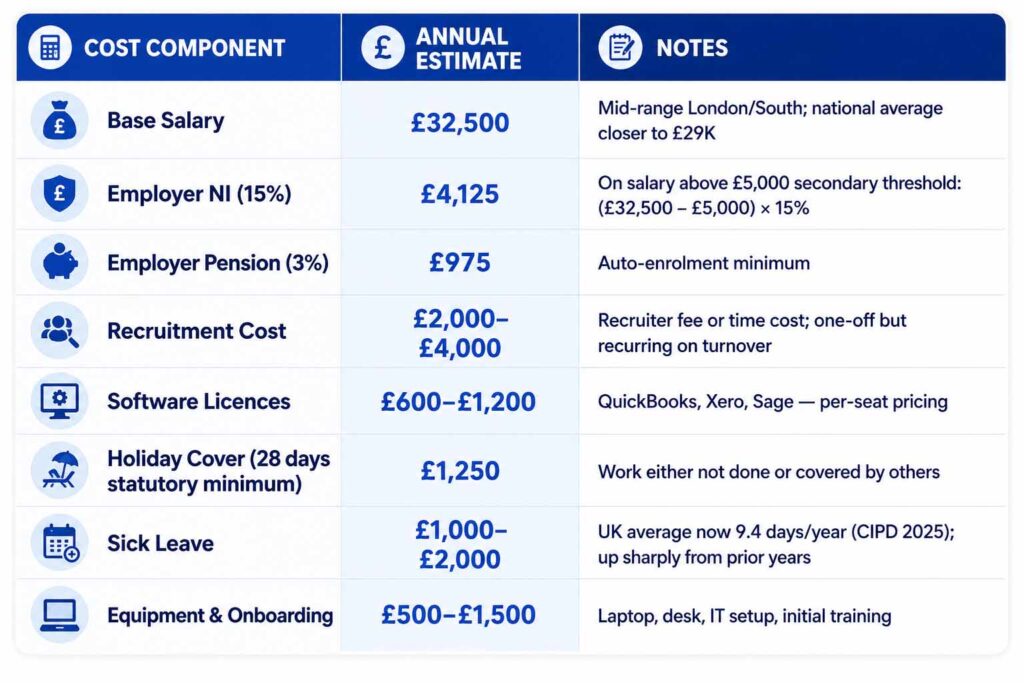
TOTAL (LOW ESTIMATE): ~£42,950 TOTAL (HIGH ESTIMATE) : ~£57,550
A note on sick leave :
The CIPD’s 2025 Health and Wellbeing at Work report found UK employees took an average of 9.4 sick days per year – nearly two full working weeks and a record high. This is a 62% increase on pre-pandemic levels. The financial and operational impact of that absence falls entirely on the employer with an in-house hire.
A note on employment allowance :
Businesses eligible for the Employment Allowance (now £10,500 for 2025/26, with the £100,000 eligibility cap removed) can offset some employer NI costs. However, this is only available to qualifying employers and cannot be claimed by companies where the director is the sole employee. Check your eligibility before adjusting these figures.
What Outsourced Bookkeeping actually costs in 2026
Outsourced bookkeeping in the UK is priced by transaction volume and service scope. The most common model is a fixed monthly retainer – giving businesses cost certainty without surprise invoices.
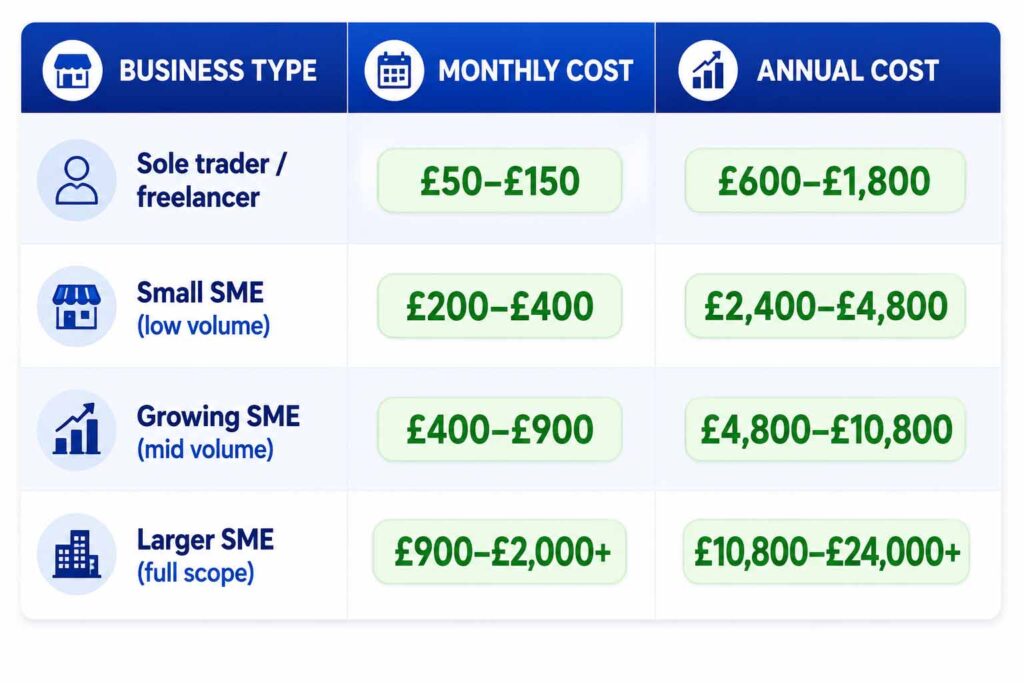
Full-scope typically includes : AP/AR processing, bank reconciliations, VAT returns, monthly management accounts, cash flow reporting and MTD compliance.
The side-by-side comparison
Hidden costs most business owners never factor in
Beyond the spreadsheet figures above, there are costs that rarely appear in any budget – but are very real.
- The cost of getting it wrong
An in-house bookkeeper who makes errors in VAT returns or misses MTD deadlines creates HMRC exposure – and potentially expensive accountant time to fix it. HMRC’s penalty regime for late VAT filings operates on a points-based system, with £200 fines triggered once thresholds are crossed and late-payment interest charged separately.
- The cost of knowledge walking out the door
When your bookkeeper resigns, they take months of institutional knowledge with them. You’re looking at weeks of catch-up, re-training, and disruption. With the UK labour market for finance professionals remaining competitive, replacement timelines can be long.
- The cost of scaling friction
Growing your business almost always means growing your transaction volume. An in-house bookkeeper hits capacity quickly – and hiring a second one isn’t always the right answer.
- The opportunity cost of time
Even ‘managing’ an in-house bookkeeper takes owner and director time – reviewing work, answering queries, approving payments. That time has value.
- The rising sick leave reality
UK employees took an average of 9.4 sick days in 2025, according to the CIPD – the highest figure on record. Mental ill health is now the leading cause of long-term absence. With a single in-house bookkeeper, an absence at a critical period (VAT deadline week, month-end close) has a direct operational impact. With an outsourced team, there is no single point of failure.
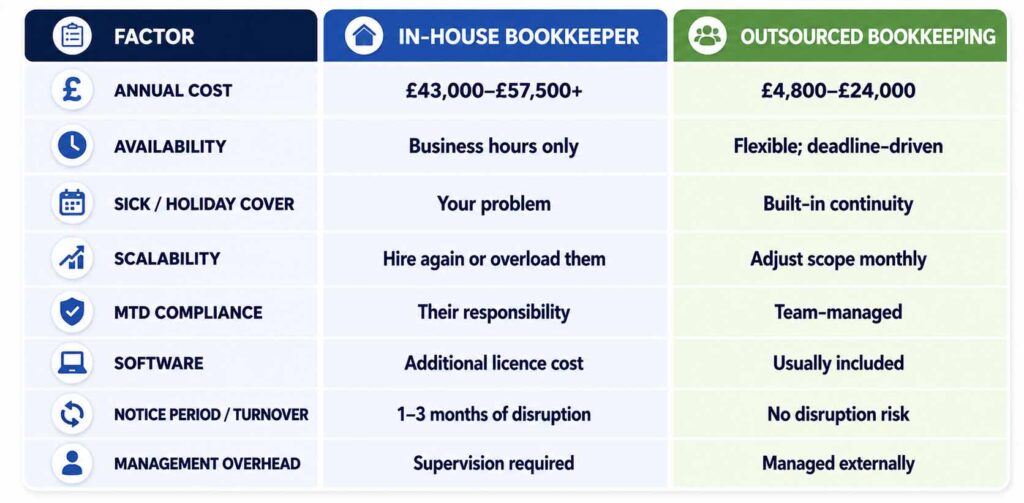
What you actually get : In-house vs Outsourced
The numbers are one thing. But the qualitative difference matters too. An in-house bookkeeper gives you proximity and familiarity. An outsourced team gives you depth of expertise, continuity and coverage across more specialisms than one person can hold.
The outsourcing advantage in practice :
When your in-house bookkeeper is off sick the week VAT is due, that’s your problem. When your outsourced team has a delivery date, they hit it – because it’s not one person responsible. It’s a team.
MTD readiness matters more now
From 6 April 2026, MTD for Income Tax Self Assessment (MTD ITSA) becomes mandatory for self-employed individuals and landlords with qualifying income over £50,000. This extends to those with income over £30,000 from April 2027. Professional outsourced teams are built around these obligations; a single in-house hire may not have kept pace with the evolving compliance landscape.
Who should still hire in-house?
This isn’t a one-size-fits-all argument.
In-house bookkeeping still makes sense for :
- Large businesses (100+ employees) with complex, high-volume daily transactions requiring on-site presence.
- Businesses with highly sensitive or confidential financial data that cannot leave the building.
- Companies with an existing finance team where a bookkeeper integrates into a larger function.
For the vast majority of UK SMEs – particularly those with fewer than 50 employees – the cost-benefit calculation points clearly toward outsourcing.
How Pragmatic Techsoft supports UK finance teams
Pragmatic Techsoft provides outsourced bookkeeping services to UK-based businesses and accountancy practices. Our team is active across the full scope of day-to-day and month-end bookkeeping – working within existing client systems, including QuickBooks Online.
Our UK clients rely on us for :
✓ Daily transaction processing and supplier invoice coding
✓ Accounts payable and receivable management
✓ Bank reconciliations and control account reconciliations
✓ VAT return preparation and MTD-compliant quarterly submissions
✓ Month-end close, management accounts and cash flow reporting
✓ Year-end support and audit preparation
What this means for your cost comparison:
You get the full scope of an experienced finance team – without the employment costs, continuity risks or management overhead that comes with a single in-house hire. For most UK SMEs, that’s the smarter number.
It’s Not Just a Cost Decision – It’s a Strategy Decision
The in-house vs outsourced question isn’t purely financial – though the financial case for outsourcing is compelling. It’s also about how you want your business to operate.
Do you want a single point of dependency in your finance function? Or a scalable, reliable team that grows and contracts with your needs?
In 2026, with employer NI at 15% (applied from a lower £5,000 threshold), UK sick leave at a record high of 9.4 days per employee, MTD compliance adding quarterly bookkeeping obligations and the talent market for finance professionals remaining competitive, the arithmetic increasingly favours outsourcing. The question isn’t whether you can afford it. It’s whether you can afford not to.
Tell us your transaction volume and current finance setup and we’ll show you exactly what outsourcing your bookkeeping would cost vs what you’re paying now. No pitch. Just a straight comparison.
FAQs
Q: Is outsourced bookkeeping safe for sensitive financial data?
A: Reputable outsourced providers operate under data processing agreements (DPAs) in compliance with UK GDPR. Before engaging any provider, check that they have a signed DPA in place, appropriate cyber security certifications, and clear data handling policies. At Pragmatic Techsoft, data security and client confidentiality are foundational to how we operate.
Q: Will outsourcing bookkeeping mean I lose control of my finances?
A: Not at all. Outsourced bookkeeping means your books are handled by professionals working within your systems — you retain full visibility and sign-off on all payments and reporting. Most clients find they have more financial clarity with outsourced support, not less.
Q: How do I know if my transaction volume is too low to justify outsourcing?
A: There’s virtually no volume too low to benefit. Sole traders with as few as 20–30 transactions per month use outsourced bookkeeping services. The cost scales with volume, so smaller businesses pay less — and still get professional, MTD-compliant books.
Q: Can outsourced bookkeepers work alongside my existing accountant?
A: Yes, and it’s a very common arrangement. Outsourced bookkeepers maintain the day-to-day and month-end records; your accountant handles year-end accounts, tax strategy, and filing. The two functions complement each other rather than overlap.
Q: How quickly can outsourced bookkeeping be up and running?
A: In most cases, onboarding takes less than a week. At Pragmatic Techsoft, we connect to your existing QuickBooks Online account, review your current setup, and are processing transactions within days — not months.
Q: Does the Employment Allowance change this comparison?
A: It can partially offset employer NI costs for eligible businesses — up to £10,500 in 2025/26, with the previous £100,000 eligibility cap now removed. However, eligibility rules still apply (for example, sole-director companies with no other employees cannot claim it). Even with the allowance, the total employment cost of an in-house bookkeeper typically remains significantly higher than an equivalent outsourced arrangement. We recommend checking your eligibility with your accountant.