
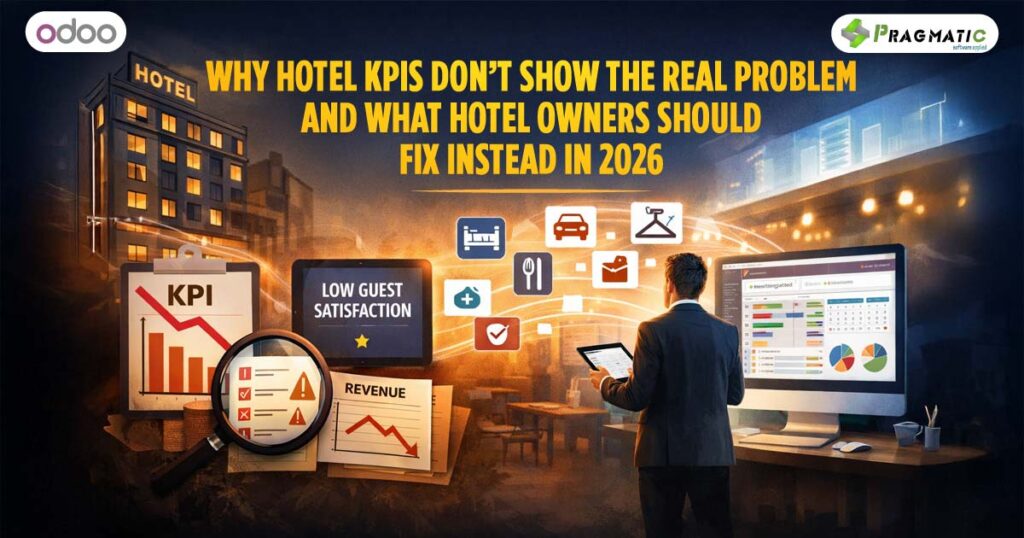
Your KPIs are telling you something – just not early enough
Hotels today are not short on data.
Occupancy rates, guest feedback scores, revenue numbers – everything is tracked.
Most hotel owners review reports regularly and have visibility into how the business is performing.
Yet, there’s a common frustration.
Even with all this data, it often feels like you’re reacting instead of controlling.
That’s because KPIs are designed to show outcomes – not causes.
👉A drop in guest satisfaction appears after the stay is complete.
👉A dip in revenue shows up after opportunities are already lost.
👉Operational inefficiencies become visible only after teams have struggled through them.
So while the numbers are accurate, they come too late to influence the situation that created them.
This is where the gap lies.

⭐⭐⭐
KPIs become far more useful when they sit inside a system that also shows reservations, availability, checkouts and real-time operational status in one place.
Why running a Hotel feels harder to control today
The nature of hotel operations has changed.
Earlier, performance was largely driven by room occupancy and pricing. Today, a guest’s experience – and your revenue – depends on a much broader set of interactions.
A typical stay now includes :
- Dining and in-room services
- Laundry and housekeeping requests
- Transportation and pickups
- Event or activity bookings
- Personalized guest preferences
- Digital touchpoints before and after the stay
This expansion has created more opportunities – but also more complexity.
Hotels are no longer managing isolated transactions. They are managing connected experiences.
And when those experiences are not handled cohesively, problems begin to surface :

Individually, these are small gaps. Collectively, they create inconsistency – both in guest experience and business performance.
This is why many hotel owners feel that even with demand and activity, control is getting harder.In many hotels, these gaps exist because reservations, services, billing and housekeeping are handled across separate systems or manual processes.
👉Without a central structure like a unified guest folio, the stay itself becomes fragmented.
What KPIs can show – And where they fall short
KPIs are essential. They help you measure performance, identify trends and compare periods.
But they need to be understood correctly.
KPIs are indicators – not explanations.
They show what happened, but not the chain of events that led to it.
For example :
A low guest satisfaction score highlights a problem.
But it does not tell you whether the issue came from:
- Delayed check-in
- Poor room readiness
- Service coordination gaps
- Billing confusion at checkout
Similarly, revenue underperformance does not always mean fewer bookings.

Low efficiency is rarely about lack of effort.
It is usually about how work flows – how teams coordinate, how tasks are triggered and how information moves.
This is where many decisions go wrong.
Owners trying to fix the KPIs, instead of fixing the system behind it.
Where Hotel performance actually breaks down
Performance issues in hotels rarely begin as major failures.
They start as small, repeated inefficiencies – the kind that seem manageable in isolation but gradually become part of the operating structure.
Some of the most common patterns include :
1) Reservations without full continuity
Bookings are captured, but the lifecycle around them lacks clarity. Teams operate with partial visibility, leading to assumptions instead of structured execution.
2) Limited control over rooms and pricing
Room availability, readiness and pricing are not always managed dynamically. This reduces flexibility and affects both revenue and planning.
3) Services not fully connected to the stay
Guests use multiple services – dining, laundry, amenities, transport. When these are not properly linked to the stay, it leads to :
- Missed revenue
- Inconsistent billing
- Lack of service visibility
4) Checkout experiences affected by back-end gaps
When services and charges are scattered across systems, checkout becomes slower and error-prone. This impacts the final impression of the guest.
5) Housekeeping not aligned with guest movement
Room readiness depends on tight coordination.
If housekeeping is not triggered or tracked properly, availability and experience both suffer.
These issues don’t stand out individually.
But together, they define how the hotel operates – and ultimately, how your KPIs look.
The shift owners need to make : From reporting to operating
Most hotels try to improve performance by focusing on reporting. More tracking. More analysis.
But reporting does not improve operations. It only reflects them.
The real shift is this :
From asking “What do the numbers say?”
to asking “How is the business actually running?”
Because performance is created in execution – not in reports.
When operations are structured and connected :
- Reservations move through structured stages into room allocation
- Each stay is maintained as a unified guest folio
Services like dining, laundry, and amenities are directly linked to that stay - Billing and payments are automatically consolidated
- Housekeeping is triggered based on real guest movement
The hotel begins to operate as a single system.
And that changes the level of control entirely.
How Hotels are solving this today
This is the point where many hotel owners start rethinking their approach.
Not because they want new software – but because they want :
- Clearer visibility
- Better coordination
- Stronger control over revenue and operations
With over 17+ years of experience, Pragmatic Techsoft has worked extensively in building and implementing business systems that go beyond surface-level functionality.
Our solutions are built using Odoo – an open source, simple, efficient and scalable software that acts as a strong platform to connect all your business operations.
The Odoo experts at Pragmatic Techsoft have also developed multiple applications on the Odoo appstore, reflecting strong product and technical expertise within the ecosystem.
Instead of focusing only on implementation, the focus is on structuring operations properly.
Our Odoo Hotel Management Solution is designed as a holistic system, not just a booking tool.

Connect reservations, rooms, services, billing and housekeeping into one flow

Create a unified guest folio that captures the entire stay

Ensure services like F&B, laundry and amenities are properly linked and billed

Automate operational triggers such as housekeeping after checkout

Maintain pricing discipline across room types, dates and channels

Reduce dependency on manual coordination between teams
The result is not just better reporting – but better execution behind the report.
What changes when operations are properly connected
When the underlying structure improves, performance follows naturally.

This creates something many hotel owners value deeply – a sense of control.
Better KPIs start before the report
By the time you review a KPI, the outcome is already defined.
The guest has checked out.
The services have been delivered.
The billing is complete.
So the KPI is not the starting point.
It is the result.
If you want better numbers, the focus has to shift earlier – to how the hotel runs every day.
Because better KPIs don’t come from better reports.
They come from better operations.
If this resonates, start by mapping your current flow :
Reservation → Stay → Services → Billing → Checkout
Look for :
- Where manual effort is high
- Where systems don’t connect
- Where teams depend on follow-ups
Those gaps usually explain your KPIs better than the reports themselves.
If you want to explore what a more structured setup could look like, this is exactly the kind of work done by Pragmatic Techsoft.
Connect with our team for a free demo of our Hotel Management solution. You will surely love it!
Our focus remains – to make operations simpler, clearer and more connected.
FAQs
1. Why don’t hotel KPIs show the full picture?
Because KPIs are outcome-based. They reflect results, but not the operational processes that created those results.
2. What are the biggest operational gaps in hotels today?
Common issues include disconnected systems, unlinked services, inconsistent billing, lack of real-time room visibility, and weak coordination between teams.
3. Can improving systems really impact revenue?
Yes. A large part of revenue loss happens due to missed service capture, pricing inconsistencies, and billing gaps – all of which can be improved with better systems.
4. How do I know if my hotel needs a more integrated solution?
If you rely heavily on manual coordination, experience billing issues or struggle to connect services with stays, it’s a strong indicator.
5. What makes Odoo suitable for hotel management?
Odoo allows hotels to build a fully connected system across operations instead of using multiple disconnected tools, making it easier to manage the business holistically.
6. Why is working with an experienced partner important?
The effectiveness of any system depends on how well it is implemented. An experienced partner ensures that the solution aligns with real operational workflows, not just technical setup.