

TallyPrime vs Odoo in 2026 : Which Is Better for Growing Indian Businesses?
For decades, Tally has been synonymous with accounting in India.
From small trading firms to established manufacturers, millions of businesses have relied on it to manage accounts, taxation, compliance and financial reporting.
Even today, more than 7 million businesses use Tally to manage their accounting operations, making it one of the most widely adopted business software platforms in the country.
That level of adoption is not accidental.
Tally earned its reputation by doing something exceptionally well: helping businesses maintain accurate books while staying compliant with India’s evolving regulatory requirements.
But business requirements have changed significantly.
In 2026, companies are not only managing accounts.
They are managing multiple warehouses, ecommerce channels, distributors, field sales teams, procurement workflows, manufacturing operations, customer relationships and increasingly complex supply chains.
As a result, many business leaders are asking an important question :
Is TallyPrime enough for where our business is headed next or do we need a broader ERP platform like Odoo?
The answer depends less on accounting and more on operational complexity.
Why more than 7 million businesses trust Tally
Before comparing TallyPrime and Odoo, it is important to understand why Tally remains so dominant.
TallyPrime is widely trusted because it focuses on the fundamentals that businesses cannot afford to get wrong.
It offers strong support for :
- GST compliance
- E-Invoicing
- E-Way Bills
- TDS and TCS
- Financial accounting
- Audit trails
- Banking workflows
- Inventory accounting
Most accountants and chartered accountants in India are already familiar with Tally. This significantly reduces training requirements and helps businesses become productive quickly.
The latest versions of TallyPrime have also introduced improvements such as cloud backups, improved banking integration, better search functionality, invoice management enhancements and stronger compliance capabilities.
For businesses whose primary requirement is accounting and statutory compliance, TallyPrime continues to be one of the strongest solutions available.
However, accounting is only one part of running a business.
And that is where the discussion begins to change.
The changing reality of Indian businesses
A decade ago, many businesses could operate comfortably with separate systems.
👉Accounting was handled in Tally.
👉Customer information was managed manually.
👉Inventory was tracked through spreadsheets.
👉Operational reporting happened monthly.
Today, that model is becoming increasingly difficult to sustain.
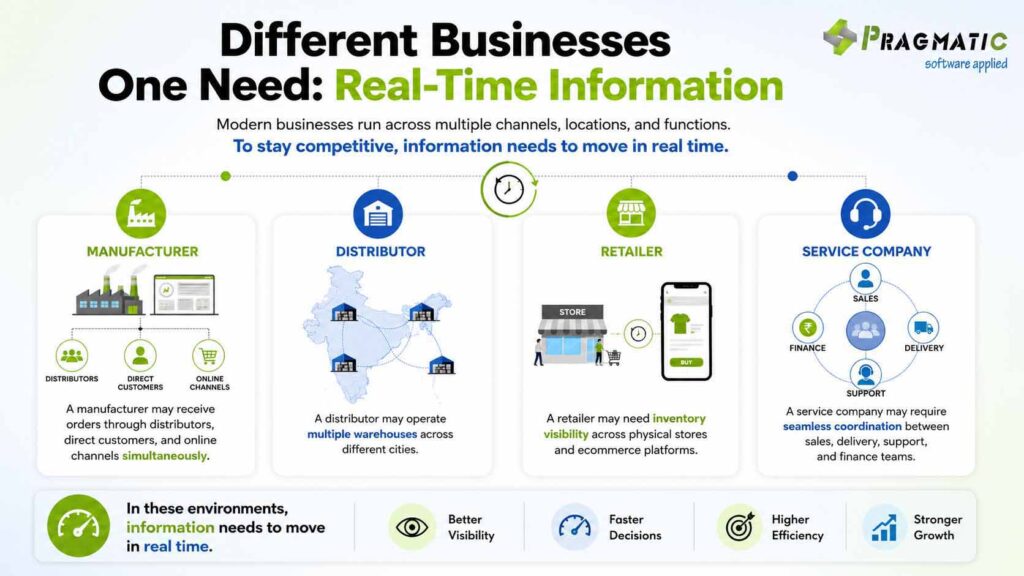
Sales teams need access to inventory information.
Procurement teams need visibility into demand.
Finance teams need access to operational data.
Management needs reports that reflect current reality rather than last month’s numbers.
Businesses increasingly want one connected system instead of multiple disconnected applications.
This shift is one of the primary reasons ERP adoption continues to accelerate among growing Indian SMEs.
TallyPrime vs Odoo : Understanding the core difference
One of the biggest misconceptions is that TallyPrime and Odoo are direct competitors.
In reality, they were designed for different objectives.
TallyPrime is primarily an accounting and compliance platform.
Odoo is a complete business management platform that includes accounting as one component of a much larger ecosystem.
While Tally focuses on financial management, Odoo brings together multiple business functions including :
- Accounting
- CRM
- Sales
- Inventory
- Manufacturing
- Procurement
- HR
- Projects
- Ecommerce
- Customer support
- Business intelligence
This distinction is critical.
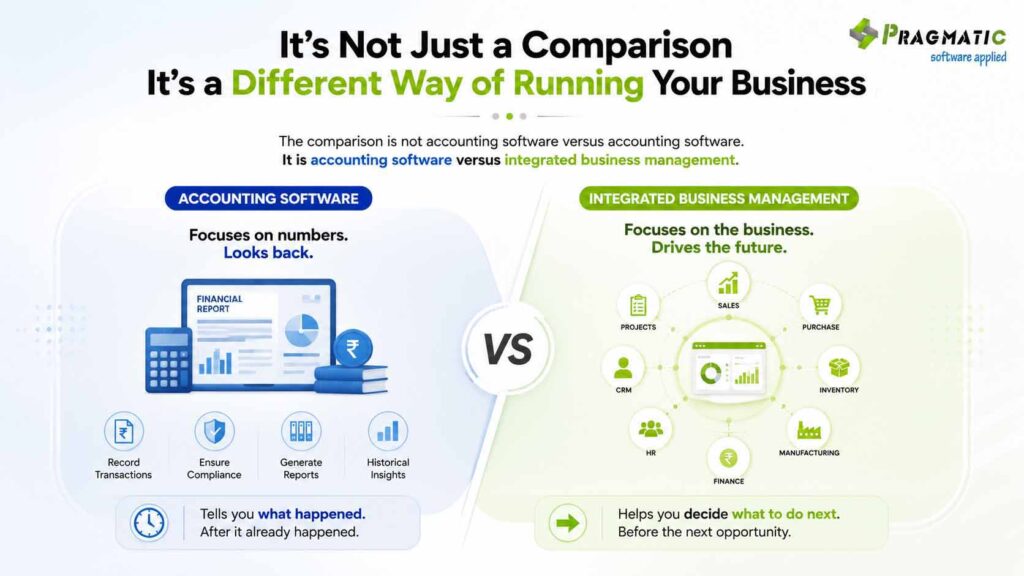
As businesses grow, this difference becomes increasingly important.
Where TallyPrime continues to excel
Despite the growing popularity of ERP systems, there are several areas where TallyPrime remains extremely strong.
- Accounting and compliance
Tally’s accounting foundation has been refined over decades. Financial reporting, audit readiness, taxation, and compliance remain among its greatest strengths.
For many businesses, especially those that are accounting-focused, this remains a compelling advantage.
- Familiarity and adoption
One of Tally’s biggest strengths is its widespread adoption.
Hiring experienced accounting professionals is relatively easy because most finance professionals are already familiar with the platform.
This reduces training time and minimizes operational disruption.
- Reliable inventory accounting
Tally provides inventory management capabilities that are sufficient for many small and medium businesses.
Features such as stock tracking, batch management, expiry tracking and bills of materials help businesses maintain accurate inventory records.
For organizations with straightforward operational requirements, this may be entirely sufficient.
Where growing businesses start facing challenges
Most companies do not outgrow Tally overnight.
The transition usually happens gradually as operational complexity increases.
Several common challenges begin to emerge.
- Customer management becomes fragmented
Customer information often exists outside Tally.
Sales conversations may be stored in emails.
Lead tracking may happen in spreadsheets.
Customer communication may be spread across WhatsApp and individual employees.
As the customer base grows, this fragmentation becomes increasingly difficult to manage.
- Inventory visibility becomes more important
Recording inventory and managing inventory are two different things.
As businesses scale, they often require :
- Multiple warehouse visibility
- Replenishment planning
- Barcode operations
- Demand forecasting
- Warehouse automation
- Real-time stock reservations
These requirements go beyond traditional inventory accounting.
- Manufacturing complexity increases
Many manufacturers initially manage production through basic bills of materials and manual planning.
However, growth often creates requirements such as :
- Production scheduling
- Capacity planning
- Work center management
- Material requirement planning
- Shop floor visibility
Without these capabilities, production decisions become heavily dependent on manual coordination.
- Multiple systems create data silos
This is often the biggest challenge.
Many businesses eventually find themselves using :
- Tally for accounting
- Separate CRM software
- HR software
- Ecommerce platforms
- Warehouse systems
- Reporting tools
Each application may perform its individual role effectively.
The challenge arises because the systems do not naturally work together.
As a result, teams spend increasing amounts of time reconciling information instead of acting on it.
Odoo : Extending beyond accounting
This is where Odoo becomes relevant.
Rather than focusing solely on accounting, Odoo attempts to create a single operational platform for the business.
For example :
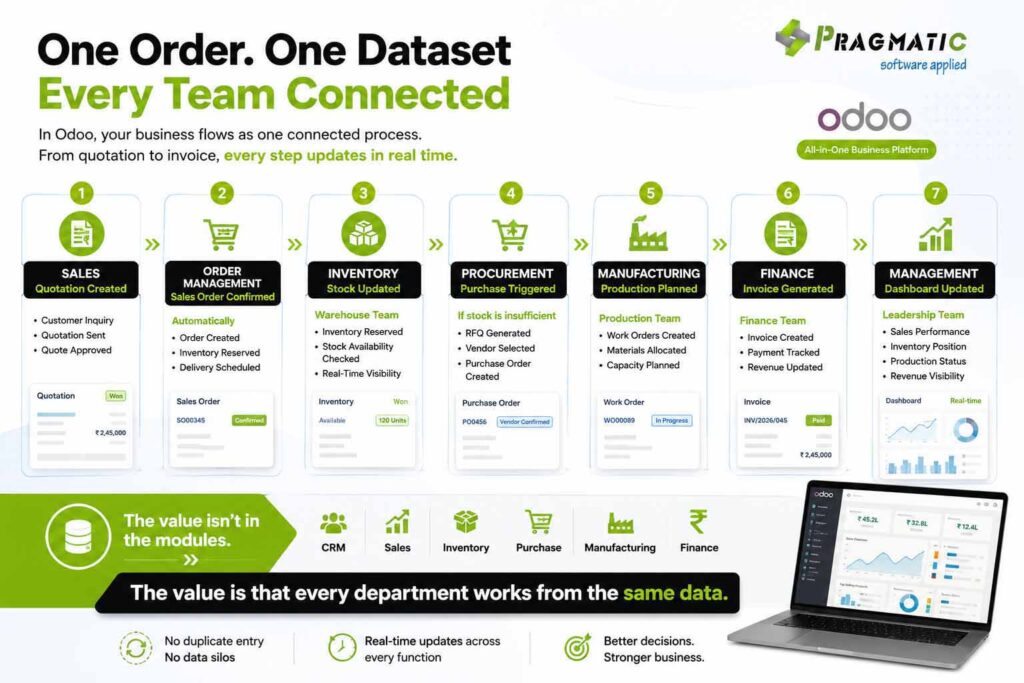
For growing businesses, this creates several advantages.
- Better operational visibility
Business leaders gain access to real-time information rather than relying on manually consolidated reports.
- Reduced manual work
Data entered once becomes available throughout the organization.
This reduces duplicate entries and reconciliation efforts.
- Stronger cross-department collaboration
Sales, operations, procurement, finance and management teams work from a shared source of truth.
This often leads to faster decision-making and fewer operational bottlenecks.
When should you move beyond Tally?
There is no universal answer.
Many businesses continue using Tally successfully for years.
However, certain indicators often suggest that a broader ERP discussion is warranted.
These include :
- Operating from multiple locations
- Managing multiple warehouses
- Running ecommerce alongside traditional sales channels
- Manufacturing complexity increasing
- Growing dependence on spreadsheets
- Lack of real-time reporting
- Multiple disconnected software systems
- Significant manual reconciliation effort
- Increasing headcount and operational complexity
The more of these conditions that exist simultaneously, the stronger the case for evaluating ERP platforms becomes.
Should you integrate Tally with Odoo or replace it?
One of the most overlooked aspects of this discussion is that migration is not the only option.
Many businesses successfully integrate Tally with Odoo.
In this model :
- Tally continues handling accounting
- Odoo manages operations.
- Data flows between both systems
This approach can be particularly attractive for organizations that are comfortable with their existing accounting processes but require stronger operational capabilities.
For other businesses, a full ERP implementation may provide greater long-term value by eliminating system fragmentation entirely.
The right approach depends on business goals, operational complexity and growth plans.
What growing businesses need to consider next
TallyPrime remains one of the strongest accounting and compliance solutions available to Indian businesses today.
For many organizations, it remains the right choice.
However, the challenge facing growing businesses is often no longer accounting accuracy.
It is operational visibility.
When sales operates in one system, inventory in another, HR in a third, and finance in a fourth, growth becomes increasingly dependent on manual coordination.
The result is slower reporting, delayed decisions, duplicated effort and growing complexity.
This is why many businesses are evaluating platforms such as Odoo.
Not because Tally has failed.
But because their operational requirements have evolved.
At Pragmatic Techsoft, we regularly work with manufacturers, distributors, retailers, ecommerce businesses and service organizations facing this exact decision.
In some cases, the right answer is a Tally-Odoo integration that preserves existing accounting workflows while improving operational visibility.
In others, a complete Odoo ERP implementation creates a stronger long-term foundation for growth.
The most successful businesses are rarely the ones that adopt technology first.
They are the ones that adopt the right technology at the right stage of growth.
If your business question today is “Are our accounts accurate and are we GST-compliant?” – TallyPrime 7.0 is your answer.
💡If your business question is “Why are our three systems not talking to each other and why does month-end take five days?” – Odoo is where you need to be looking.
The businesses that will compete most effectively in India over the next five years are not the ones that chose between Tally and Odoo.
They’re the ones that understood what each tool is built for, made the move at the right time and built their operations on a foundation where their data flows cleanly from sale to delivery to invoice to compliance – without anyone copying numbers from one screen to another. That time, for most growing Indian SMEs, is now.
READY TO EVALUATE Odoo FOR YOUR BUSINESS?
Connect with our team to schedule a free consultation.
FAQs
1) Is TallyPrime still relevant in 2026?
Absolutely. TallyPrime remains one of India’s most trusted accounting and compliance platforms and continues to be widely used across industries.
2) Can Odoo replace TallyPrime?
Yes. Odoo includes accounting, GST functionality, inventory management, CRM, manufacturing, and other business applications. Whether it should replace Tally depends on business requirements.
3) Can Tally and Odoo work together?
Yes. Many businesses integrate Tally and Odoo to retain accounting processes while improving operational visibility across departments.
4) Which industries benefit most from Odoo?
Manufacturing, distribution, retail, ecommerce, logistics, project-based businesses, and multi-location organizations often gain the most value from ERP platforms.
5) What are the biggest signs that a business is outgrowing Tally?
Increasing spreadsheet dependency, multiple disconnected systems, limited visibility across departments, manual reconciliation, and growing operational complexity are common indicators.
6) Is ERP only for large enterprises?
No. Modern ERP platforms are increasingly being adopted by growing SMEs that want to improve efficiency, visibility, and scalability before operational complexity becomes a bottleneck.
7) What should businesses evaluate before choosing between TallyPrime and Odoo?
They should assess operational complexity, growth plans, manufacturing requirements, inventory needs, reporting expectations, customer management processes, and the number of systems currently being used.