
The weak link in ERP adoption
ERP systems are often implemented to solve challenges such as inventory mistakes, inefficient planning and disconnected departments.
And in India, manufacturing companies use ERPs to manage daily operations – production, scheduling, material movement, quality checks, dispatch and costing.
But here’s the surprising truth –
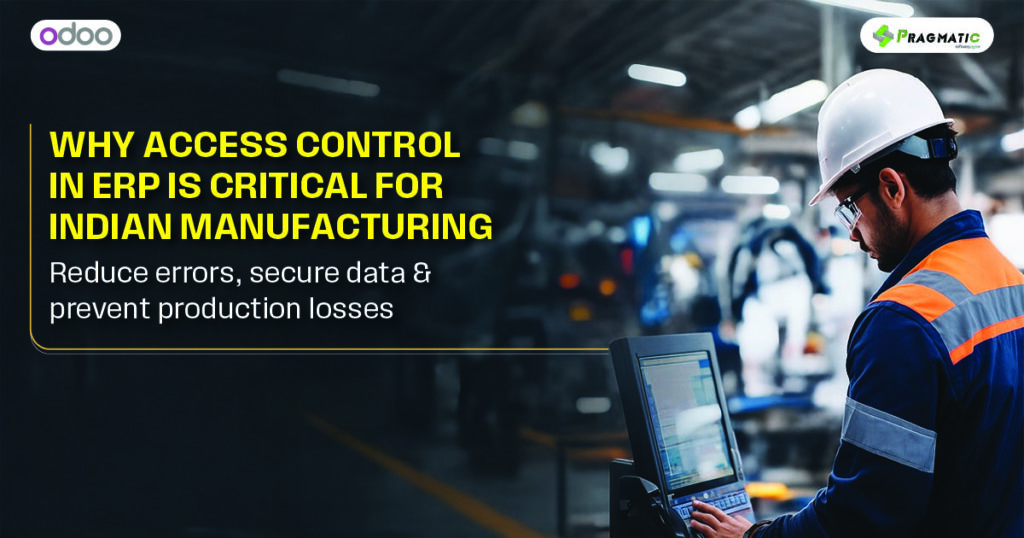
Most production losses don’t come from machine failures or supply chain issues. They come from data mistakes and uncontrolled access inside the ERP.
This is especially common in Indian manufacturing setups where :
- Multiple people share systems
- Training is limited
- Operators are rotated between functions
- Decisions are made fast on the shop floor
Even if the ERP works perfectly, it becomes risky when :
- An operator can change a BOM
- QC can modify a production order
- Maintenance can view purchase pricing
- Someone sees reports they shouldn’t
This is where access control becomes the real backbone of stable ERP operations.
And when Indian manufacturers skip it, the results show up quickly :
- Wrong items issued to production
- Incorrect reporting
- Compliance failures
- Uncontrolled downtime
- Unreliable data
Access management isn’t about controlling people. It’s about controlling risk.
Why Access Control matters more in Manufacturing than other industries
ERPs in sectors like retail or professional services are transactional. Manufacturing ERPs are transformational.
Every action affects real physical processes :
✓ Materials move
✓ Machines are scheduled
✓ Production orders are triggered
✓ Quality checks are recorded
One small change isn’t just a record change – it causes real-world consequences on the shop floor.
For example –
- Wrong routing = wrong machine schedule
- Wrong BOM = scrap and rework
- Wrong QC value = batch rejection
- Wrong inventory data = delayed dispatch
When access is open or poorly configured, these risks multiply.
Manufacturing has more at stake than most industries because :
- Data translates directly into production
- Systems operate continuously
- Multiple roles interact with the ERP
- Decisions happen in real time
That’s why access control isn’t optional.
It’s preventative.
The operational risks of poor access control
Let’s break down real risks Indian manufacturers face when user access isn’t properly restricted.
Production Mistakes
Example –
An operator edits a BOM because the button was visible.
Result –
Material mix-up, rework and delayed orders.
Information Leakage
Many Indian manufacturers outsource or have distributed teams.
When people see purchase pricing, vendor rates or costing :
- Vendor negotiations weaken
- Costing becomes public
- Confidential pricing leaks
Wrong work orders issued
Someone issues a work order without authorization.
This can create :
- Incorrect schedules
- Machine overload
- Delays in high-value jobs
QC Manipulation
Imagine QC operators having access to modify results.
Now add compliance-heavy sectors like pharma or automotive.
One wrong value affects :
- Audit trails
- Customer trust
- Safety certifications
Maintenance Mismanagement
If maintenance staff edits production plans :
- Downtime increases
- Preventive schedules fail
- Breakdowns aren’t planned
This isn’t a tech issue. It’s an operational domino effect.
ERP maturity in India : Why this problem is more visible here
Indian manufacturing is in transition.
Most factories fall into these stages :
Stage 1 : Excel + Semi-ERPs
Processes exist but they’re not controlled.
Stage 2 : ERP Implemented, But No Access Strategy
System exists, but access is open.
Stage 3 : ERP Used Across Departments, But Limited Governance
Users rely on workarounds, shared logins, manual approvals.
Why?
Because traditionally shop floors in India operate on :
- Speed
- Improvisation
- Informal communication
Digital transformation is happening fast, but access control discipline is still catching up.
And when companies grow, this gap gets exposed.
Common access pitfalls in Manufacturing companies
Across 200+ ERP deployments, we discovered typical patterns :
Across 200+ ERP deployments, we discovered typical patterns :
1. One account used by multiple roles
Seems harmless, but :
- No traceability
- No accountability
- No audit readiness
2. Everyone has admin or power-user access
India’s number #1 ERP failure point.
3. No standard operating procedures for access
Permissions are granted “as needed” instead of planned.
4. Operators see unnecessary screens
More screens = more confusion.
5. No separation of duties
The person who executes should not approve or modify.
Access isn’t just about restricting.
It’s about reducing complexity.
How role-based access control works in practice
Here’s what smart access looks like in a manufacturing ERP :
Shop Floor Operators
They should only see :
Work orders
- Instructions
- Job completion
- Reporting buttons
Not :
- BOM
- Routings
- Costing
- Purchase rate
- Planning
Quality Control
Only QC menu and forms.
No access to dispatch or purchase.
Maintenance
Only maintenance menu + equipment history.
Engineers
BOM, routing and process logic.
No financials.
Production Supervisor
Full line-level insights.
When access is designed like this:
- Training is faster
- Mistakes drop
- Transparency increases
- ERP adoption improves
Real use cases from Indian factories
Case : Auto Component Manufacturer – Pune
Problem :
Shop floor changed BOM values accidentally.
Impact :
₹6–8 lakhs worth scrap/month
Solution :
Restricted BOM editing to EngineeringResult :
Scrap reduced by 25% in 3 months
Case : Sheet Metal Fabricator – Rajkot
Problem :
QC staff saw production scheduling screens and intervened.
Solution :
Role separation
Result :
Inspection cycle time improved by 30%.
Case : Pharma Packaging – Telangana
Problem :
Compliance challenges and audit failures due to unauthorized edits.
Solution:
Controlled access + audit trail.
Result:
Passed external compliance audit smoothly.
Compliance, ISO and Auditor Pressure
Indian manufacturers are now facing increasing compliance pressure :
- ISO 9001
- IATF 16949
- GMP / FDA
- Automotive supply norms
There are two things auditors always question :
- Who has access to what?
- Can you trace the change?
ERP access control helps you answer confidently.
And in sectors like automotive, aerospace and pharma, access control isn’t just safety – it’s business continuity.
Why Odoo is becoming the ERP of choice in India
Odoo adoption is growing rapidly because :
- Affordable compared to SAP
- Faster implementation than traditional ERPs
- Better usability
- Manufacturing-ready modules :
- MRP
- Quality
- Maintenance
- PLM
- Inventory
And very importantly :
Odoo fits the way Indian factories operate.
It’s flexible, modular, scalable and familiar across talent pools.
But it still needs an extra layer of manufacturing control – access management.
How Access Management tools solve these problems
- Hide menus and screens by role
- Restrict actions like delete/edit/export
- Secure reports and sensitive fields
- Prevent unauthorized BOM changes
- Enforce separation of duties
- Simplify the interface for operators
And the best part? No coding required.
It becomes an operational tool, not a technical one.
You solve problems before they happen.
Strengthening ERP means strengthening operations
Manufacturing losses don’t start at machines – they start at systems and processes.
If access is uncontrolled :
- Data is unreliable
- Production mistakes increase
- Compliance becomes harder
- Downtime rises
After working with manufacturers for 17+ years, we’ve seen one clear pattern :
Companies with controlled access run smoother, faster and more compliant operations.
At Pragmatic Techsoft, we help manufacturers achieve this through Odoo implementations and our Access Management App – specifically built for Indian factory conditions.
It gives you the control to :
- Reduce risks
- Secure data
- Simplify user roles
- Speed up operations
Not by adding complexity, but by bringing clarity and discipline.
If you want to secure your ERP environment and protect your operations, Access Management is a great place to begin.
Connect with our team for a free demo or schedule a free consultation with our experts.
FAQs
1. Is access control only for big factories or large ERP users?
No. Smaller factories have more role overlaps and therefore higher risk. Access control matters even more in smaller setups.
2. Can I limit access only to certain screens or actions?
Yes. Modern access management works at menu, button, field and action level – not just module level.
3. What is the cost of access-related mistakes in factories?
Scrap, rework, production delays and audit failures. In India, even a single mistake can cost lakhs.
4. Does access control reduce the need for training?
Absolutely. When people see fewer screens and fewer options, onboarding becomes simpler and faster.
5. Is access management only for Odoo?
No. The problem exists in every ERP. But Odoo offers the flexibility to fix it efficiently with the right tools.