
Why Odoo 19.3 feels different
Most ERP upgrades usually follow a predictable pattern.
- A few interface changes
- Some automation features
- A handful of technical improvements
- Maybe a redesign somewhere
But Odoo 19.3 feels different for a very specific reason :
It focuses heavily on operational interruptions businesses quietly learn to live with every day.
Because most businesses today are not struggling due to lack of software anymore.
They struggle because operations become harder to coordinate as the company grows.
- Inventory teams are working faster than reporting systems update
- Production teams identify delays too late
- Finance teams still double-check numbers manually in spreadsheets
- Warehouse approvals slow down because supervisors need to return to terminals repeatedly
- Customer-facing teams promise faster fulfillment while backend operations are still catching up.
Over time, these small inefficiencies become expensive.
Not because they create one massive failure.
𝗕𝘂𝘁 𝗯𝗲𝗰𝗮𝘂𝘀𝗲 𝘁𝗵𝗲𝘆 𝗰𝗿𝗲𝗮𝘁𝗲 𝗵𝘂𝗻𝗱𝗿𝗲𝗱𝘀 𝗼𝗳 𝘀𝗺𝗮𝗹𝗹𝗲𝗿 𝗼𝗽𝗲𝗿𝗮𝘁𝗶𝗼𝗻𝗮𝗹 𝗱𝗲𝗹𝗮𝘆𝘀 𝗲𝘃𝗲𝗿𝘆 𝘀𝗶𝗻𝗴𝗹𝗲 𝘄𝗲𝗲𝗸.
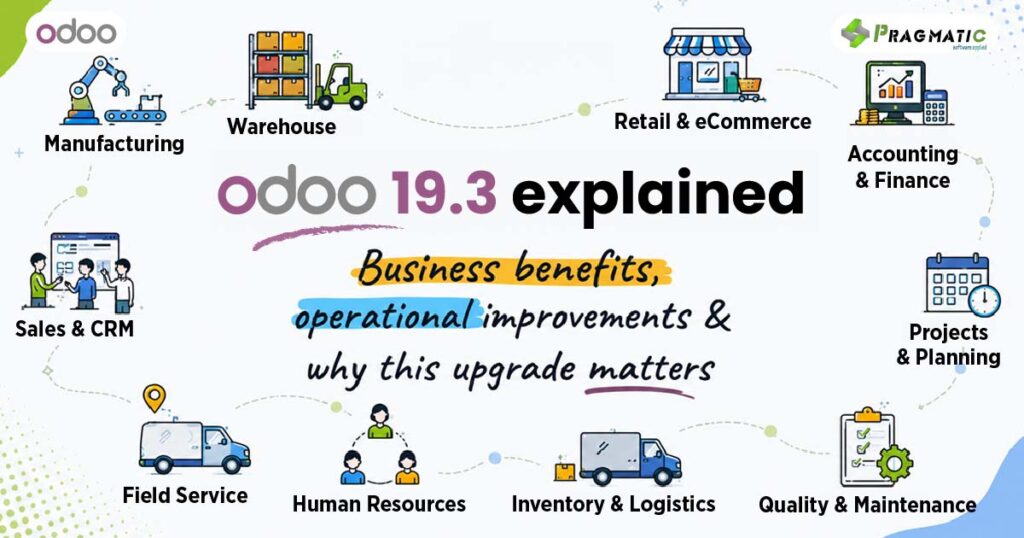
The 19.3 release introduces improvements that reduce friction across manufacturing, inventory, accounting, field operations, eCommerce and coordination-heavy workflows.
And for growing businesses, reducing operational friction is often more valuable than adding entirely new systems.
Odoo’s evolution : From integration to operational continuity
To understand why Odoo 19.3 matters, it helps to look at how Odoo itself has evolved.
Earlier Odoo versions primarily helped businesses move away from disconnected systems.
That alone was transformational for many growing companies.
Businesses could finally manage :
- CRM
- Inventory
- Manufacturing
- Accounting
- HR
- Procurement
- Sales
- eCommerce
inside one connected ecosystem.
Instead of departments working in isolation, information started flowing between teams more naturally.
Then versions like Odoo 17 and 18 focused heavily on usability improvements.
- Cleaner interfaces
- Faster workflows
- Better production visibility
- Improved barcode workflows
- Simpler planning coordination
Those updates improved how users interacted with the ERP daily.
Now Odoo 19.3 appears focused on something even more operational : reducing interruptions.
Many of the updates in this release seem designed around a simple business reality : operations slow down when teams constantly need to stop, switch systems, recheck information or manually coordinate basic tasks.
That direction becomes visible throughout the release.
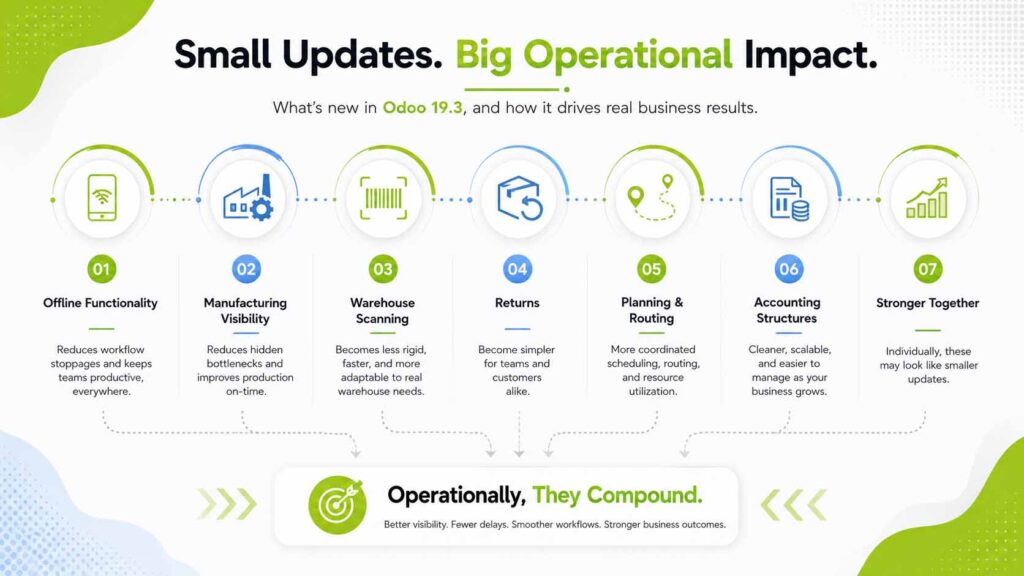
And that’s usually how operational efficiency improves in real businesses – not through one dramatic feature,
but through dozens of small workflow improvements working together.
Offline ERP Actions & Mobile Improvements
One of the most underrated updates in Odoo 19.3 is offline ERP functionality.
Users can now :
- Create records
- Edit records
- Archive and unarchive records
- Delete records
even while offline.
Operationally, this matters far more than many businesses initially realize.
A large percentage of operational work does not happen inside stable office environments anymore.
👉Warehouse teams move constantly
👉Factory-floor supervisors work near machinery and storage zones
👉Construction teams work across large sites
👉Field-service teams travel between customer locations
👉Sales and logistics teams frequently work from mobile devices
𝗔𝗻𝗱 𝗶𝗻 𝗺𝗮𝗻𝘆 𝗿𝗲𝗮𝗹-𝘄𝗼𝗿𝗹𝗱 𝗲𝗻𝘃𝗶𝗿𝗼𝗻𝗺𝗲𝗻𝘁𝘀, 𝗶𝗻𝘁𝗲𝗿𝗻𝗲𝘁 𝗰𝗼𝗻𝗻𝗲𝗰𝘁𝗶𝘃𝗶𝘁𝘆 𝗶𝘀 𝗶𝗻𝗰𝗼𝗻𝘀𝗶𝘀𝘁𝗲𝗻𝘁.
Previously, teams often delayed updates until connectivity returned.
That creates operational gaps quickly :
- Delayed stock updates
- Forgotten entries
- Inaccurate production visibility
- Incomplete field reports
- Manual corrections later
Now operations can continue instead of pausing entirely.
The mobile improvements are also strategically important.
Odoo 19.3 improves the mobile form-view experience and introduces mobile command-palette support, helping users navigate workflows more efficiently from touch-screen devices.
That matters because many operational employees no longer work primarily from desktops.
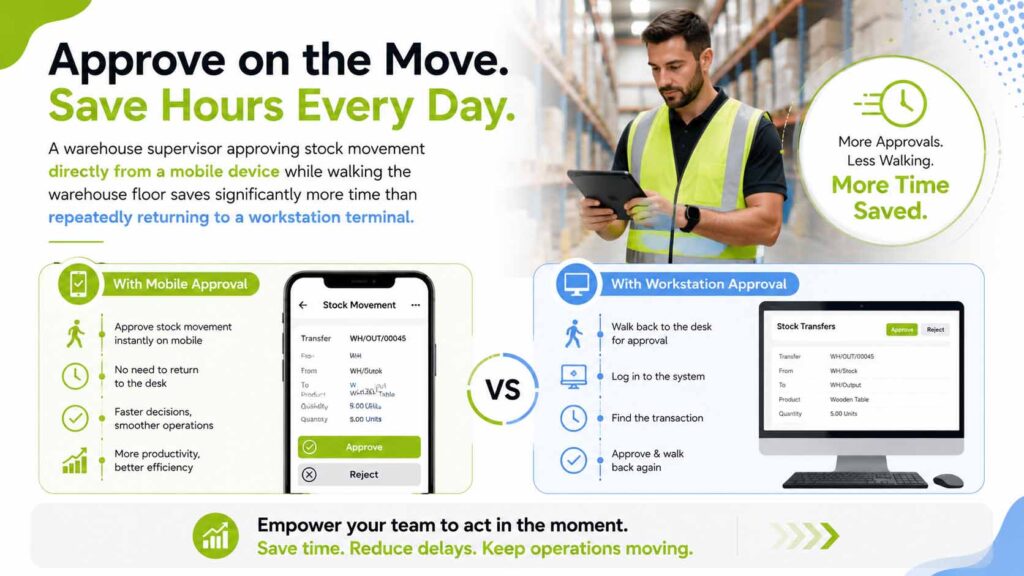
The same applies to maintenance teams, logistics coordinators, field technicians and operational managers.
As businesses become more mobile-first operationally, ERP mobility stops being a convenience feature.
𝗜𝘁 𝗯𝗲𝗰𝗼𝗺𝗲𝘀 𝗮𝗻 𝗲𝘅𝗲𝗰𝘂𝘁𝗶𝗼𝗻 𝗿𝗲𝗾𝘂𝗶𝗿𝗲𝗺𝗲𝗻𝘁.
Manufacturing & Production visibility improvements
Manufacturing teams will likely feel the impact of Odoo 19.3 faster than most departments.
The redesigned Manufacturing Order Kanban view now surfaces operational information more clearly, including :
- Component availability
- Active work centers
- Deadlines
- Remaining production time
This is important because production problems rarely begin as major disruptions.
Most manufacturing delays begin quietly.
👉One missing component
👉One overloaded work center
👉One delayed shipment
👉One maintenance issue
👉One scheduling mismatch
Individually, these problems look manageable.
But together, they create production slowdowns that ripple across purchasing, inventory, dispatch and customer delivery timelines.
🔺By the time leadership notices the issue, production schedules are already behind.
Odoo 19.3 improves visibility into these operational bottlenecks much earlier.
Production managers can identify where delays are happening before operations become heavily impacted.
That changes how manufacturing teams respond operationally.
Instead of reacting after delays happen, teams gain better visibility while production is still manageable.
The component replacement improvements are also strategically useful.
Odoo now improves visibility into where components are used across Bills of Materials.
That matters especially in industries where :
- Raw material prices fluctuate
- Suppliers change frequently
- Substitute materials become necessary
- Engineering changes happen regularly
Manufacturers today are operating in increasingly unstable supply-chain environments.
Understanding exactly where a component is used across production workflows becomes operationally critical.
Inventory & Warehouse simplification
Inventory complexity becomes a major challenge for growing businesses.
Especially businesses operating in the middle ground where –
- Spreadsheets no longer work properly
- Manual stock checks increase
- Fulfillment errors grow
- But enterprise-grade warehouse structures still feel too heavy
💡𝗢𝗱𝗼𝗼 𝟭𝟵.𝟯 𝗶𝗻𝘁𝗿𝗼𝗱𝘂𝗰𝗲𝘀 𝘀𝗶𝗺𝗽𝗹𝗶𝗳𝗶𝗲𝗱 𝗶𝗻𝘃𝗲𝗻𝘁𝗼𝗿𝘆 𝗺𝗮𝗻𝗮𝗴𝗲𝗺𝗲𝗻𝘁 𝗳𝗼𝗿 𝗲𝗖𝗼𝗺𝗺𝗲𝗿𝗰𝗲 𝗮𝗻𝗱 𝗣𝗼𝗶𝗻𝘁 𝗼𝗳 𝗦𝗮𝗹𝗲 𝗲𝗻𝘃𝗶𝗿𝗼𝗻𝗺𝗲𝗻𝘁𝘀.
Businesses can now manage simpler inventory structures without requiring the complete Inventory application setup.
That lowers ERP adoption friction significantly.
This matters because many growing businesses want operational visibility without implementing highly complex warehouse logic too early.
For modern D2C brands, retailers, distributors and SMEs, operational simplicity itself becomes a competitive advantage.
The simplified returns process is another important operational improvement.
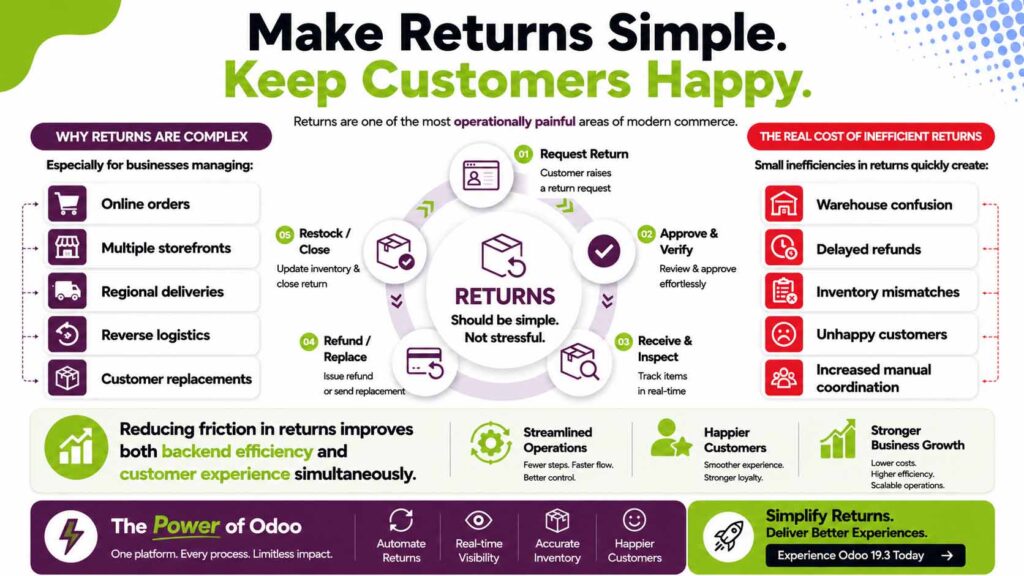
The addition of variant-specific packaging also helps businesses managing multiple product configurations.
For warehouse teams, packaging accuracy directly affects fulfillment speed, shipping costs and operational consistency.
Accounting & Finance improvements
Accounting updates in Odoo 19.3 are practical rather than flashy.
And finance teams usually appreciate practical improvements more than visual redesigns.
One major structural change is the shift from account groups to parent accounts.
This creates cleaner financial hierarchies and improves scalability for businesses managing larger charts of accounts.
As businesses grow across –
- Multiple entities
- Divisions
- Business units
- Regional operations
Financial reporting structures often become increasingly difficult to manage cleanly.
Parent-account structures improve reporting clarity while reducing structural complexity.
Another important improvement is the addition of auditable Cumulative Translation Adjustment (CTA) handling.
For international businesses, exchange-rate differences often create reconciliation and balancing complications.
Many finance teams still handle portions of these adjustments manually outside ERP systems.
Odoo 19.3 improves transparency around this process.
The ability to pay bills directly from Odoo through integrated payment-initiation services also reduces unnecessary switching between banking systems and ERP workflows.
This may seem small operationally.
But fragmented financial workflows create hidden inefficiencies at scale.
Even the new batch “Reset to Draft” action saves meaningful operational time for finance teams handling corrections and revisions regularly.
Small workflow improvements become extremely valuable when repeated hundreds of times monthly.
eCommerce & Customer operations enhancements
Most eCommerce businesses think operational problems begin with sales.
In reality, operational strain usually begins after the order gets placed.
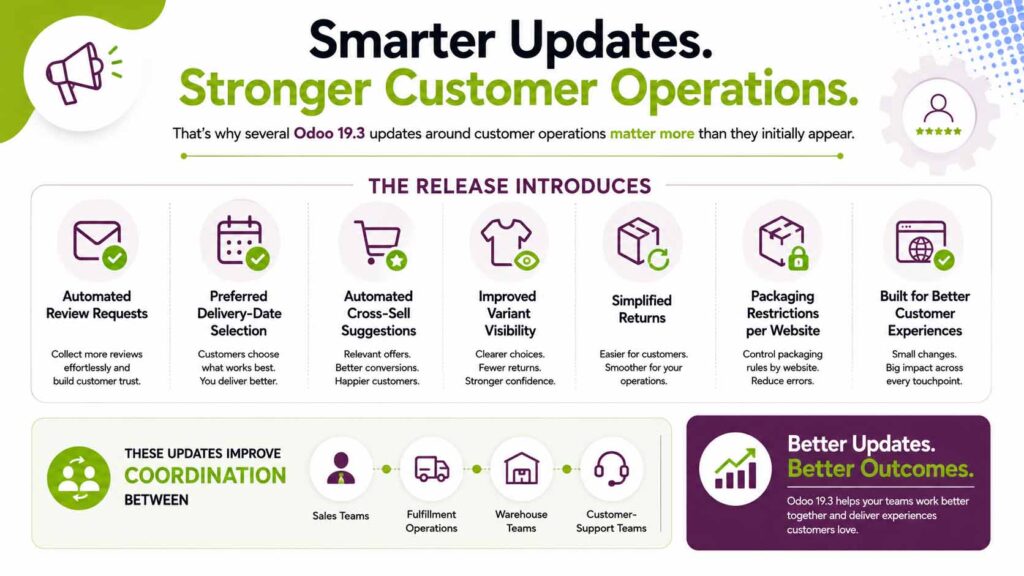
For example, businesses managing multiple regional storefronts can now control packaging configurations separately per website.
Without that kind of operational control, warehouse teams often end up manually correcting inconsistencies later.
The improved product filtering and variant-thumbnail visibility also create cleaner customer experiences.
That matters because customer expectations around online buying experiences continue rising rapidly.
Operational coordination between the website and backend fulfillment is increasingly becoming a competitive advantage.
Not just marketing.
Planning, Coordination & Workforce visibility
One of the strongest hidden themes across Odoo 19.3 is coordination reduction.
Several updates improve how teams coordinate operationally :
- Live technician tracking
- Routing optimization
- Linked calendar records
- Floating call widgets
- Simultaneous calling
- Improved workforce scheduling
Businesses often underestimate how much operational time gets lost through coordination itself.
Not execution. Coordination.
- Teams following up repeatedly
- Departments checking statuses manually
- Schedulers calling technicians for updates
- Employees switching between apps during workflows.
Those small interruptions add up quickly.
For field-service businesses especially, the planning updates are operationally valuable.
Live technician visibility and improved routing directly affect :
- Scheduling efficiency
- Fuel costs
- Response times
- Onsite coordination
- Customer satisfaction
The linked-record functionality inside Calendar also improves operational continuity between activities and actual business records.
That reduces information fragmentation across departments.
Barcode, Logistics & Fulfillment enhancements
Warehouse and logistics operations received several meaningful improvements in Odoo 19.3.
One of the strongest additions is pre-encoded package contents.
Suppliers can now communicate package contents directly in advance.
Operationally, this becomes very useful for :
- Distributors
- Import/export businesses
- Manufacturing receiving operations
- High-volume warehouses
Instead of manually validating incoming goods package-by-package, warehouse teams can process inventory much faster through scanning workflows.
At scale, that saves enormous operational time.
Odoo also improved manufacturing barcode workflows by reducing unnecessary workflow rigidity.
This sounds technical initially. But operationally, smoother scanning reduces warehouse interruptions significantly during busy receiving and production cycles.
Warehouse efficiency is often determined by how little friction exists during repetitive operational tasks.
Not by how advanced the system looks.
Website, AI & Customer experience updates
Odoo 19.3 also continues improving customer-facing flexibility.
Website editing, form customization, search functionality and content management have all been enhanced.
That matters because modern marketing and operations teams increasingly want faster execution without depending heavily on developers for every small website change.
The release also introduces several AI-related capabilities.
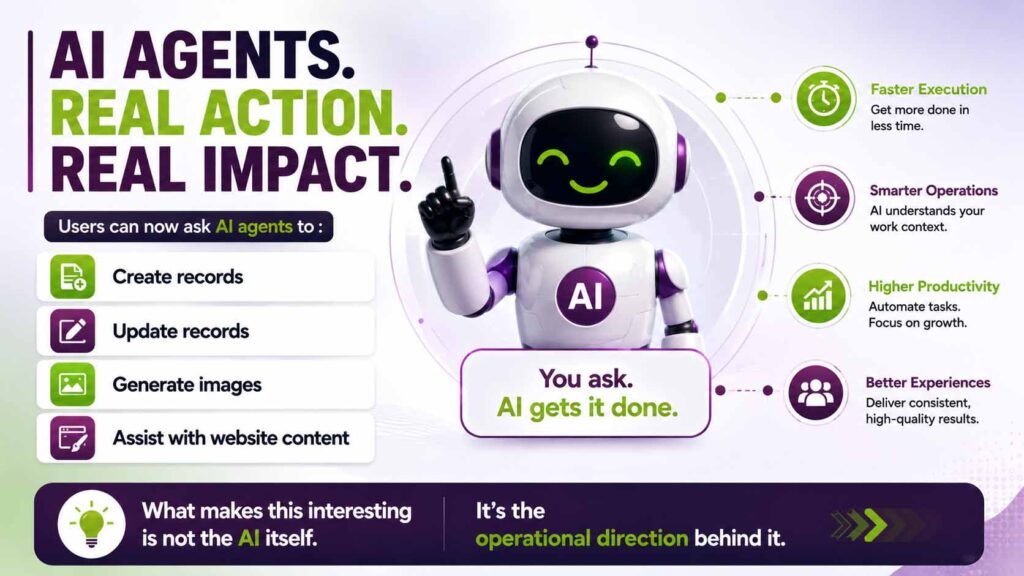
Businesses increasingly want faster execution with fewer repetitive manual actions.
If used correctly, these AI capabilities could reduce administrative workload across operational teams significantly over time.
The AI Website Assistant also signals Odoo’s continued push toward making website management more accessible for non-technical teams.
Localization & Compliance maturity
One of Odoo’s strongest long-term advantages continues to be localization maturity.
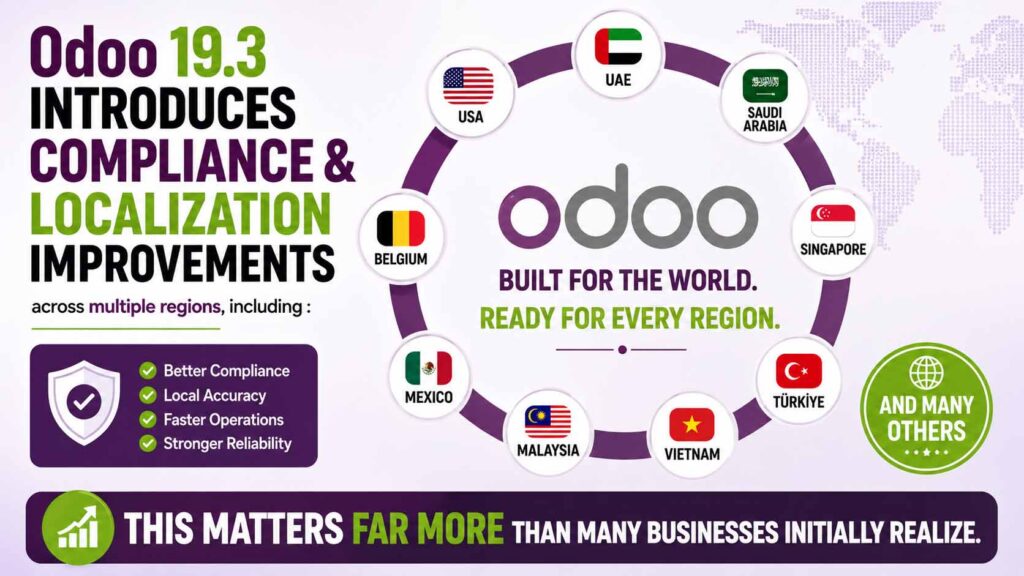
ERP implementations often fail not because of missing features, but because localization and compliance handling remain weak.
As businesses expand internationally, requirements around :
- Taxation
- Payroll
- Invoicing
- Statutory reporting
- Regional compliance
become increasingly complex.
The stronger Odoo becomes operationally across different countries, the more scalable it becomes for international businesses.
Why existing Odoo users should pay attention
For existing Odoo users, 19.3 is not simply another visual refresh.
It improves operational execution quality across multiple departments.
Businesses already running Odoo can expect –
- Smoother workflows
- Better operational visibility
- Fewer manual follow-ups
- Cleaner finance structures
- Improved warehouse coordination
- Stronger production visibility
- Simpler operational handling
And these improvements become increasingly valuable as businesses scale.
Because scaling problems rarely begin with lack of software.
They begin when operational coordination becomes harder to manage consistently.
Why non-Odoo businesses should consider Odoo
Many growing businesses today still operate using :
- Disconnected tools
- Spreadsheets
- Manual approvals
- Fragmented reporting
- Siloed operational teams
All leading to human errors!
Initially, those systems may appear manageable.
But operational complexity increases rapidly as businesses grow.
That’s where ERP systems become necessary.
Not simply for data centralization, but for operational coordination.
Odoo’s direction with 19.3 highlights something important that modern ERP systems are increasingly helping businesses reduce operational interruptions themselves.
Not just store information.
And that difference becomes extremely valuable at scale.
Final thoughts
Odoo 19.3 feels more operationally focused than many traditional ERP release cycles.
The direction becomes clear throughout the release –
- Fewer interruptions
- Simpler workflows
- Faster execution
- Better operational visibility
- Reduced coordination friction
For businesses operating across manufacturing, warehousing, finance, eCommerce, logistics, field operations and distribution, these improvements can create meaningful operational impact over time.
At Pragmatic Techsoft, we help businesses move beyond disconnected operations, manual coordination and workflow inefficiencies through practical Odoo implementations built around real operational challenges.
Whether it’s manufacturing, warehousing, inventory, finance, eCommerce or operational visibility, the goal is not just to install software.
It’s to help businesses operate faster, cleaner and with better control as they scale.
Because the real value of an ERP system is not in the features alone.
It’s in how smoothly the business can run every single day.
Your next steps
If your business is reaching a stage where operations are becoming harder to manage, teams are depending heavily on manual coordination or visibility across departments is slowing down decision-making, it may be the right time to rethink how your systems operate together.
Connect with Pragmatic Techsoft to explore how Odoo can help simplify operations, improve visibility and support long-term business growth.
FAQs
Is Odoo 19.3 worth upgrading to?
For most existing Odoo users, yes. Especially businesses dependent on manufacturing, inventory, accounting, warehousing, field-service coordination or eCommerce operations.
Which industries benefit the most from Odoo 19.3?
Manufacturing, logistics, distribution, retail, eCommerce, warehousing and operationally complex businesses benefit significantly from the workflow improvements introduced.
Does Odoo 19.3 improve warehouse operations?
Yes. Barcode improvements, simplified returns, pre-encoded package handling and smoother manufacturing scanning workflows improve warehouse efficiency considerably.
Why does simplified inventory management matter?
Because many growing businesses need operational visibility without implementing highly complex warehouse structures too early.
Is Odoo suitable for scaling businesses?
Yes. Odoo’s modular structure allows businesses to scale operations gradually while keeping workflows integrated across departments.
Why are ERP upgrades important beyond features?
ERP upgrades improve workflow speed, operational visibility, compliance handling, coordination efficiency, scalability and long-term operational stability.